The Drakkar's arrival at Niflheim
Mickey7The Drakkar’s arrival at Niflheim overturns the colonists’ imagined welcome before they ever reach the surface. From orbit, the planet proves to be an icebound world rather than a promising refuge, and the expedition must decide whether to risk settlement despite a hostile climate and atmosphere. The first landing follows only hours later, carrying the people and equipment tasked with testing whether life on Niflheim can be made possible at all.
From interstellar transit to orbital arrival
The arrival becomes visible to the colonists when the Drakkar shuts down its main torch and switches to ion thrusters for orbital insertion. Until then, the exhaust has prevented observations of their destination. In the forward common room, Mickey Barnes is with Nasha and roughly twenty or thirty others as a free-fall warning appears in their oculars. About thirty seconds later, their weight eases away; around a minute after that, the planet appears on the main screen. The ship has crossed almost eight light-years to reach it, and the gathered colonists are finally able to see what they came for.
The first response is an attempted cheer, which dies almost immediately. From several million kilometers away, Niflheim looks smooth, white, and featureless, like a snowball. The group watches as the ship’s maneuvering and the planet’s rotation shift their view, but the whiteness does not resolve into cloud cover. After roughly ten minutes, Nasha recognizes it as ice. The revelation sharply reverses the expectation of a welcoming world; an earlier hope for warm breezes and beaches now reads as bitterly misplaced.
The scene is intimate as well as collective. Mickey and Nasha hold hands to keep from drifting apart, and each squeezes the other’s fingers while Mickey thinks of colonies that have failed to take root. The planet’s appearance offers no reassurance. Nasha voices the fear that the expedition may have traveled all this way only to die, and Mickey draws her close. Before the moment can settle, his ocular pings with an order from Command: he is to report to Biology immediately and come prepared to deploy. The new world is not merely something to behold; it is already a workplace with urgent demands.
Choosing to attempt settlement
By the time the landing party is assembled, the expedition understands that Niflheim’s climate and atmospheric composition are both serious obstacles. Humans cannot survive outside without rebreathers. Hieronymus Marshall considers continuing to a secondary target, but the prospect of reaching one is almost negligible. After substantial discussion and argument, Dugan and other members of Biology persuade him that engineered algae might eventually raise the atmosphere’s oxygen partial pressure to survivable levels. Their estimate is stark: the improvement might not come within the lives of the expedition’s adult members, though it could arrive within the lifetimes of some of the embryos carried aboard. Marshall ultimately decides to give Niflheim a chance.
That decision makes the arrival a commitment made under severe uncertainty, not a declaration that the planet is already habitable. The proposed solution depends on a long biological intervention, while the colonists must begin work in an environment that requires breathing equipment beyond the dome. The atmospheric plan offers a possible future, not immediate safety; the expedition proceeds because its alternatives are scarcely more viable.
The first descent and its mission
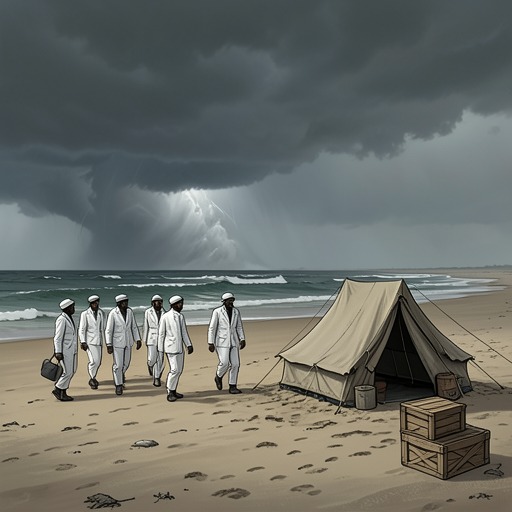
A few hours after the Drakkar reaches orbit, the first part of the colony comes down to Niflheim’s surface. Nasha pilots the lander, which carries a biological isolation chamber, teams from Medical and Biology, and Mickey. The landing party’s composition reflects the immediate priorities of a new settlement: bring protective scientific equipment, investigate the local environment, and determine whether it contains threats to human health.
The first order of business at any new colony is to find out whether local microbiota pose a danger. Mickey’s narration emphasizes that the danger is not a remote possibility: there is always something in a new world’s microbiota that will threaten human health. The expedition therefore arrives not with a settled understanding of Niflheim but with an urgent testing program. The isolation chamber and specialist teams are part of the practical response to that unknown, while Mickey’s presence reflects the use of an Expendable for work that may kill the particular body performing it.
The cost of a beachhead
Mickey had signed his contract on Midgard because he needed passage off the planet and had few practical skills that would qualify him for another berth. The recruiter, Gwen Johansen, had listed jobs likely to kill an individual instantiation, including exposure to local organisms, medical experiments, external repairs, and combat. What he had not grasped was how frequently a beachhead colony would need such work. On Midgard, remote machines handled some dangerous exploration; on Niflheim, human bodies could tolerate certain radiation exposures longer than mechs, and some medical procedures could not be performed by machines at all.
The colony’s material limitations deepen the logic of that assignment. A mech is difficult to replace when the settlement has no serious mineral extraction or heavy industry; lost metal cannot be recovered until those systems exist. Replacing an Expendable instead depends on raw materials that the agricultural base is supposed to provide. Yet agriculture is itself uncertain on Niflheim: growing food outside the dome is a long-term challenge, and local microbiota interfere with crops grown inside. The arrival thus begins a chain of dependencies in which the colony needs biological knowledge and agricultural success even as its environment threatens both.
Later, the settlement’s reliance on closed-loop systems makes the stakes of that commitment tangible. The Biological recycler converts waste, food scraps, and eventually corpses into protein paste, vitamin slurry, and fertilizer; its disassembly process consumes enormous energy, supplied by the Drakkar’s antimatter-driven engine. The colony can subsist on recycled paste in desperate circumstances, but that does not remove its dependence on power or the difficulty of establishing food production. The arrival at Niflheim is therefore the beginning of a precarious effort to make an inhospitable planet support human life: the first view exposes the danger, the landing initiates its investigation, and the colony’s later survival remains bound to resources it has not yet secured.