Nino's Inn
MomoNino's Inn is a transformed meeting place: the little tavern Momo remembers has become a busy fast-food restaurant, where customers move through a rail-guided queue and Nino works at a cash register. When Momo arrives expecting news of her friends and a warm reunion, the changed building confronts her with the city’s altered rhythms. The restaurant makes that change visible in its architecture, its service, and Momo’s repeated attempts to ask what has become of the children.
From Tavern to Fast-Food Restaurant
The day before Momo reaches the restaurant, she sets off toward noon with Cassiopeia tucked under her arm. She is buoyant with expectation. She imagines that Nino will tell her where Guido Guide and Beppo Roadsweeper are, and that she can then find the children and bring everyone together. In her plans, Nino and his wife might join them for a party, where she could tell her friends about the flowers, the music, and Professor Hora. She is hungry, but lunch is only one part of the reunion she anticipates.
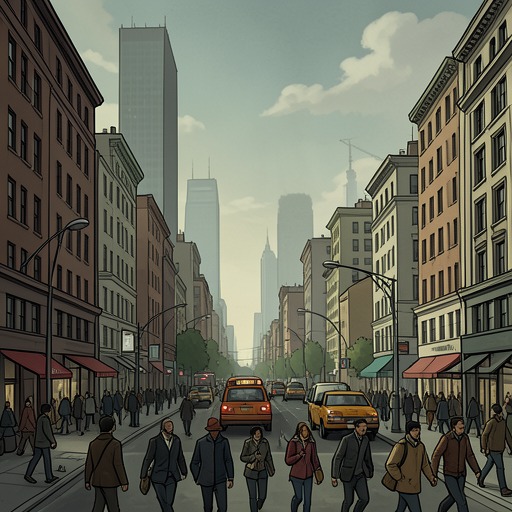
The street makes her doubt that she has found the right place. Where the old tavern once stood, with damp-stained walls and a vine around its door, there is now a long concrete building with large plate-glass windows. The street has been asphalted and carries steady traffic; a petrol station stands opposite, beside an enormous office building. Cars gather outside the new establishment, whose neon sign reads “NINO’S FASTFOOD.” The contrast is not simply between old and new buildings: the familiar, modest tavern has been replaced by a conspicuous commercial frontage within a street reorganized around traffic and business.
A Restaurant Built for Throughput
Inside, Momo initially struggles to orient herself. The tables are fixed beside the windows, each with a narrow single leg and a tiny top. They are designed for adults to eat standing up, and there are no chairs. Along the opposite side, a shiny, chromium-plated rail channels customers past glass cases displaying sandwiches, sausages, salads, puddings, cakes, and other foods. People shuffle along, taking plates, bottles, and cardboard cups as they pass.
The arrangement briefly misleads Momo: seeing customers help themselves, she wonders whether the food is free. The register at the end of the cases explains the system. Nino sits there, pressing buttons, taking money, and giving change without pause. The rail keeps customers from reaching the tables without passing him, turning the room into a controlled sequence of selection, payment, and eating. Its design is efficient, but it leaves little space for lingering or conversation.
Momo Finds Nino
Momo calls to Nino from the crowd, then waves Guido Guide’s letter, but the electronic register is too loud for him to hear her. She climbs over the rail and makes her way along the line. When customers begin to protest, Nino looks up; on recognizing Momo, his glum expression changes at once. The moment of recognition offers a brief return of personal warmth within a room governed by the rush of customers and the demands of the register.
That welcome does not give Momo the conversation she came for. The crowd jostles her past the cash desk, and she waits for a place at one of the small tables. She eats a second tray of food with less enjoyment than the first, but does not leave it uneaten. Her practical concern remains: she needs to find out what has happened to the children who used to keep her company. To speak to Nino again, she has to join the line once more, pass the cases, and load her tray rather than risk hostile remarks. By the time she reaches the register, waiting itself has become part of asking a simple question.
The Changed City in Miniature
Momo asks what has become of the children and why they no longer come. Nino, sweating as she reappears, says that everything has changed and that he cannot explain while he is so rushed. His answer supplies no details about the children, but the setting gives his difficulty a concrete form: Momo has to return through the restaurant’s customer flow to ask him, while his work keeps interrupting the exchange. The old tavern’s replacement is therefore also a change in the conditions under which people can meet and talk.
The restaurant belongs to a wider city where time-saving has been promoted at the cost of conversation, attention, and ease. The Men in Gray advise Mr Figaro to shorten his conversations with customers and even the time he spends with his mother; he goes on to direct his workers by a precise timetable. The novel’s broader warning is that people may save time while losing parts of life, and that the children feel this loss especially keenly when adults have no time for them. Nino's Inn does not by itself explain the whole transformation, but its cramped standing tables, constant queue, and hurried proprietor give that social change a local, everyday shape. It is the place where Momo’s hope of gathering friends again meets the practical difficulty of reaching someone who once might have had time to listen.