Anti-Nazi resistance
MunichAnti-Nazi resistance in the novel is not a single organization with secure power, but a fragile coalition trying to prevent Adolf Hitler from forcing Germany into war. Its central plan depends on a precise conjunction: Hitler must issue the order for mobilisation, the Army must be willing to act, and a small group must move quickly enough to arrest him. When diplomacy postpones mobilisation and the military opportunity slips away, resistance changes its objective—from removing Hitler to preventing the Munich agreement—and finally confronts the possibility that no individual or institution will intervene.
Military Opposition and Its Opening
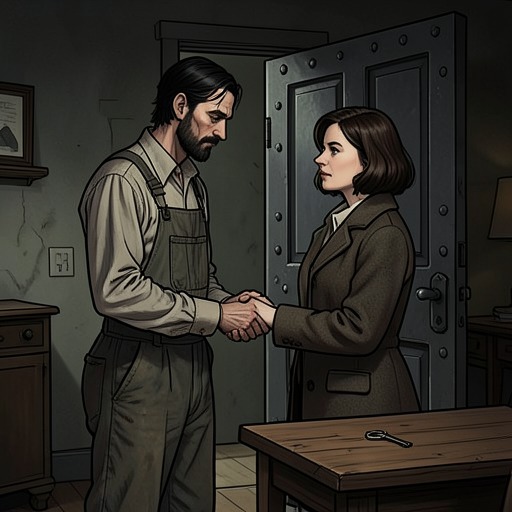
The resistance gains its most consequential opening through General Ludwig Beck, who tells Colonel Hans Oster, Hans Gisevius, and Paul von Hartmann that he resigned as Chief of the General Staff a little under six weeks earlier to protest the plan for war with Czechoslovakia. Beck had promised Adolf Hitler not to make the resignation public and had kept that promise, but he remained in contact with former colleagues in the high command. He now reports strong opposition there and believes that if Hitler orders mobilisation the following day, the Army may disobey and move against the regime. His account turns military dissent from an uncertain hope into the basis for a specific, time-limited plan.
The conditions of that opposition matter as much as its strength. Beck explains that the German Wehrmacht has sworn an oath of loyalty to Hitler, so the Army cannot openly make the first move against him. It could, however, enter the Chancellery to restore order if a disturbance began there. The conspirators therefore need a civilian or otherwise separate first action that would create a justification for military intervention. Resistance is presented as constrained by the very institution that gives it force: the Army might be able to protect a coup, but its oath prevents it from initiating one.
That constraint makes timing decisive. At the British Cabinet table, Neville Chamberlain considers whether partial mobilisation might show Hitler that Britain is prepared to fight; he also fears that such a step could provoke the war it is meant to deter. The crisis has an immediate deadline: Hitler has rejected even a short wait over the transfer of the Sudetenland and threatens invasion, while his reported response to British and French involvement is that war may follow within days. These exchanges establish the unstable political setting for the conspirators’ plan: military action is possible only while an invasion order remains imminent, and diplomacy can alter the opportunity before the conspirators are ready to use it.
The Arrest Plan and Its Limits
Oster has been analysing the operation for weeks with Captain Friedrich Heinz. They estimate that an initial force of about fifty experienced fighters would suffice to arrest Hitler, provided they achieved surprise and the Army undertook to prevent a rescue attempt by the Nazi SS. Heinz says the men have already been found and are prepared to move the next day. The plan is therefore more than a wish for a coup: it has an estimated force, a tactical condition, and a proposed division of responsibility between the arresting party and the Army.
The conspirators nevertheless distinguish arrest from assassination, and treat the distinction as a decision they must face before acting. When Hans von Dohnányi asks what they will do with Hitler, Oster argues that debating Germany’s future government is premature until the immediate danger is stopped. Their first priority is to prevent the mobilisation order. If Hitler surrenders, they will take him alive; if he appears likely to escape, Oster believes they may have to shoot him. Hartmann supports that position, and the others eventually follow, including Beck, whose agreement comes most reluctantly. The scene makes the resistance’s objective deliberately narrower than a settled political programme: first prevent the order and seize Hitler; questions about what follows must wait.
The plan’s dependency on Army leadership proves critical. After the mobilisation is postponed, Hartmann asks what happened to the Army. Oster explains that everything depended on the commander in chief, who was still deciding what to do when Hitler issued the postponement. The account identifies not a simple lack of courage among the conspirators, but a bottleneck in decision and timing: the expected trigger disappears before the military leadership has committed itself. The resistance’s carefully imagined action remains contingent, and the delay that averts an immediate clash also deprives it of the moment it hoped to exploit.
From Coup to Diplomatic Obstruction
The postponement follows intervention by Benito Mussolini. At seven minutes past two, Hugh Legat hears Sir Nevile Henderson report that Mussolini has asked Hitler to delay mobilisation for twenty-four hours while the situation is reconsidered, and that Hitler has agreed. That diplomatic pause changes the conspirators’ prospects. Later, Oster explains that the Army’s uncertain leadership had not acted before the order was postponed; the opening Beck had described has not become an operation.
The resistance then turns toward the conference planned for Munich. As party officials celebrate in the corridor, Hans Gisevius asks what the conspirators can do if they cannot move without the Army. Hartmann proposes preventing an agreement from being signed the next day. Erich Kordt considers the conference nearly settled, since Hitler appears ready to accept terms already offered by Britain and France. Hartmann counters that mobilisation has been postponed, not cancelled: the danger remains, but the route to stopping it has shifted from a direct seizure of power to disrupting diplomacy.
The conference’s course sharpens the irony of that shift. Sir Horace Wilson briefs Chamberlain that Hitler presents Czechoslovakia as a threat, cites a quarter of a million refugees who have fled the Sudetenland into Germany, and insists that the dispute must be settled by Saturday or he will invade. Wilson says Hitler repeatedly watches the time, as though measuring the remaining pause in mobilisation, and concludes that he is not bluffing. Mussolini then produces a draft agreement, which is translated for the delegates. Later, Hartmann learns that Chamberlain has drawn Hitler into detailed negotiation and that unresolved matters will be left to an international commission of the four powers. The conference moves toward agreement while the resistance’s military alternative remains unrealized.
Hartmann’s Warning and Chamberlain’s Refusal
Hartmann makes a direct appeal to Chamberlain, presenting the document in his hands as proof that Hitler’s stated lack of further territorial demands is false. He warns that Hitler intends a war of conquest for living space, that the incorporation of Austria and Czechoslovakia is only a first step, and that such a war will begin within five years at the latest. He also argues that commanders who objected, together with the Foreign Minister, have been replaced, and that if Britain and France stand firm the Army will move against Hitler to prevent a disastrous war. Hartmann offers the information in good faith and at grave risk to himself, urging Chamberlain not to sign the agreement that night.
Chamberlain acknowledges Hartmann’s courage and sincerity but rejects the political premise of the appeal. He believes that the British and French public cannot be expected to take up arms to deny ethnic Germans the right of self-determination, and he makes averting immediate war his overriding objective. He also treats Hitler’s longer-term threats as something that must be assessed in the future, rather than a reason to abandon the conference. The encounter exposes the distance between the resistance’s forecast of what Hitler will do and the democratic governments’ immediate calculation of what their publics will accept. Hartmann can bring evidence to the Prime Minister, but he cannot make that evidence outweigh Chamberlain’s judgment about the political cost of war.
Working Within the Regime, and the Final Impasse
After the agreement, Hartmann describes resistance as an exhausting continuation rather than a decisive act. He compares the knowledge that disaster is coming with an incurable disease: ordinary work goes on even as the end appears unavoidable. His immediate assignment is to prepare a foreign press summary, which he may have to present to Hitler personally. The possibility of access to the regime’s leader might be useful to the cause, but it also sharpens Hartmann’s dilemma: whether to keep serving the government in the hope of sabotaging it from within, or to kill himself rather than continue.
Hartmann also considers killing Hitler, but says that everything in him prevents it and that the likely consequence would be a bloodbath in which his family would be destroyed. He chooses to continue in hope, while recognizing hope as a burden as well as a reason to persist. This is not confidence in a functioning resistance network: it is a compromised strategy shaped by the danger to those close to him, the consequences he expects from assassination, and the absence of an effective collective move.
The final encounter makes that failure of action concrete. Alone with Hitler for a second time, Hartmann touches the metal inside his jacket, then withdraws his hand. He knows arrest is imminent, yet still cannot act. In that moment he concludes that neither he, the Army, nor a lone assassin will disrupt Germany’s shared course before it has run its course. The resistance’s arc therefore ends not with a successful arrest or a clear renunciation of opposition, but with the recognition that its possible agents have not converted warning, preparation, or access into action. Its tragedy lies in the gap between seeing the danger and finding a way to stop it.