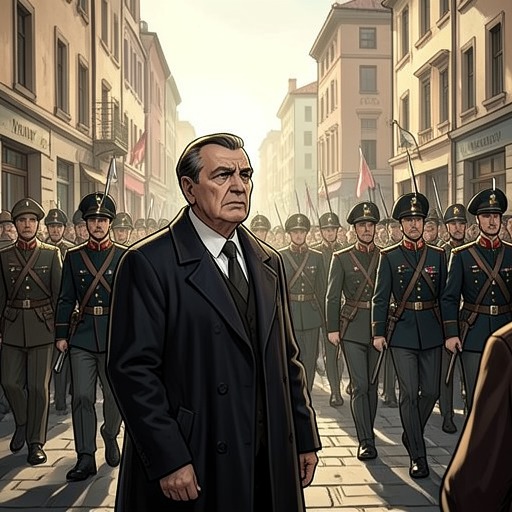
The power of unreason
MunichThe power of unreason is the insight Paul von Hartmann reaches while driving with Hugh Legat: Nazi Antisemitism is not an aberration that can be set aside while other achievements are praised, but evidence of a violence capable of extending much further. The idea marks a break with the rational explanations Hartmann once accepted and gives his account of the regime a personal, painful force.
The violence behind the idea
Hartmann grounds his conclusion in the account of a Jewish woman who, he says, was reported to have fallen from a third-floor window. He believes she did fall, but says that first her attackers carved a Star of David into her back. The account is not offered as an abstract argument about prejudice: its sequence makes the violence impossible to dismiss as a passing excess. As they drive, Hartmann asks for another cigarette, and Legat lights it for him.
A break with Oxford rationalism
Hartmann identifies what he has learned over the preceding six years as the power of unreason, set against what Oxford had taught him. He recalls the readiness of people like himself to call Hitler terrible while still crediting his achievements, and to imagine that the regime’s supposedly medieval Antisemitism would pass. His conclusion is that the prejudice cannot be isolated from the rest. If a regime is capable of such violence, its other actions cannot safely be judged as though that violence were unrelated or temporary.
Legat’s recognition
Hartmann speaks with his right hand on the wheel and his eyes on the road, then looks briefly at Legat with wet eyes to check that he understands. Legat answers that he does, and that he now sees exactly what Hartmann means. The change is not presented as a debate won through abstraction: the reported torture has made the old separation between political achievement and persecution untenable. Afterward, the two men drive on in silence for half an hour.