The legacy of the First World War
MunichThe legacy of the First World War is both an intimate wound and a public argument in the novel: a remembered father’s departure returns in the language of a new crisis, while Neville Chamberlain’s experience of the war gives his pursuit of peace its moral force. Yet remembrance does not resolve the choices facing Britain. It sharpens the fear of repeating 1914 even as the principle of law and the danger of military unpreparedness make avoidance harder to sustain.
Personal memory and the return of crisis
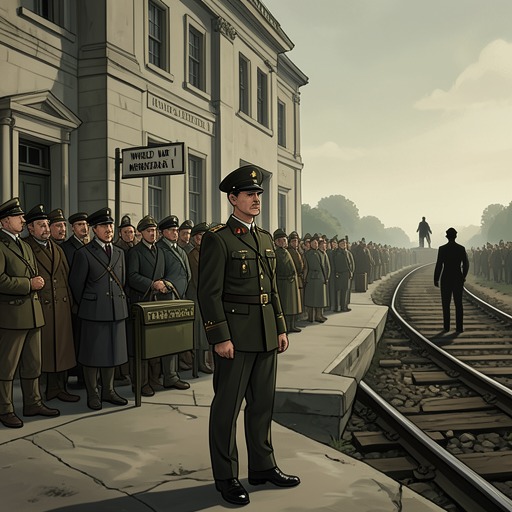
For Hugh Legat, the past surfaces in an ordinary expression heard amid signs of impending war. As he makes his way through London, he sees objects rising above the Houses of Parliament and recalls his father using the same phrase when he had to return to France during the First World War. Legat was six; the words sounded to him like the announcement of a party. That departure was the last time he saw his father. The scene does not explain what became of him, but it establishes how a child’s incomplete understanding can remain attached to a moment of separation.
The recollection gives a familiar phrase a private history before the surrounding events give it renewed public meaning. The phrase belongs first to Legat’s childhood and his father’s departure, then to a present in which the threat of war is visible in the London sky. Nearby, preparations make that threat material: soldiers unload sandbags, anti-aircraft guns are put into position, and a searchlight battery is being enclosed. The novel thus places family memory beside hurried defence. What once sounded, to a child, like an excursion now belongs to a crisis whose consequences Legat can understand.
Chamberlain’s inheritance of the war
Chamberlain’s memory is political as well as personal. He tells Legat that he was too old to fight in the First World War, while Legat was too young. For Chamberlain, being unable to act made witnessing the suffering worse. He recalls the deaths of three-quarters of a million men from Britain and the grief extending beyond the dead to parents, wives, children, relatives, and friends. The scale matters not as a statistic alone but as a measure of how widely war’s consequences spread.
Afterward, war memorials and the cemeteries in France where his friends were buried renewed his vow: if he ever held a position from which he could prevent another catastrophe, he would do anything, sacrifice anything, to preserve peace. He calls that commitment sacred. The recollection explains the intensity behind his diplomacy without making it a simple refusal to fight. He acknowledges that Britain’s military and psychological unreadiness can be remedied and says that work is under way; what he fears, beyond immediate military weakness, is the damage to the people’s spiritual health if their leaders fail to make every effort to prevent a second great conflict.
Repetition, law, and the limits of remembrance
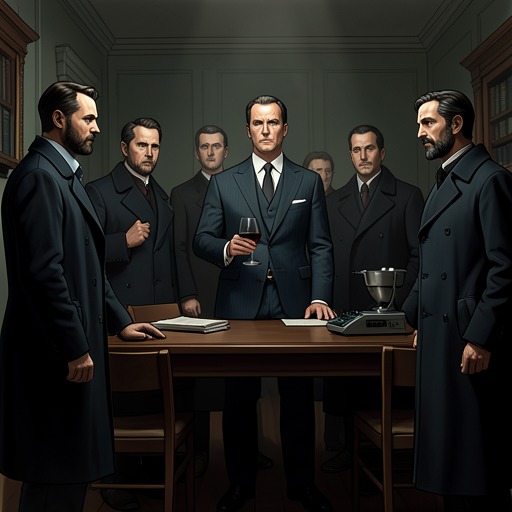
The prospect of war makes Chamberlain think of August 1914: he fears that countries will be drawn in one by one, as if nothing had been learned. But the analogy does not supply an easy answer to the present crisis. In discussing the likely defeat of Czechoslovakia and the prospect of a prolonged war, he points to the contradiction between fighting for the country and Britain’s recognition that the three and a half million Sudeten Germans should have self-determination. The separation of the Sudetenland, he observes, would therefore not be an Allied war aim. He asks what such a war would be for.
Lord Gort suggests the rule of law. Chamberlain accepts that this could be a reason to fight and says that Britain would do so if necessary, while wishing there were another way to uphold it. The exchange sets memory against a present moral dilemma: the horror of repeating the last war counsels peace, but fear alone cannot settle what Britain owes to law or to Czechoslovakia. The First World War’s legacy is therefore not a ready-made lesson. It is a burden of remembered suffering that makes each choice more urgent and more difficult.
The warning embedded in unpreparedness
The past also governs expectations about the future through Britain’s defence planning. The government’s plans had assumed that conflict with Germany would not come before 1939. In the crisis, that assumption meets practical shortcomings: the air force’s warplanes are said not to work, and London has only about a third of the anti-aircraft guns thought necessary for its defence. Most are obsolete, and the city is short of searchlights and lacks ranging and communication equipment. The army, too, had counted on another year to prepare.
This gap between planned time and actual danger gives the historical echo a material consequence. Chamberlain warns Legat that, should another war come, it will be infinitely worse than the last and will require great fortitude from those who must survive it. His hope of preventing war grows from memory, but the failing timetable of rearmament shows why memory cannot guarantee safety. The past returns not only through grief and analogy but through the defences Britain has not yet completed.