Propaganda and political myth
MunichPropaganda and political myth turns political staging into a story that seems natural to its audience. In these scenes, an official announcement recasts the Munich conference as Adolf Hitler’s initiative, while the Nazi Party organizes a conspicuous public welcome that presents the city as united behind him. Hartmann sees how the two forms reinforce each other: a convenient account gives the spectacle meaning, and the spectacle makes the account visible.
An account people want to believe
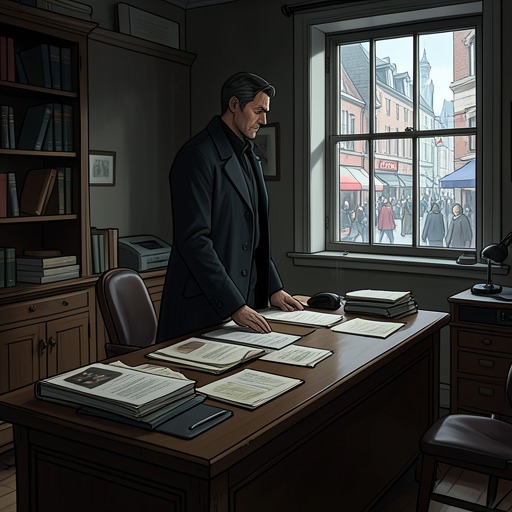
After hearing the communiqué announce that Adolf Hitler had invited Benito Mussolini, Neville Chamberlain, and Édouard Daladier to Munich, Hartmann notices how its wording makes the conference seem to have been Hitler’s idea. He expects people to believe that version, not simply because they lack information, but because, as he reflects, they believe what they want to believe. Hartmann identifies this willingness to accept a reassuring account as the insight associated with Goebbels: people can be given an excuse not to trouble themselves with inconvenient truths. Propaganda’s force here lies partly in what it lets its audience avoid thinking about.
A city arranged as an image of unity
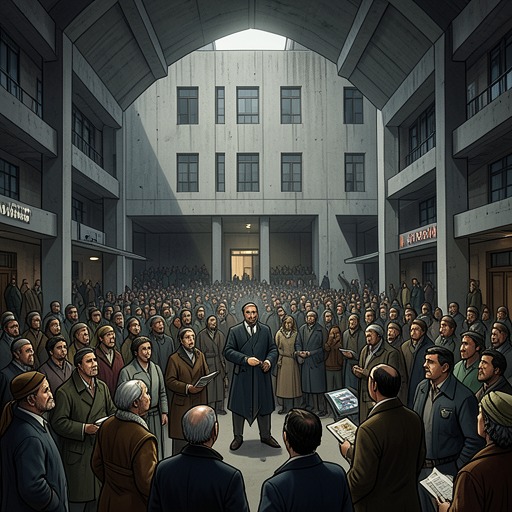
The welcome in Munich makes that political story tangible. During Oktoberfest, the city is presented under the official slogan “Proud City, Cheerful Country”; on short notice, the Nazi Party calls on residents to come into the streets for Adolf Hitler and his foreign guests. Schools are closed and workers are given time off, while station posters identify the delegations’ hotels and publish the route their leaders will take through the city. The apparent public celebration is therefore also carefully organized: its timing, audience, and procession have been laid out in advance.
The spectacle and its dissonance
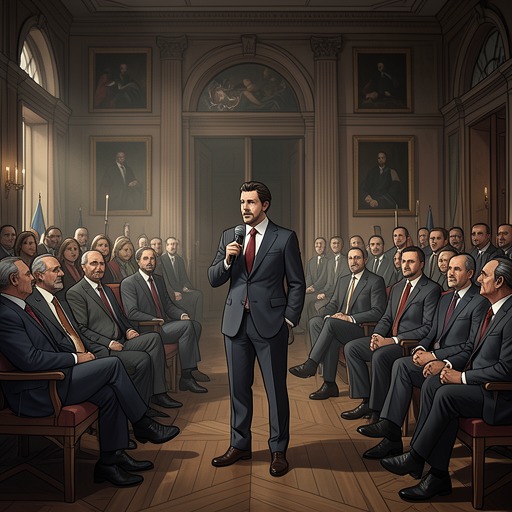
At the station, flags, a band, an honour guard, and cheering crowds furnish the welcome with visible signs of national enthusiasm. Children wave swastika flags, and flowers are presented to Adolf Hitler and Benito Mussolini. Yet Hartmann is struck less by the ceremony’s pageantry than by Hitler’s grim expression as he stands through the anthems and inspects the troops. Hitler manages a smile for the girls, but his expression darkens again after he gives his bouquet to an aide and gets into his car. The contrast does not undo the public performance; it exposes a gap between its cheerful image and the person at its center. Together, Hartmann’s suspicion of the communiqué and his attention to the staged welcome show political myth being made both through a version of events and through the repeated public signs that invite people to accept it.