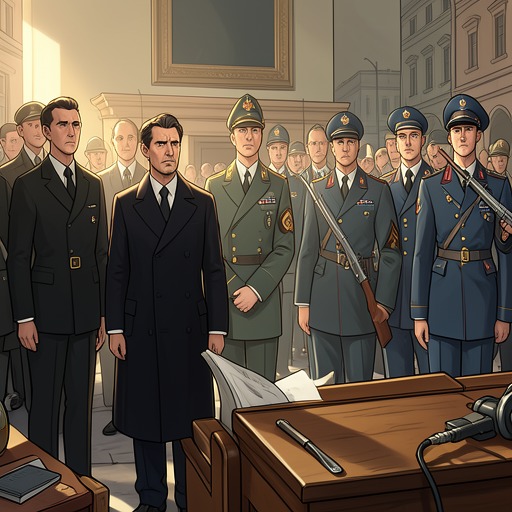
National Socialism (Nazism)
MunichNational Socialism (Nazism) appears in these scenes not as an abstract definition but as a disputed name whose political force is tested against personal loyalties and institutional choices. The distinction between calling someone a Nazi and describing him as a German nationalist or socialist matters: so does the distinction between rejecting Adolf Hitler’s regime and opposing it only when its military prospects look poor. Together, these exchanges expose both the instability of political labels and the limits of resistance within the regime’s own institutions.
Political Labels and Nationalism
In Hugh Legat’s account of his Oxford friendship with Paul von Hartmann, political disagreement had acquired a sharper meaning in Germany. Legat explains that his friend was not a Nazi and, if anything, considered himself a socialist, but was also a German nationalist. The combination had led to arguments during the July election campaign, when politics could not be kept at a distance, particularly in Munich. The scene therefore resists an easy equation between every form of German nationalism and adherence to the Nazi movement, even as it shows why the two could become difficult to distinguish from outside.
Sir Alexander Cadogan turns that difficulty into a joke, asking whether Hartmann was “A national socialist, then – but lower case, perhaps, rather than upper?” The wordplay separates a descriptive combination of national and socialist commitments from the proper name of a political movement, but it also shows how little security a change of capitalization offers. Legat recognizes the remark as what Hartmann would have called “a classic piece of English sophistry.” Cadogan accepts the point with some amusement. Their exchange makes the label itself a site of interpretation: a clever distinction can clarify what someone claims to believe, but it can also seem like a verbal escape from the political consequences of those beliefs.
The old argument returns when Legat and Hartmann meet again in Munich. Recognizing the botanical park and the place where they once sat, Legat recalls accusing Hartmann of being a Nazi at heart. He apologizes, explaining that German nationalism had sometimes sounded no different from Nazism to an outsider. Hartmann declines to reopen the dispute because there is no time; he immediately turns to his request for a meeting with Neville Chamberlain. The remembered disagreement is thus not resolved by a final definition. Instead, it frames their changed circumstances: an old political suspicion sits beside the urgent practical work of warning the British prime minister.
The Army’s Conditional Opposition
A different test of the distinction between opposition and rejection comes in the discussion of the German Army. Erich Kordt confirms that the Army’s opponents of Hitler believed Germany would lose. Hartmann then states the implication plainly: the Army has no moral objection to the regime, and its opposition depends on the country’s military prospects. His interlocutor answers that soldiers are not clergymen. The exchange makes clear that military resistance does not, in this account, amount to a principled rejection of National Socialism.
Hartmann draws out the danger in that condition. If the Army will turn against Hitler only when he begins to lose, then its opposition may come too late to prevent the consequences of his success. Kordt warns him to lower his voice because Rudolf Hess’s office is along the corridor, bringing the political risk into the immediate setting: a frank assessment of the Army’s loyalties must be spoken quietly, even among men discussing resistance. The conversation distinguishes the Army’s capacity to obstruct Hitler from any moral commitment to do so. Its willingness to act is tied to anticipated defeat, not to opposition to the regime as such.
Colonel Hans Oster’s response underscores how much effort had gone into securing even that conditional position. He says it took months to bring the Army this far and that, throughout the summer, he had sent messages to London arguing that if Britain stood firm, the rest could be left to the conspirators. His disappointment is directed not only at the failure of the effort but at what he calls the cowardice of the British and French. The scene sets his months of political work against Hartmann’s blunt conclusion: an opponent who acts only once defeat is apparent may not be an ally capable of stopping the regime in time.
Tolerated Dissent and Its Limits
The regime’s treatment of dissent is shown through a conversation between Hartmann, Kordt, and Ernst von Weizsäcker. Asked how they know Adolf Hitler will be in Munich, Kordt admits that they do not know; Oster is trying to arrange it through his Abwehr contacts. Weizsäcker recognizes the significance of the connection. His response shifts the conversation from the immediate plan to the danger surrounding those who pursue it.
Weizsäcker warns that Oster’s activities have not gone entirely unnoticed. There has, until then, been a certain tolerance of dissent, he says, provided it does not go too far; he senses that this tolerance is ending as National Socialism enters a more vigorous phase. The warning gives dissent a precarious, conditional space of its own. The conspirators’ activity has not been invisible, and its continuation cannot be assumed to be safe. The political climate, as described by Weizsäcker, is changing from limited forbearance toward a more forceful assertion of the regime.
That warning is followed by a practical, unsettling reversal. Weizsäcker calls for Frau Winter and directs her to add Hartmann to the list of people accredited to the conference the next day, entering him as a translator to assist Dr Schmidt. Hartmann’s access is therefore arranged within the official machinery, even as the conversation has exposed the danger of his associates’ dissent. The scene does not make accreditation proof of safety or of political approval; it places a specific opportunity beside a specific warning. In this account, the regime’s reach and the resistance’s access occupy the same narrow corridor.
The Concept in the Novel
Across these episodes, National Socialism is approached through competing claims about what a person believes and what an institution is prepared to do. Legat’s account separates Hartmann’s friend’s socialism and German nationalism from Nazi allegiance, while the Munich memory admits why an outsider might hear little difference. Cadogan’s joke briefly turns that uncertainty into verbal play, but the surrounding arguments restore its stakes: the labels affect trust, interpretation, and the possibility of cooperation.
The Army discussion sharpens the contrast between ideological or moral opposition and resistance based on military calculation. Oster has spent months trying to move the Army toward action, yet Hartmann sees that an army waiting for Hitler to begin losing may act only after the decisive opportunity has passed. Weizsäcker’s warning adds another limit: even the dissent tolerated so far may soon face a more vigorous regime. The concept is therefore tied not only to names but to thresholds—what counts as opposition, how long it is permitted, and whether those who oppose Hitler will act before the danger becomes irreversible.