German nationalism and the Greater Germany ideal
MunichGerman nationalism and the Greater Germany ideal carry a double meaning in the novel: they express Paul von Hartmann’s attachment to his country, yet the territorial enlargement achieved under Adolf Hitler makes that ideal difficult to separate from the regime’s ambitions. Austria and the Sudetenland appear as successive gains, adding ten million ethnic Germans to the Reich in less than seven months without a shot being fired. The political success that seems to vindicate national unity also unsettles those who oppose Hitler, forcing them to consider whether their judgment of the movement—and of their own cause—has been mistaken.
National feeling and the scale of the country
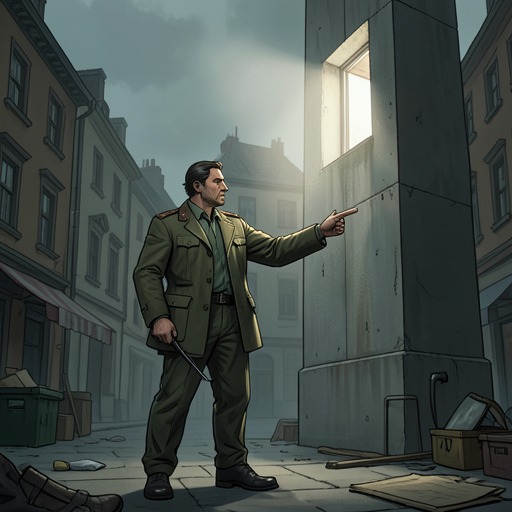
On the journey south aboard Hitler’s heavily armoured special train, Hartmann lies awake and looks out at the darkness, then watches the landscape emerge at dawn. The train crosses wooded hills and valleys, meadows, villages, church spires and a wide river he assumes to be the Danube. This immense country prompts him to think about a national feeling he has never managed to explain to his Oxford friends. In his account, their sense of nationality is bounded by a coastline; his is shaped by a hard, broad and fertile land whose possibilities seem limitless and whose size, he believes, demands a sustained effort of imagination and will to order it as a modern state.
The scene gives nationalism a personal and spatial dimension before it becomes a question of policy. Hartmann knows that describing these feelings risks making him sound mystical, or, to an English listener, like a German nationalist in the most suspect sense. He nevertheless asks what is wrong with being one. His resentment is directed at the way Hitler has corrupted what Hartmann regards as honest patriotism. The distinction is important to his self-understanding: attachment to Germany is not, in his view, the same as allegiance to Nazism. The novel does not make the distinction easy to sustain, however. The immense national landscape that Hartmann experiences as a source of identity is also invoked within a political project that brings more ethnic Germans under the Reich.
Unification as political triumph
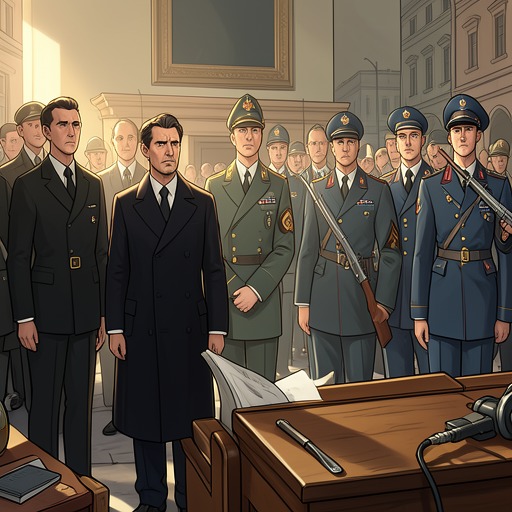
At a gathering of opponents of Hitler, the territorial gains are described in terms that expose their unsettling appeal. Hans Bernd Gisevius repeats the celebratory language of newly liberated Sudeten territory and fears that Hitler will become more popular than ever. Count von Schulenburg responds that the gains might indeed make Hitler appear to be a great statesman: first Austria, then the Sudetenland, with ten million ethnic Germans added to the Reich in under seven months and no fighting required. His question—whether the men present have considered that they may be wrong—turns political success into a crisis of confidence.
The exchange shows how the Greater Germany ideal can work as more than an abstract slogan. A territorial change presented as national liberation can command approval even among people who distrust the ruler responsible for it. The absence of fighting strengthens the appearance of achievement: Hitler seems to have delivered expansion without the costs that might have exposed its danger. The opposition’s silence after Schulenburg’s challenge leaves that appeal unresolved. National feeling is not simply dismissed as a disguise for dictatorship; the difficult fact is that Hitler’s victories can seem to answer a real desire for national unity while advancing his power.
Hartmann and Legat dispute the meaning of patriotism
The disagreement between Hartmann and Hugh Legat becomes explicit when they meet beside a lavender bed in a Munich beer garden. The place recalls an earlier argument in which Legat accused Hartmann of being a Nazi at heart. Hartmann apologizes: he recognizes that German nationalism can sound much like Nazism to an outsider. He then moves directly to his purpose, asking Legat to arrange a meeting with Neville Chamberlain. Legat refuses, arguing that Chamberlain already knows Hitler is a bad man and that Hartmann cannot offer a warning the prime minister has not considered.
Their argument is not merely about whether Chamberlain understands Hitler. Legat believes Germany has a strong case on the issue under discussion, and that Hitler’s involvement does not make that case weaker. He connects appeasement to the attempt to redress injustices created by the Versailles Treaty, recalling Hartmann’s own earlier insistence on those wrongs. Legat also remembers why he had suspected Hartmann’s opposition to Hitler: it had seemed to rest chiefly on contempt for Hitler as a vulgar Austrian corporal, rather than on a clear rejection of Nazism. His challenge makes the boundary Hartmann draws between patriotism and dictatorship look precarious, because disliking Hitler’s character does not by itself amount to opposing the political ends he pursues.
Hartmann does not withdraw his earlier position on Versailles. He admits that part of him rejoices that Britain and France have had to come to terms with the wrongs they helped sustain. But he insists that the correction has come too late. In his view, overturning Versailles is no longer Hitler’s ultimate purpose; it is only a prelude to what is coming. The distinction marks Hartmann’s political change without erasing his national grievance: he can welcome redress and still recognize that the regime has moved beyond it. His warning is therefore directed not only at Hitler’s character but at the danger of mistaking a legitimate grievance, or a successful settlement of it, for the limit of Hitler’s ambitions.
The ideal’s unresolved contradiction
Across these scenes, German nationalism remains both an intimate attachment and a contested political language. Hartmann’s description of the land gives his patriotism a felt basis that Legat, shaped by a more bounded English conception of nationality, has not understood. Yet the gains in Austria and the Sudetenland demonstrate how readily the language of national belonging can be joined to Hitler’s expanding authority. Schulenburg’s doubt and Legat’s accusation press from opposite directions: the former asks whether success has discredited the opposition’s judgment, while the latter asks whether Hartmann’s own hostility to Hitler has ever been sufficiently ideological.
Hartmann’s answer is not to deny the attraction of national unity or the injustice of Versailles. Instead, he distinguishes those claims from what Hitler intends to do with them. That distinction leaves the ideal unsettled rather than resolved: patriotic feeling may be sincere, and redress may be deserved, while the political programme that claims to fulfil them continues beyond either purpose. By placing the dawn landscape, the opposition’s silence, and the argument at the beer garden alongside one another, the novel shows why opposing Hitler cannot be reduced to rejecting Germany, and why celebrating a national success cannot establish that Hitler’s ambitions have been satisfied.