Event 1
Bradley the Buyer’s spree
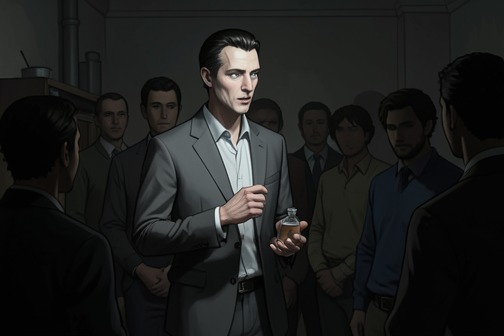
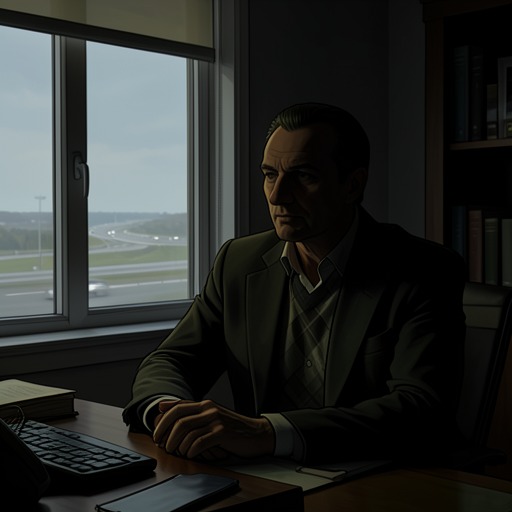
[Bradley the Buyer’s spree](entity:event-recall-event-buyer-73f2694a694b) traces the transformation of a celebrated narcotics agent into a predatory figure whose dependence consumes both colleagues and the institution that employs him. His ability to approach pushers and obtain drugs without being remembered first makes him an effective agent; the same anonymous access develops into a [contact habit](entity:state-recall-state-4c8e62df6a72), then into a need that cannot be satisfied by contact alone. The disappearance of the District Supervisor and the later destruction of the Buyer after he consumes the Narcotics Commissioner turn that transformation into a satire of drug enforcement and bureaucratic self-preservation.
## From agent to contact addict
The Buyer is introduced as a leading narcotics agent who can move through the drug trade with unusual ease. He is so grey and anonymous that a pusher can sell to him directly and fail to remember him afterward. In the story’s account of the trade, this ability resembles the pushers’ own contact habit: selling itself becomes a form of dependence, and the agent who repeatedly approaches suppliers is caught in a related circuit of access and need.
The resemblance becomes physical and behavioral. The Buyer increasingly looks like a junkie; he cannot drink, cannot perform sexually, and loses his teeth. He compulsively sucks on Baby Ruth candy bars, a detail that makes his new appetite visible even as he continues to serve as an officer of the narcotics industry. His body takes on a grey-green color, and the narrative suggests that it is producing its own junk or an equivalent. The Buyer describes himself as having a steady connection within himself, a private supply that separates him, in his own view, from the compromised people on either side of the trade.
## Need escalates beyond contact
The Buyer’s habit grows heavier until he requires a recharge every half hour. He sometimes cruises police precincts and bribes a turnkey to admit him to a cell of junkies, treating proximity to users as a means of sustaining his dependency. But even repeated contact eventually fails to satisfy him. His reliance has crossed from a professional facility for reaching the drug world into an appetite that cannot be managed through ordinary access.
The District Supervisor responds to rumors about the Buyer’s conduct by telling him that [the Department](entity:organization-recall-organization-99944aad36e9) must remain above suspicion and offering to accept his immediate resignation. The confrontation exposes the department’s concern with its public standing, but for the Buyer the institution is not merely an employer. He crawls to the Supervisor and pleads that the Department is his lifeline, offering menial service in exchange for being allowed to stay. When the Supervisor rejects him, the scene shifts from a disciplinary hearing to the point at which the Buyer’s dependence takes an unmistakably predatory form.
## The Supervisor’s disappearance and the official response
An hour after the confrontation, the Buyer is found in the Supervisor’s chair, apparently on the nod; the Supervisor has disappeared without a trace. At the subsequent hearing, the judge says that the evidence indicates the Buyer has somehow assimilated the District Supervisor, but acknowledges that there is no proof. The judge considers confinement, then releases him because no institution seems suitable for a man of his caliber. The ruling’s cautious language and ineffective outcome make official process appear powerless before the transformation it is trying to classify.
The episode’s horror spreads through the narcotics industry. Junkies and agents disappear, while the Buyer’s presence is associated with a narcotic mist that incapacitates victims. After obtaining what he needs, he withdraws for days, like a creature that has gorged itself. The sequence enlarges the initial disappearance into a wider crisis: the agent who once moved anonymously among users now makes people across the industry vanish.
## Destruction and institutional irony
The Buyer is finally caught digesting the Narcotics Commissioner and destroyed with a flamethrower. A court of inquiry rules that the measure was justified because he has lost his human citizenship and become a species-less menace to the narcotics industry at every level. The decision supplies an official ending, but its reasoning also reveals the institution’s priorities: the Buyer is treated as intolerable once he threatens the industry as a whole, after his transformation has already exposed how porous its divisions between agent, addict, and supplier have become.
The spree’s central reversal is that the narcotics agent’s expertise does not keep him outside the system he polices. His skill at making contact becomes dependence; dependence becomes an appetite that cannot be met by access; and that appetite consumes officials as well as people in the drug trade. The Supervisor’s unexplained disappearance, the Commissioner’s destruction, and the Buyer’s own killing make the enforcement apparatus part of the same grotesque economy of need it claims to control.
Event 2
Freeland R.C. breakout
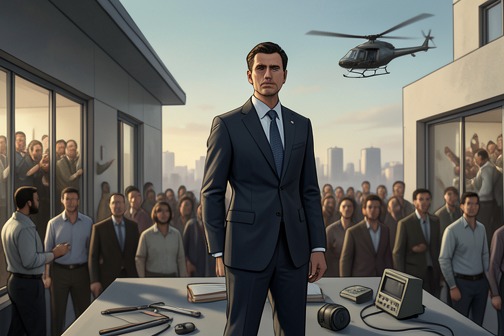
The [Freeland R.C. breakout](entity:event-recall-event-freeland-33b5b736a191) is the mass release of every subject held in the [Reconditioning Center](entity:organization-recall-organization-26ad0a351a64) after its electronic brain goes berserk during a game of six-dimensional chess with the Technician. [Dr. Benway](entity:character-recall-character-dr-benway-1c90c5e5e291) receives the news during lunch, accepts an immediate assignment with [Islam Incorporated](entity:organization-recall-organization-islam-incorporat-1647ab862524), and calls for Operation Helicopter. From the Center’s roof, he and his companions witness the institution’s controlled population spilling into the streets; the disturbance then widens into a worldwide crisis of destructive behavior and flight from [Freeland](entity:location-recall-location-freeland-b3ded64364a3). The episode’s force lies in the scale of that reversal: a system built to contain and recondition people becomes the point from which disorder escapes.
## The Release and the Rooftop View
The news arrives while the group is eating lunch in Dr. Benway’s office. After taking a phone call, Dr. Benway reports that the electronic brain has gone berserk while playing six-dimensional chess with the Technician and has released every subject in the Reconditioning Center. He immediately says he is prepared to accept an assignment with Islam Incorporated and declares that Operation Helicopter is indicated. The abrupt pivot from lunch to emergency response gives the breakout the rhythm of a crisis managed through institutional procedure, even as the institution’s own machinery has failed.
From the roof of the Center, the observers survey a scene in which former patients occupy the spaces of ordinary public life. People with [IND](entity:concept-recall-concept-ind-05243fe51b57) stand in front of cafe tables; people with [Latah](entity:state-recall-state-latah-6ffbd0a3f1e1) imitate passers-by; people with catatonia are described in the parks, while agitated people with [schizophrenia](entity:state-recall-state-894d301b886c) move through the streets. The account also identifies partially reconditioned subjects surrounding homosexual tourists. These details establish that the release is not merely a breach in the Center’s perimeter: it has carried the Center’s populations and disorders into streets, parks, and public gathering places.
Other groups make the collapse still harder to contain. Simopaths, described as citizens convinced they are apes or other simians, swing from chandeliers, balconies, and trees; the narration says the disorder is peculiar to the army and that discharge cures it. Amoks move through the streets, while citizens described as having incipient Bang-utot appeal to tourists for help. The episode’s catalog of different conditions does not present a single organized uprising. Instead, it makes the breakout legible as a collision of many incompatible behaviors released into the same civic space.
## From Institutional Failure to Public Disorder
The disturbance expands beyond the Center through acts against cultural landmarks, public utilities, transport, hospitals, and international institutions. Rock and Roll adolescent hoodlums storm streets in multiple nations, attack the Mona Lisa with acid at the Louvre, and open zoos, asylums, and prisons. The account then ranges across sabotage of water supplies and sewers, transport dangers, and assaults on hospital care, before describing the dumping of pigs into the Curb and the defilement of the United Nations’ treaties and agreements. The breadth matters: the crisis is not confined to Freeland or to one kind of target, but reaches the infrastructures and symbols on which public order depends.
The episode’s movement from a malfunctioning electronic brain to attacks on public systems creates a sharp contrast between technical control and its consequences. Elsewhere in the book, a conference speaker describes biocontrol as the possible regulation of movement, mental processes, emotional reactions, and apparent sensory impressions through bioelectric signals. The speaker imagines brain connections installed shortly after birth and a miniature radio receiver linked to State-controlled transmitters; the [biocontrol apparatus](entity:object-recall-object-8624d3209929) is described as a prototype for one-way telepathic control. Those proposals are not identified as the cause of the breakout. Their juxtaposition with the Reconditioning Center’s electronic failure, however, places both scenes within a wider inquiry into systems that seek to direct human behavior through technology—and into the gulf between a system’s claim to control and its actual effects.
## The Flight from Freeland
The clearest consequence of the breakout is a mass movement across borders. Tourists arrive by plane, car, horse, camel, elephant, tractor, bicycle, steam roller, and on foot; others use skis, sleds, crutches, or pogo sticks. Their means of travel are as varied as the list of the Center’s released subjects, but their demand is shared: asylum from what they call the unspeakable conditions in Freeland. The absurd range of vehicles turns the crisis into a global exodus while keeping its cause firmly in view: people are trying to get away from conditions associated with the country and its institutions.
The Chamber of Commerce attempts to calm the arriving tourists, insisting that only a few crazies have broken out of the crazy place. Its reassurance cannot stem the debacle. The phrase reduces a widespread emergency to a small administrative problem, while the scale of the flight makes that minimization plainly inadequate. The contrast supplies the episode with its bureaucratic comedy: an official voice tries to make the situation manageable by naming it as limited, even as the movement of people demonstrates that it is not.
## Form and Significance
The breakout is narrated through an accelerating catalogue rather than through a single escapee’s journey or a step-by-step account of the Center’s defenses. The rooftop vantage initially frames the release as something being observed; the account then keeps widening, from the Center’s grounds to international streets and finally to frontiers. Repetition of groups, sites, and improvised means of escape makes the crisis feel cumulative. The structure offers no orderly restoration of control: the last emphasis is on tourists continuing to demand asylum while the Chamber of Commerce fails to contain the consequences.
That form makes the event more than a story of a facility’s mechanical malfunction. The electronic brain’s failure initiates the release, but the aftermath shows the limits of treating social disorder as a problem that can simply be sealed inside an institution or corrected by technical means. The account does not establish that every disturbance in the wider crisis is directly caused by the released subjects; instead, it assembles the breakout, the international vandalism, and the exodus as parts of a sweeping portrait of breakdown. Its dark humor—especially the contrast between elaborate modes of flight and the Chamber of Commerce’s bland reassurance—sharpens the central reversal: an institution meant to protect the social order becomes synonymous with conditions people flee.
Event 3
The centipede incident
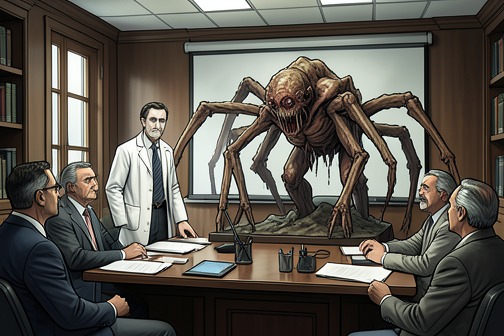
[The centipede incident](entity:event-recall-event-a6bead4041f3) is the public unmasking of [Doctor “Fingers” Schafer](entity:character-recall-character-doctor-fingers-scha-bd4ac4ce31e7)’s promised model of a supposedly perfected human nervous system. At a conference on technological psychiatry, his demonstration produces not the controlled, anxiety-free subject he advertises but a monstrous transformation identified as Clarence Cowie. The assembled experts respond by proposing to suppress the evidence and destroy the creature; a later courtroom scene recasts that response as the killing of an innocent person and connects Schafer’s experiment to a history of forcible lobotomy. The episode’s force lies in the reversal: a presentation meant to display mastery instead reveals the cost and fragility of the authority claiming it.
## Conference and Demonstration
Schafer rises before the conference and presents his work as a radical reduction of the human nervous system. In his account, the body can be simplified to a compact spinal column, while the brain and other structures are treated as dispensable. He calls the result “The Complete All American De-anxietixed Man,” turning a medical ideal into a national showpiece and presenting bodily reduction as technical progress.
The demonstration immediately overturns that confident framing. [The Man](entity:character-recall-character-the-man-09c20a42b22b) is carried onto the platform, and the body Schafer has presented as his achievement changes into transparent, jelly-like matter that disperses, revealing a huge black centipede. The figure’s transformation makes the supposedly controlled human body impossible to separate from the creature that emerges from it. The conference’s polished language of improvement gives way to an event its participants cannot explain or master.
Schafer’s response is personal as well as public: he wrings his hands and addresses the creature as Clarence, reproaching it for what he sees as betrayal. His appeal establishes that the being before the conference is not merely an unforeseen specimen in his demonstration; it is associated with Cowie, whom the later proceedings identify as the innocent human creature the doctors killed. Schafer’s distress does not resolve the contradiction between his claim to have engineered a finished product and the creature’s uncontrolled appearance.
## Suppression and Panic
The conference members initially react with disbelief and dismissive remarks about Schafer and publicity. Their uncertainty hardens into a collective claim that the creature must not be allowed to survive or become known. One speaker calls it an illegitimate product of Schafer’s mind and frames its destruction as a duty to humanity, converting fear of an unexplained being into a justification for violence.
That language of public duty is compromised by the visible failure of control. A Southern doctor advances on the centipede but stops when confronted with its size and threatening appearance; another doctor, under the influence of LSD25, refuses to commit himself and invokes the possibility of a prosecutor. The creature remains present and agitated while the experts debate what should be done. A bearer remarks that it is hungry, and the room’s professed confidence breaks into alarm.
The conference ends not with a considered scientific decision but with a wave of fear: its members rush toward the exits, screaming and clawing as they try to escape. The sequence converts a staged demonstration into a failed containment effort. The experts who had gathered to discuss technological psychiatry cannot agree on an account of what they have seen, much less maintain order in its presence.
## Courtroom Reversal
A fadeout shifts the incident into a courtroom, where the district attorney challenges the conference’s explanation. He reports that the doctors claim the innocent human creature they killed suddenly turned into a giant black centipede and that destroying it was necessary to protect humanity. He presents that account as a self-serving lie and demands evidence of the creature after its destruction. The courtroom thus makes the central uncertainty explicit: the conference’s participants insist on a transformation, but their claim that they destroyed the result leaves the jury unable to inspect it.
The prosecutor’s case also places Schafer’s demonstration within a broader record of medical coercion. He points to Schafer as a figure previously charged with “brain rape,” then translates the accusation into plain terms: forcible lobotomy. He accuses Schafer of reducing whole provinces to near-idiocy and filling warehouses with dependent people, referred to as “The Drones.” These claims are made in the prosecutor’s speech, not independently established by the courtroom scene, but they change the terms of the incident: the question is no longer only what the creature was, but what Schafer’s methods have already done to human beings.
The jury’s reaction becomes another breakdown of institutional composure. One juror dies of a heart attack, while three others fall to the floor in a state of intense excitement. As the prosecutor speaks, the centipede is again described as rushing about in agitation; one bearer shouts that it is hungry, and people begin looking for a way out. The courtroom does not settle the dispute. Instead, the creature’s continued presence and the audience’s response make the boundary between testimony, spectacle, and immediate danger unstable.
## Meaning and Narrative Form
The incident stages a collision between scientific authority and the body it claims to govern. Schafer’s sales pitch depends on treating the nervous system as something that can be reduced and perfected; the transformation exposes the human subject as neither a finished product nor a safely contained object. The centipede’s emergence reverses the conference’s hierarchy: the experts who meant to display control become frightened witnesses, while the being they would classify and eliminate dominates the room’s attention.
The courtroom continuation refuses a clean explanatory resolution. The district attorney offers a forceful account of murder and coercive medical practice, but the central evidence has supposedly been destroyed; the conference’s version is itself challenged as a tissue of lies. The scene’s staged transitions—from lecture, to transformation, to attempted suppression, to trial—make the reader move among competing performances of authority rather than rest on a stable report. Its grotesque reversal is therefore also structural: the promised demonstration of mastery becomes an accusation against the institution staging it, while the question of what happened to Clarence Cowie remains bound to the witnesses’ claims and evasions.
Event 4
A.J.’s Annual Party
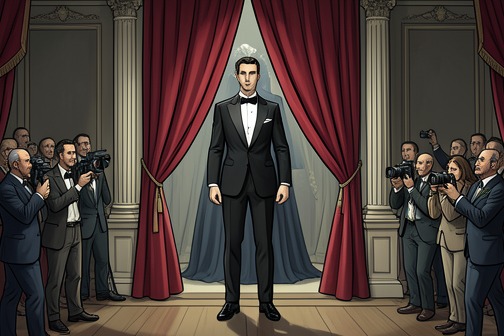
[A.J.’s Annual Party](entity:event-recall-event-a-j-55f634575463) is a spectacle of excess that breaks into a riot, revealing how quickly [Interzone](entity:location-recall-location-interzone-08fd9209b7ee)’s performances of status and control give way to violence and grotesque bodily disorder. [A.J.](entity:character-recall-character-a-j-6b1fa6fcef52) answers an assault on his guests and guards not by restoring ordinary order but by escalating the performance: cutlass, pirate song, hog-call, and a thousand rutting Eskimos transform the party into a shambles. [Hassan](entity:character-recall-character-hassan-109d8d8b1e3f) finally banishes him, leaving the host’s authority exposed as both theatrical and precarious.
## The Party and Its Performers
The episode is introduced under the emphatic title “A.J.’S ANNUAL PARTY,” which gives the gathering the shape of a recurring social ritual before its disorder overwhelms that form. A.J. turns to his guests and announces the Great Slashtubitch, an internationally known impresario of blue movies and short-wave television. A sixty-foot red velvet curtain is struck by lightning and torn open to reveal the enormous, immobile impresario in evening dress, a blue cape and monocle. The grand staging makes the party a show within the show: titles, costumes, curtain, and a commanded audience all promise a carefully controlled display.
Slashtubitch’s persona is itself built around judgment and spectacle. His immense grey eyes are said to be unbearable to all but the Coordinate Factualist; when he is angered, the force of his displeasure can blow his monocle across the room. He berates actors for counterfeit orgasms and shoddy tricks, insisting on sincerity, art, and devotion while listing devices such as dubbed gasps, rubber turds, milk hidden in the ear, and Yohimbine smuggled in from the wings. The party’s extravagant presentation thus arrives with a parody of artistic standards: authenticity is loudly demanded in a world where performance, bodily manipulation, and deception are already part of the entertainment.
## The Assault and A.J.’s Counterattack
The party’s breakdown is announced by Hassan’s accusation that A.J. has ruined the celebration. A.J. replies with an insult that calls Hassan a liquefying gook, bringing their political antagonism into the room as personal abuse. Almost at once, a horde of lust-mad American women rushes in from farms, dude ranches, factories, brothels, country clubs, penthouses, suburbs, motels, yachts, and cocktail bars. Their entrance collapses the distinctions the guest list and the elaborate staging had seemed to preserve: women in riding clothes, ski togs, evening dresses, jeans, tea gowns, slacks, bathing suits, and kimonos converge on the guests, clawing at the hanged boys and shouting demands for sex. The guests flee through the room, dodging among the bodies and overturning iron lungs.
A.J. orders his Sweitzers to protect him, but his secretary, Mr. Hyslop, looks up from a comic book to report that they have already liquefied. That answer punctures the idea of a dependable guard force: the defenders have vanished into the very process of bodily absorption associated with liquefaction. A.J. responds by declaring that their backs are to the wall and their bodies at stake, then orders Hyslop to issue short arms. The mock-military language converts a party crisis into a siege, though the scale and tone of the scene make its declarations as theatrical as the curtain that introduced the entertainment.
A.J. draws a cutlass and decapitates the American women while singing a pirate song. Surrounded and fighting overwhelming odds, he throws back his head and makes a hog-call. A thousand rutting Eskimos immediately pour into the room, grunting and squealing, and fall upon the women. The narration attributes their swollen faces and purple lips to a seasonal rutting period during which the tribes gather for orgies. The sudden arrival turns A.J.’s call into an impossible-looking instrument of escalation: instead of ending the assault, his intervention brings a second, still larger force into the already crowded room.
## The Shambles and the Expulsion
Hyslop reacts with bored resignation, waving the Jolly Roger listlessly as he observes that A.J. is at it again. A house dick sticks his head through the wall to ask whether there is a menagerie in the room. Hassan, meanwhile, wrings his hands and condemns the scene as a filthy shambles. The contrast is precise: Hyslop treats the violence as a recurrence, the house dick tries to name it through ordinary institutional language, and Hassan speaks as the host whose party has ceased to be governable.
A.J. ends the spectacle not as a defeated guest but as a pirate tableau. He sits on a sea chest with a parrot on his shoulder, an eyepatch over one eye, and a tankard of rum in his hand, scanning the horizon through a huge brass telescope. Hassan calls him a cheap Factualist and orders him never to darken the rumpus room again. The banishment is the episode’s decisive consequence: A.J.’s performance has overwhelmed the gathering so completely that Hassan can reassert his authority only by casting him out.
## Political and Formal Significance
The party’s comic violence is inseparable from the novel’s larger presentation of Interzone as a place where political labels, public events, and bodily transformations cross into one another. Hassan’s accusation and A.J.’s retaliatory insult frame the disorder as a clash between a liquefactionist and a self-identified Factualist, but the scene supplies no orderly political debate. Instead, the ideological conflict takes the form of vanished guards, a cutlass, an improvised battle speech, and a fantastical invasion. A.J.’s own identity is elsewhere described as uncertain: he is believed to be on the Factualist side, though the narrator allows that he may be a Liquefaction agent. The party’s theatrical certainty therefore sits beside a broader uncertainty about whom A.J. serves.
The episode also turns ceremony into its opposite. Its annual title, celebrity unveiling, curtain, and formal audience set up the expected rhythm of a hosted entertainment; the attack breaks that frame, and each attempted response produces more spectacle rather than restoring order. Hyslop’s habitual weariness and Hassan’s final expulsion suggest that the chaos is not an isolated breach but a recurring feature of A.J.’s public presence. The scene’s grotesque bodies and abrupt transformations make control seem less like a stable condition than a performance that can be overwhelmed, absorbed, or converted into another act of disorder.
Event 5
Interzone riot
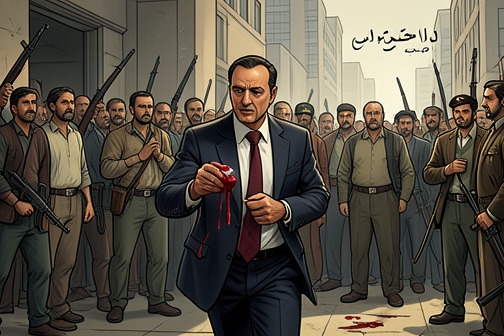
The [Interzone riot](entity:event-recall-event-interzone-riot-e7dd26ff2f34) is a [Market](entity:location-recall-location-market-d4181c09cb35) uprising in which political hostility spills into public violence and ends with a police crackdown. Its progression—from nationalist antagonism and an unexplained death to a crowd attack and organized repression—presents street disorder not as an isolated eruption but as a spectacle shaped by competing performances of power.
## Causes and Participants
The scene establishes a charged political setting before the mass violence begins. A group of Nationalists sit outside the Sargasso, sneering at the queens and speaking Arabic. [Clem and Jody](entity:character-recall-character-clem-and-jody-54e4a7a0c22e) sweep in with theatrical bravado, announcing that they have come to feed on the group’s backwardness. A Nationalist answers that his people are hungry. Their exchange places material grievance beside deliberate provocation: the encounter is not a reasoned political discussion, but a public contest in which antagonism is staged and sharpened.
The escalation is not given a single, clearly explained trigger. A Nationalist drops dead, and [Dr. Benway](entity:character-recall-character-dr-benway-1c90c5e5e291) rushes forward, asks the crowd to stand back, and takes a blood sample. He then remarks that nothing more can be done. The narration associates the death with hatred, but provides no further medical or political explanation. The moment instead serves as a hinge in the scene: the argument gives way to a wider disturbance, while the brief intervention fails to restore order.
## Riot and Police Response
Riot noises rise at a distance, and the Market empties with startling speed: shutters slam, while patrons are pulled indoors in the panic. The disturbance then reaches the square, where the rioters attack an old drunkard who has been left unconscious there. Their cries of “Death to the French” turn the violence into an openly nationalist spectacle, although the victim is identified only as a man of uncertain nationality. The episode offers no evidence that he took part in the dispute that preceded the riot; his vulnerability, rather than any stated political act, makes him its target.
The spectacle also draws an approving audience. Salvador [Hassan](entity:character-recall-character-hassan-109d8d8b1e3f) watches the crowd through a keyhole and celebrates the apparent sameness of the rioters, dancing the Liquefactionist Jig. His reaction frames the crowd as an image to be appropriated for an ideological fantasy of collective uniformity, even as its violence is directed against an exposed individual. The contrast makes the riot’s claim to collective purpose uneasy: the crowd acts as a mass, but its victim is isolated and defenseless.
Police squads enter the Market from every adjoining street and beat and kick the rioters with methodical brutality. The coordinated arrival turns scattered street violence into an encounter with organized force. Once the rioters have been carried away in trucks, residents emerge into a square littered with teeth and sandals and marked by blood. The clearing of the streets restores public access, but not a sense of safety or political resolution; the aftermath leaves the costs of both mob violence and police repression visible in the ordinary civic space.
## Political Context and Institutional Echoes
The Market riot belongs to a wider [Interzone](entity:location-recall-location-interzone-08fd9209b7ee) landscape in which political identity is performed under coercive conditions. Elsewhere, Clem and Jody are described as old-time vaudeville performers who pass themselves off as Russian agents whose purpose is to represent the United States unfavorably; their shifting political roles make their provocation at the Sargasso part of a larger pattern of politics treated as theatrical performance. The riot scene does not explain how that background causes the outbreak, but it places the pair’s taunting beside nationalist grievance and the sudden collapse of public order.
The city’s other institutions offer a parallel picture of authority as procedure backed by force. On the Island, a British military and naval station opposite Interzone, residents must formally renew an annual lease and residence permit in a compulsory ceremony. [The Island](entity:location-recall-location-the-island-446fbe02bcc5)’s President crawls across the municipal dump to deliver the papers to the Resident Governor, while soldiers sweep the crowd with mounted machine guns; its Senate and Congress retain jurisdiction only over garbage disposal and outhouse inspection. These details do not describe the riot itself, but they sharpen its political setting: public participation and official procedure can coexist with constrained power and armed supervision.
## Institutional Parallels and Narrative Form
The riot’s portrayal of political authority resonates with other episodes in Interzone, though those episodes are not presented as causes of the outbreak. On the Island, a British military and naval station opposite the city, residents are required to attend an annual renewal ceremony for their lease and residence permits. The Island President crawls across the municipal dump to deliver the papers to the Resident Governor, while soldiers sweep the assembled crowd with mounted machine guns. The Senate and Congress retain jurisdiction only over garbage disposal and outhouse inspection. Beside the Market’s abrupt violence, this ritual presents another form of public power: official participation persists, but within sharply limited bounds and under armed supervision.
The episode’s abrupt shifts—from political taunting to a death, a vulnerable bystander’s killing, and a coordinated police crackdown—leave the conflict without a settled account of its origin or a political resolution. Its closing image is not a restored civic order but residents returning to a square marked by the violence. By placing crowd action and methodical repression within the same sequence, the narrative makes the Market both a public stage for political hostility and a space where ordinary people bear its consequences.
Event 6
New York Metropolitan opening-night orgy
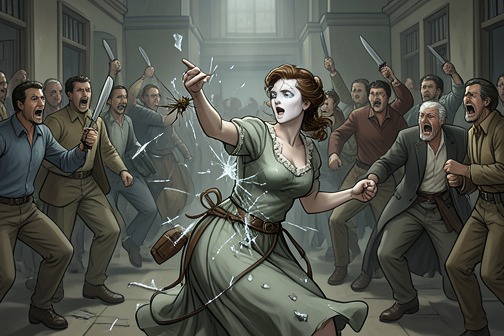
The [New York Metropolitan opening-night orgy](entity:event-recall-event-xiucutil-04ff6de5283e) is an episode in which A. J. releases Xiucutils at the opera’s opening, precipitating chaos among the audience. Its abrupt reversal—from a formal public occasion to uncontrolled collective behavior—makes the event a concentrated example of the book’s grotesque treatment of spectacle, authority, and bodily vulnerability.
## Causes and Setup
A. J. enters the episode prepared: he has protected himself with bug repellent before releasing the swarm. The insects are described elsewhere as powerful aphrodisiacs, and the account of the opening night turns that premise into an attack on the composed, socially regulated audience of the Metropolitan.
The incident belongs to a wider pattern of A. J.’s disruptive public pranks. In another episode, he tampers with water by introducing a South American vine that softens gums; elsewhere, his provocations puncture the authority of an eminent restaurant proprietor. The opera prank likewise uses a carefully chosen agent to overturn the decorum of an elite setting.
## The Opening-Night Outbreak
The scene begins with Mrs. Vanderbligh swatting at a [Xiucutil](entity:creature-recall-creature-xiucutil-3e2b650f6e61). Her cries are followed by breaking glass and torn clothing, as the audience’s reaction escalates into a mass of bodies and scattered evening clothes, jewelry, and flowers. The narration presents the event as a rising wave of involuntary response rather than as a planned gathering: one person’s encounter with the insect becomes a public disturbance that overwhelms the occasion.
A. J.’s protection contrasts with the audience’s exposure. He initiates the episode from a position of preparation, while the guests are caught unready; the result is a reversal of the Metropolitan’s carefully maintained social order. The opera house becomes a stage for a spectacle that its audience neither chose nor controls.
## Significance and Narrative Context
The event’s comic grotesquerie depends on the collision between formal prestige and disorder. The opening night’s status as a public cultural occasion does not contain the disturbance; instead, the setting magnifies the contrast between elite ceremony and the crowd’s loss of composure. The episode makes the body, usually disciplined by public decorum, the means through which that decorum collapses.
The surrounding narrative also unsettles straightforward chronology. A. J.’s repartee is said to refer to future events, making his episodes part of a larger, deliberately unstable sequence rather than a simple progression of pranks. The opening-night outbreak is therefore both a discrete act of sabotage and an instance of the book’s recurring transformation of social performance into unpredictable public spectacle.
Event 7
Chez Robert restaurant incident
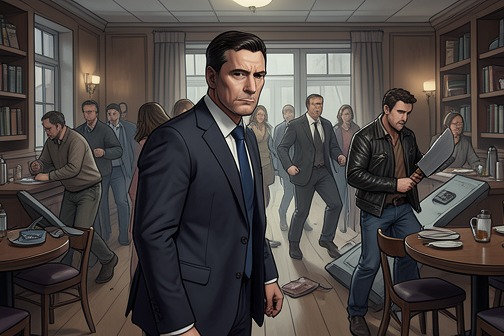
The [Chez Robert restaurant incident](entity:event-recall-event-chez-robert-76275f5dfe8a) begins with A. J. deliberately provoking the establishment’s formidable owner and ends with a hundred hungry hogs overwhelming the restaurant. What starts as an insult to elite dining becomes a lethal reversal: Robert is killed, his restaurant passes to his brother Paul, and its intimidating reputation continues to protect a deteriorating menu.
## The Provocation
A. J. had reserved a table a year ahead at Chez Robert, where the owner’s hostile scrutiny was so intimidating that some clients responded by humiliating themselves in attempts to win his approval. A. J. arrived with six Bolivian Indians, who chewed coca leaves between courses. When Robert approached the table, A. J. called for ketchup, directly affronting the restaurant’s elaborate cuisine and its owner’s authority.
## Escalation and Reversal
The provocation becomes a restaurant-wide crisis when thirty gourmets stop eating and Robert erupts in rage. He rushes to the kitchen for a meat cleaver; the sommelier breaks a bottle of champagne, and the head waiter takes up a boning knife. The three pursue A. J. through the dining room as tables overturn and its celebrated food and vintage wines crash to the floor. Other diners join the threat, with cries of “Lynch him!” and one elderly gourmet fashioning a hangman’s knot from a red velvet curtain cord. The etiquette and cultivated prestige of the restaurant have given way to collective violence, leaving A. J. cornered and in immediate danger.
## The Hog Call and Its Aftermath
Cornered and facing the threat of being dismembered, A. J. resorts to a prepared escape: he throws back his head and gives a hog call. A hundred hungry hogs, which he had stationed nearby, charge into the restaurant and begin eating the elaborate food. In the sudden reversal, the diners’ assault on A. J. is displaced by the animals’ arrival, while the room’s carefully guarded culinary prestige is reduced to food being consumed in a frenzy. Robert falls to the floor and is eaten by the hogs. A. J. treats the outcome with brutal nonchalance, remarking, “Poor bastards don't know enough to appreciate him.”
## The Restaurant After Robert
Robert’s death does not end the restaurant’s hold over its customers. His brother Paul emerges from retirement in a local institution and takes over, presenting his approach as “Transcendental Cuisine.” The change is gradual rather than openly announced: the food declines until Paul is serving literal garbage, but customers remain too intimidated by the reputation of Chez Robert to protest. Its prestige thus survives its founder as a mechanism of compliance, detached from the quality of what is served. The account’s sample menu makes the deterioration concrete, naming clear camel-piss soup with boiled earthworms and a filet of sun-ripened sting ray. The restaurant’s aftermath extends the incident’s reversal: the refined establishment that A. J. disrupted persists, but its authority now conceals a cuisine reduced to its grotesque opposite.
Event 8
Escuela Amigo inauguration
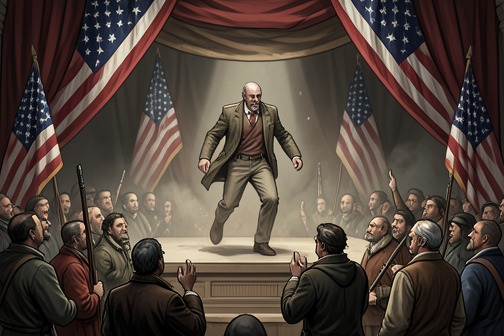
The [Escuela Amigo inauguration](entity:event-recall-event-escuela-amigo-25d16b1a44b0) is a public ceremony for a school endowed by A. J., but its announced purpose of reforming delinquent boys gives way to a spectacle built around a provocative statue. Faculty and press gather beneath American flags as A. J. staggers onto the platform; a button, a storm of dust and drapery, and the crowd’s sharply divided reactions turn the unveiling into a comic reversal of the ceremony’s respectable frame.
## Setting and Public Occasion
[Escuela Amigo](entity:organization-recall-organization-escuela-amigo-ef4c3bbb8d4e) is described as a school for delinquent boys of Latin American origin, endowed by A. J. Its inauguration draws faculty members and press, giving the event the outward form of a civic and educational celebration. A. J. appears on a platform draped with American flags, a formal backdrop that lends his entrance the look of an official ceremony even as he staggers onto it.
The speech invoking Father Flanagan’s belief that no boy is bad gestures toward rehabilitation and public benevolence. Yet A. J. interrupts that uplifting premise almost at once by demanding the statue. The contrast establishes the scene’s governing tension: the school’s stated concern with delinquent youth is staged alongside a display designed to provoke rather than reassure.
## The Delayed Unveiling
The technician asks whether A. J. wants the statue unveiled, and A. J. responds impatiently, insisting that he should not have to unveil it in absentia. The exchange makes the ceremony’s practical delay part of its performance: the sponsor wants the central object present, visible, and under his control. The technician then has it towed into place by a Graham Hymie tractor.
A. J. presses a button, setting turbines beneath the platform in motion. Their rising whine blows the red velvet drapes from the statue; the cloth tangles around faculty members in the front row as dust and debris sweep through the spectators. When the sirens subside and the faculty disentangle themselves, the audience falls silent before the newly exposed work. The unveiling therefore arrives not as a quiet, orderly presentation but as a mechanical disturbance that physically disrupts the front row and postpones the crowd’s judgment until the statue is revealed.
## The Statue and the Crowd’s Response
The monument is made of shiny pink stone and depicts a naked boy bending over a sleeping companion, apparently intending to wake him with a flute. One hand holds the instrument; the other reaches toward a piece of cloth over the sleeper’s middle, whose shape makes the composition suggestive. Both figures wear flowers behind their ears and share expressions described as dreamy and brutal, depraved and innocent. The tableau rests on a limestone pyramid bearing the school motto, “With it and for it,” in porcelain mosaic letters of pink, blue, and gold.
Reactions from the assembled adults and boys do not settle into a single verdict. Father Gonzalez cries out in shock, the representative of Time says he cannot believe what he sees, and the Daily News dismisses the work as fruity. The boys answer with a chorus of whistles. Their contrasting responses make the statue’s public meaning part of the event: religious alarm, disbelief, journalistic mockery, and the boys’ noisy approval coexist around the same monument. Its polished material and elaborate pedestal give it the scale of a civic dedication, while its subject matter breaks with the respectable expectations created by the school setting.
## A. J.’s Closing Gesture and the Ceremony’s Reversal
After the statue is exposed, A. J. lurches forward and breaks a champagne bottle across the stone boy’s taut buttocks. He follows the gesture with the remark, “And remember, boys, that's where champagne comes from.” The act and punchline replace the decorum of a dedication with a deliberately coarse joke, bringing the sponsor’s intervention into direct contact with the monument itself.
The scene makes no account of the school’s subsequent work or of any lasting response to the statue. Its close instead fixes attention on the mismatch between institutional purpose and public performance. An inauguration intended to mark a school’s opening becomes, through machinery, startled spectators, competing reactions, and A. J.’s final gesture, a burlesque of civic ceremony in which the promised uplift is overwhelmed by spectacle and provocation.
Event 9
Republic of Hassan ergot poisoning
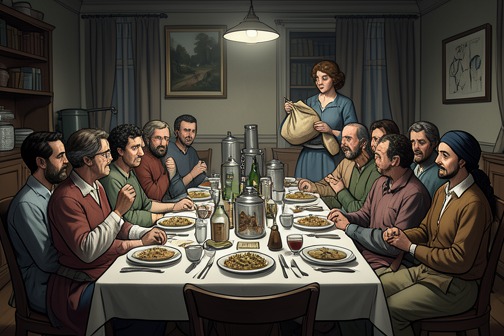
The [Republic of Hassan ergot poisoning](entity:event-recall-event-d690935dcd0c) is the catastrophe caused by [Clem and Jody](entity:character-recall-character-clem-and-jody-54e4a7a0c22e)’s sale and use of ergot-contaminated wheat. They served food made from the shipment at a banquet for a Caid, and the guests became ill and died in stages. The episode joins a concrete chain of commerce to mass death: the brothers’ account treats the wheat as a dubious bargain, while the medical explanation identifies a fungal disease capable of producing severe illness and gangrene. Its darkly comic narration does not lessen the consequences; instead, it makes the distance between the perpetrators’ excuses and the victims’ deaths part of the event’s significance.
## Background and the Wheat
Clem and Jody are implicated in the poisoning through their handling of a wheat shipment obtained in [Panama](entity:location-recall-location-panama-8575a5c7bbb8). They describe buying it from a woman who had inherited the cargo after a Finnish skipper died. Their story presents the transaction as a matter of good faith, even though their account also makes clear that they paid for the wheat with heroin. The shipment therefore enters the episode not as an openly acknowledged poison, but as a commodity passed along through a chain of unreliable claims and opportunistic exchange.
The brothers’ commercial posture is central to the account. Their discussion treats the wheat as a purchase whose quality and price can be bargained over, rather than as a substance whose safety must be established. Their casual references to its origin and sale contrast with the scale of what follows. The poisoning is not presented as an isolated accident detached from commerce: it emerges from the movement of a suspect product through dealers who are willing to accept it and put it to use.
## The Banquet and the Deaths
The wheat’s most consequential use comes at a banquet for the Caid in the [Republic of Hassan](entity:location-recall-location-republic-of-hassan-8682df0a4013). Asked whether they served couscous made from the wheat, Clem and Jody confirm that they did. Their answer shifts the account from a questionable shipment to a specific public event: the contaminated food was served to citizens gathered at the banquet, turning the meal into the immediate setting for the poisoning.
The guests’ illness and deaths unfold over successive mornings. The account says that many began running about in distress and that most died the following morning; the remaining victims died the morning after that. This staggered outcome gives the episode a grim chronology rather than describing a single instantaneous toll. The narration’s matter-of-fact presentation makes the delayed deaths especially stark: the banquet is followed not by an immediate reckoning with the cause, but by a worsening sequence of fatalities.
Clem and Jody attempt to explain what happened through a false attribution to marijuana. They claim that the guests were affected by the drug and characterize the deaths as a consequence of indulgence in supposedly foreign vices. The explanation is undercut by the account’s later identification of the wheat as the source of the illness. Their excuse does not change the sequence of events, but it reveals how the brothers’ language converts a consequence of their own transaction into a judgment about the people who consumed the food.
## Symptoms and Medical Explanation
The reported physical consequences include the victims turning black and losing their legs. The text later explains these details through ergotism: ergot is a fungal disease that grows on bad wheat, and outbreaks of the illness historically caused severe effects. Gangrene can develop, making the legs turn black and causing them to fall off. This explanation connects the symptoms to the contaminated grain and establishes that the brothers’ marijuana story is not the account’s medical explanation for the deaths.
The explanatory note also gives the event a wider historical frame, identifying ergotism as a disease that periodically devastated parts of Europe during the [Middle Ages](entity:time-recall-time-6cc14ca39ac6) and was known as St. Anthony’s fire. The detail does not change the immediate cause of the Republic of Hassan outbreak, but it shows that the danger attached to bad wheat is neither mysterious nor without precedent. Within the episode, an old and serious food-borne hazard is carried into a modern, transnational trading world and treated by its handlers as another opportunity.
## Responsibility and Narrative Significance
The account places responsibility for the chain of harm alongside its commercial absurdity. Clem and Jody’s purchase story, the banquet, the deaths, and the explanation of ergotism form a clear causal sequence. The brothers’ talk frames the wheat as a bargain and the victims’ illness as the result of their own supposed excess; the explanatory account restores the material link between bad wheat and the victims’ symptoms. The contrast exposes the self-serving character of the brothers’ excuse without requiring a separate moral verdict from the narration.
The episode’s deadpan style is part of how it represents catastrophe. Commercial negotiation and the account of a mass poisoning occupy the same narrative register, so the distance between a deal and its human consequences becomes conspicuous. The poisoning is at once a specific event in the Republic of Hassan and an example of the book’s recurring world of adulterated goods, opportunistic trade, and official or personal explanations that obscure responsibility. Its decisive turn is from the brothers’ account of an ordinary transaction to the recognition that the wheat they sold and served caused a sequence of deaths.
Event 10
Carl Peterson’s examination
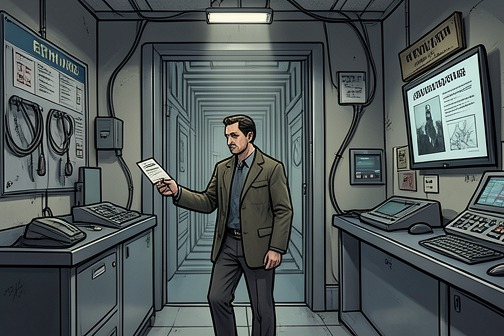
[Carl Peterson’s examination](entity:event-recall-event-505ca34abdfe) is a bureaucratic interrogation disguised as preventive medicine. At [Freeland](entity:location-recall-location-freeland-b3ded64364a3)’s [Ministry of Mental Hygiene and Prophylaxis](entity:organization-recall-organization-ministry-of-ment-aa544df5d850), [Dr. Benway](entity:character-recall-character-dr-benway-1c90c5e5e291) invokes care, scientific uncertainty, and public health to justify scrutinizing [Carl](entity:character-recall-character-carl-253c86b9cb77)’s sexuality; the routine appointment becomes a test of whether Carl will accept the state’s terms for defining him. Its significance lies in the gap between the ministry’s benevolent language and the coercive procedures that language makes possible.
## Summons and setting
Carl receives a postcard directing him to report at ten o’clock for an appointment with Dr. Benway. He suspects a mistake, but also knows that mistakes of identity are not supposed to occur. Although no penalty is attached to failing to appear, he goes: in Freeland, the state’s capacity to supply citizens’ needs makes its authority difficult to separate from its offers of assistance. The appointment therefore begins under the pressure of a system that need not issue an explicit threat to command compliance.
The Ministry’s setting reinforces that authority. Carl enters a steel-enamel labyrinth, presents his card at the information desk, and is directed to the fifth floor, Room 26. The impersonal route from reception to examination room turns an individual summons into an administrative process, while the official destination gives the encounter the appearance of ordinary institutional business.
## Care as a rationale for control
Dr. Benway begins by describing the state as a tool meant to adjust itself to individual needs. He immediately qualifies that claim with the ministry’s incomplete knowledge, then turns to sexual deviation as his example. He calls it a misfortune or sickness rather than something to censor or punish, comparing it to tuberculosis. But the distinction does little to protect Carl: the doctor argues that illness creates obligations for authorities to impose preventive measures, with hardship reduced only as far as protection of others permits.
The examination’s coercion is thus presented not as punishment but as public-health administration. Dr. Benway invokes vaccination, isolation, and compulsory treatment for people who do not report voluntarily. His hesitant, apologetic delivery softens the proposal’s surface without changing its substance. The state claims the power to classify a person as a risk and to act on that classification, while describing the resulting intervention as reasonable care.
Carl answers that the policy seems reasonable, but later asserts that he has always been interested in women and has a steady girlfriend whom he plans to marry. Dr. Benway replies that this is precisely why Carl is there. Marriage does not settle the question in the ministry’s eyes; it supplies a reason for further scrutiny, recast as a blood test before marriage. The procedure makes an intimate relationship legible to the state as evidence to be examined.
## From psychic examination to specimen
Dr. Benway explains the appointment as a kind of psychic fluoroscopic examination, adding that he expects the result to be negative for practical purposes. He does not present this reassurance as a reason to stop. Instead, he speaks of hereditary factors and social pressure, and ranges across latent and overt homosexuality, marriage, infantile environment, [schizophrenia](entity:state-recall-state-894d301b886c), cancer, and hypothalamic dysfunction. The clinical discussion runs on until Carl dozes off, leaving the doctor’s elaborate case-making more conspicuous than any clear account of what is actually being tested.
When Carl wakes, Dr. Benway names a semen-flocculation test as a diagnostic tool that may be useful as part of a larger picture. He then directs the nurse to take a specimen. The nurse leads Carl to a bare, white-walled cubicle and gives him a jar, with instructions to call when he is ready. A jar of K.Y. sits on a glass shelf. These ordinary objects mark the shift from abstract claims about public health to an intimate procedure imposed on the person under examination; Carl feels ashamed, as though his mother had laid out a handkerchief for him.
## A moving test
After the examination, Dr. Benway announces good news and produces a slip of blue paper. He calls Carl’s result negative, but names the test the Robinson-Kleiberg floculation test, although Carl had understood it to be the Blomberg-Stanlouski test. Rather than clarify the discrepancy, the doctor dismisses Carl’s correction as a misunderstanding and insists the other test is different and unnecessary. He folds the result into a file, then continues questioning him.
The examination proceeds to photographs of pin-up girls. Dr. Benway asks Carl to choose the one he would most like to make love to, has him select a photograph, and then spreads the images out to ask whether the chosen girl is among them. Carl says no. The doctor remarks that some of the supposed women are boys in drag, making the test depend on a distinction Carl cannot confidently verify. He tells Carl that he is passing the obstacle course with flying colors and asks whether the exercise seems silly. Carl admits that it does. The procedures therefore move from medical sampling to a staged test of response, without a stable explanation of how either establishes the suspicion that brought him in.
## Significance
Carl’s examination makes Freeland’s paternalism concrete. The ministry’s language turns sexuality into a possible illness, marriage into an occasion for surveillance, and a citizen’s intimate conduct into material for tests whose names and purposes remain unsettled. Dr. Benway can reassure Carl that a result is negative while continuing to probe him; a favorable result does not restore privacy or end the encounter’s scrutiny.
The scene also echoes the novel’s broader depiction of institutional methods for manufacturing or controlling identity. Dr. Benway elsewhere describes techniques that use a subject’s cover story as an identity to be reinforced through drugs and hypnosis, and procedures of sexual humiliation intended to make a subject vulnerable to control. Those accounts make the examination’s shifting tests part of a larger pattern: authority does not merely discover a pre-existing truth about a person but creates situations in which the person is classified, observed, and made to answer. Here, the administrative ritual is quieter than overt force, but its defining contradiction is the same: the state calls its intervention individualized care while reserving the power to decide what the individual is.
Event 11
The Sailor’s time-for-heroin bargain
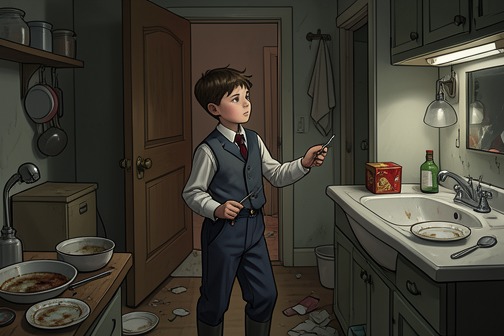
[The Sailor’s time-for-heroin bargain](entity:event-recall-event-3803711df8b5) is an encounter between the Sailor and an unnamed boy in which heroin is offered for five years of the boy’s life. The boy accepts; the Sailor then performs an uncanny bodily extraction and injects him. The scene converts the everyday economy of addiction into a literal exchange of drug for time, and its closing insistence that there is no return makes the bargain’s consequences feel irreversible even as their full extent remains mysterious.
## Setting and Approach
[The Sailor](entity:character-recall-character-the-sailor-5f56fabfde0c) lets the boy into an empty room by manipulating the door and its inside bolt. The room has not been aired since the Exterminator treated it for coke bugs, and the Sailor apologizes for its condition. Rather than presenting the transaction in a neutral marketplace, the scene places it in a sealed, disordered domestic space, where the Sailor’s control of the entrance and access to the drug sets the terms of their encounter.
The Sailor retrieves a package from beneath the washstand and lays out a dropper, needle, and spoon among dirty dishes. He says the Exterminator does a good job, sometimes almost too good, then produces a flat package wrapped in red-and-gold Chinese paper. The objects establish the familiar practical apparatus of a drug transaction before the offer departs from ordinary terms: this is recognizably a preparation for a dose, but the consideration demanded will be time.
## The Offer and Its Terms
The Sailor describes the heroin as pure and says that scarcely anyone is still alive, before adding that the supply is all the boy’s. When the boy asks what the Sailor wants in return, the answer is one word: time. The exchange begins with a clear disparity: the Sailor possesses the coveted drug and names a price that the boy cannot initially understand.
The Sailor describes time as something that is being consumed day by day. He proposes an arrangement in which minutes or hours might be taken from one place and exchanged for time elsewhere, then settles on the explicit price of five years each. Touching the dividing line below the boy’s nose, he says that the years will be taken right down the middle. The gesture makes the abstract division bodily and immediate, but the scene does not explain how the transfer works or precisely what the loss will mean in the boy’s life.
The boy says he does not understand, and the Sailor replies that he will understand in time. Asked whether he accepts, the boy glances at the package and agrees. His acceptance is explicit, but it is made while the promised drug is before him and the proposed cost remains obscure. The bargain therefore joins consent to an unequal distribution of knowledge: the boy says yes without grasping the Sailor’s account of time.
## The Transaction Made Physical
After the boy accepts, he feels a silent, black impact pass through his flesh. The Sailor then draws from the boy an uncanny, pulsing object described as a pink, eye-bearing egg. The extraction gives the bargain a physical sign, but the narrative does not define the object’s identity or explain whether it embodies the five years, some part of the boy, or another dimension of the exchange. Its appearance confirms that the Sailor’s offer is not merely metaphorical, while preserving the transaction’s underlying mechanism as an enigma.
The Sailor proceeds to cook and administer a shot. As he searches for a vein and injects the boy, he invokes the hymn “When the roll is called up yonder we'll be there, right?” The boy exclaims that he has never been hit like that before. The sequence makes the drug’s immediate effect legible through the boy’s response, in contrast to the much less intelligible long-term price: the heroin’s arrival is felt at once, whereas the loss of time remains difficult to comprehend.
## Irreversibility and Significance
After the injection, the boy smokes a cigarette and asks whether the Sailor is leaving. The Sailor refuses the possibility of an ordinary temporary arrangement, saying that junk is a one-way street and that the boy cannot go back. This warning shifts the scene from a deal that might be reconsidered to an irreversible threshold. The boy’s initial acceptance, the extraction, and the injection have already carried the exchange into action; the Sailor’s declaration frames that action as a point of no return.
The scene’s central reversal is that the drug is not simply bought with money or obtained through the familiar routines of supply. The Sailor asks for time, assigns a five-year price, and makes the demand physically present before delivering the dose. The boy receives an immediate effect, while the cost is stated but not fully comprehended. That imbalance connects the episode to the wider portrayal of addiction as a system organized around need and recurring exchanges, yet heightens it into a fantastic transaction in which the addict’s future becomes the commodity. The bargain ends with the Sailor’s warning, not with an explanation of the boy’s eventual fate; the exact consequences remain unresolved.
Event 12
Lee’s escape after killing Hauser and O’Brien
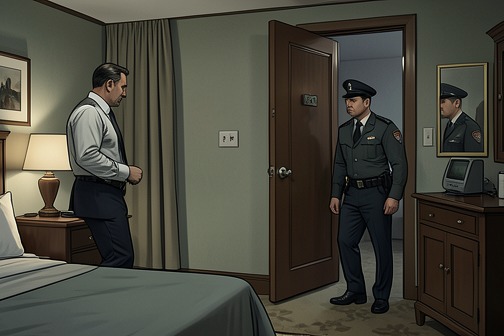
[Lee’s escape after killing Hauser and O’Brien](entity:event-recall-event-0de97f6a4300) is a turning point in which an attempted arrest becomes a fatal confrontation, then gives way to an escape that changes the terms of Lee’s existence. Told in Lee’s first-person recollection, the episode moves from a morning raid at the [Hotel Lamprey](entity:location-recall-location-hotel-lamprey-0dc914ebe5a2) to his departure from the scene and, finally, to the discovery that [Hauser](entity:character-recall-character-hauser-113ca8276b32) and [O’Brien](entity:character-recall-character-o-brien-aeb60506c6d6) no longer exist in the same present as he does. The escape is physical, but its decisive consequence is temporal: Lee understands himself as locked out of the shared space-time through which the pursuit might continue.
## The Pickup at the Hotel Lamprey
The episode opens with Lee recognizing the officers’ arrival as his last chance, though they believe they are conducting a routine pickup. Hauser had been eating breakfast when the Lieutenant assigned him and his partner to arrest [William Lee](entity:character-recall-character-william-lee-e74b61b8315b) at the Hotel Lamprey, room 606, on their way downtown. The order was deliberately narrow: pick Lee up without searching the room, but bring in all books, letters, manuscripts, and anything else printed, typed, or written. The instruction gives the encounter a documentary dimension; the officers are directed not merely to take Lee into custody but to collect his written materials.
Hauser and O’Brien have worked together on the [City Narcotic Squad](entity:organization-recall-organization-city-narcotic-sq-2f3d8949b5e4) for twenty years. Lee, who has been using heroin for sixteen years, describes them as familiar figures rather than strangers: O’Brien is the persuader, Hauser the tough one, and their contrasting methods make them resemble a vaudeville team. Hauser sometimes strikes a suspect before speaking; O’Brien offers a cigarette and works a conversational approach. Lee considers O’Brien less bad than the institution he serves, and says he does not want to kill him. But Lee sees the arrest as a threat to his only chance, so his familiarity with the pair intensifies rather than prevents the coming violence.
## The Room and the Gunfight
When the officers enter with a pass key that works even against a door locked from within, Lee is preparing his morning injection. On the table are heroin, a spike and syringe, alcohol, cotton, and a glass of water. The ordinary arrangement of the room becomes the immediate setting for the struggle: Hauser has his gun drawn, while Lee’s attention turns to the syringe, his suitcase, and the gun inside it. Hauser tells him to put on his coat; Lee asks for two seconds.
Lee uses the syringe to distract Hauser, then reaches for his suitcase and draws his gun with his left hand, although he is right-handed. Hauser fires first, but his shot hits the wall behind Lee. Lee shoots Hauser twice in the abdomen. As O’Brien reaches for the gun in his shoulder holster, Lee steadies his own wrist and shoots him in the forehead. The sequence ends not with an arrest or a negotiated surrender but with both officers dead. Lee recalls O’Brien as the man who made his first arrest, roughly fifteen years earlier; this old connection makes the killing a return to the beginning of their relationship, now reversed by Lee’s escape.
## Flight from the Hotel
Lee immediately gathers what he needs. He sweeps his notebooks into a briefcase with his drug paraphernalia and a box of shells, tucks the gun into his belt, and leaves the room while putting on his coat. As the desk clerk and bellboy pound up the stairs, he takes the self-service elevator down and crosses the empty lobby into the street. The speed of the departure matters: Lee does not remain to examine what has happened or wait for the consequences to arrive. He leaves the hotel before the staff can reach him.
The escape does not resolve his dependence or make him safe. Lee expects the authorities to cover airports, railway stations, and bus terminals, as well as the places and connections where heroin can be found. He goes to Washington Square, walks along Fourth Street, and looks for a dealer, reasoning that need will lead him to a source. His immediate objective is to obtain heroin before leaving town. The episode therefore links evasion to continued dependence: Lee’s flight from the officers leads straight back to the practical demands of addiction.
## The Pursuit and the Missing Officers
Later, Lee calls the narcotics bureau from a drugstore phone booth and asks for Hauser, then O’Brien. The person who answers says that neither officer is in the bureau. Lee insists that he has information about a large heroin shipment but will not deal with anyone else. The exchange first sounds like an obstacle in his attempt to contact the officers; in the taxi afterward, Lee interprets it as evidence that something more fundamental has happened.
He realizes that he has been occluded from space-time, and that he will never again have a Key or a Point of Intersection. The Heat is off him from then on, but this is not simply freedom from arrest: he has been relegated, together with Hauser and O’Brien, to a landlocked junk past. In that past, heroin remains available at the old price of twenty-eight dollars an ounce, and Lee imagines scoring in a Chinese laundry in Sioux Falls. He sees himself moving into the past, on the far side of the world’s mirror, while the future belongs to telepathic bureaucracies, time monopolies, control drugs, and heavy-fluid addicts.
## Retrospective Frame and Significance
Lee narrates the confrontation in the first person, beginning with his knowledge that the pickup is his last chance and then reconstructing the officers’ assignment, the room, the shooting, and his departure. The later phone call changes the meaning of the escape: the officers’ absence is not merely a gap in the bureau’s records but the sign, as Lee understands it, that he has lost access to the time and place shared by the present. The scene thus joins a concrete flight from a hotel to the book’s larger interest in dislocated chronology and the control of access to time.
The event also reverses the familiar police-and-addict relationship. Hauser and O’Brien arrive as agents of an institution that has pursued Lee, but Lee kills them before they can take him away; afterward, the officers themselves belong to the past that Lee can no longer leave. His victory is compromised by the terms in which he understands it: he has escaped this arrest, but remains bound to heroin and cut off from the temporal present. The episode’s outcome is therefore neither uncomplicated liberation nor simple capture, but an escape that strands Lee in a different order of time.