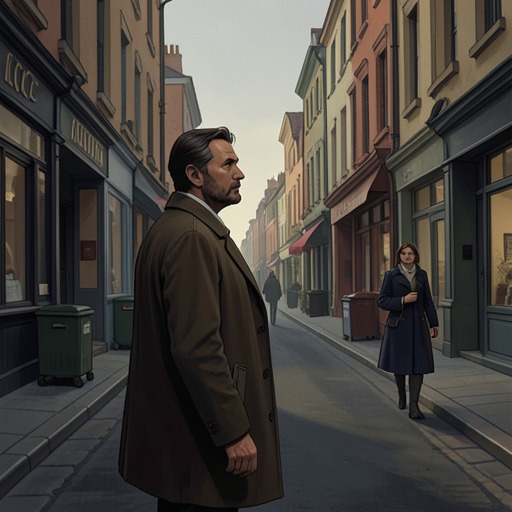
Anny’s letter summoning Roquentin
NauseaAnny’s letter summoning Antoine Roquentin is both a practical request for a meeting and a test of what survives between former lovers. After five years without hearing from Anny, Roquentin receives her brief, urgent invitation to see her at the Hotel d’Espagne in Paris on February 20. The letter revives their past, but it cannot restore it: he decides to go while admitting that his tenderness for her feels close, yet will not return as a living memory.
Arrival After Five Years
On Shrove Tuesday, as Roquentin is going downstairs, his landlady tells him that a letter has arrived. Anny’s name changes the character of the ordinary day. Roquentin has not heard from her for five years, and the envelope, sent to his old Paris address and postmarked February 1, has travelled into his life from a past he had not expected to reopen. The landlady gives him a long, thick yellow envelope; before he reads a word, its arrival has already stirred recollection and uncertainty.
The material details make the recognition intimate. Anny has kept her letter paper, Roquentin thinks, perhaps still buying it at the little stationer’s in Piccadilly. He imagines that she has also kept her familiar coiffure and heavy blonde locks, and reads this imagined continuity as austere loyalty to her own features rather than vanity or fear of age. The violet ink on the address, like the paper, seems unchanged. Even the formal address, “Monsieur Antoine Roquentin,” carries the old relationship into the present without explaining what either of them now expects from it.
The Letter and Its Delay
Roquentin does not open the envelope immediately. He carries it between his fingers and hesitates, turning the unopened message into a pause in which anticipation and apprehension coexist. The envelope’s construction gives that delay a concrete focus: its dark-green lining, decorated with gold stars, is so sumptuous and stiff that it accounts for most of the envelope’s weight. Anny’s correspondence has long seemed to him disproportionately empty. He recalls having made the same complaint repeatedly in the spring of 1924, when he struggled to draw a folded sheet from an envelope like this one. The present letter therefore arrives already shaped by a remembered pattern: elaborate enclosure, little paper, and an emotional meaning that exceeds the message’s length.
The note is written in pencil and is very short. Anny says she will be passing through Paris in a few days and asks Roquentin to come and see her at the Hotel d’Espagne on February 20. She adds “Please!” and then, above the line, writes “I beg you,” connecting it to “to see me” with a curious spiral. That handwritten addition gives the invitation a visible urgency; it does not, however, disclose why she needs to see him or what she hopes will happen when they meet. The letter establishes a place and date, but leaves the encounter’s purpose open.
An Old Pattern of Summoning
The letter recalls earlier notes Anny sent when Roquentin was in Meknes and Tangier. Sometimes he would return in the evening to find a message on his bed asking him to come at once. He would run to her; she would open the door with raised eyebrows and a surprised look, then have nothing more to tell him, sometimes seeming irritated that he had come. The remembered sequence makes the new invitation difficult to read as a simple promise of reunion. Anny has summoned him before, but the summons did not guarantee a sustained conversation or even a clear reason for his presence.
That history shapes Roquentin’s imagined possibilities after reading the note. He considers that Anny might refuse to see him, or that the hotel desk might say no one by her name is staying there. He does not believe she would arrange that particular deception, but he allows for another familiar uncertainty: she could write a week later to say she had changed her mind and propose a different time. The invitation thus revives not only intimacy but the instability of their meetings, in which an urgent request could end in disappointment or reversal.
Memory, Perfect Moments, and Consent to Meet
The prospect of seeing Anny also returns Roquentin to the relationship’s central difficulty. In their former attempts to create perfect moments, he felt that success depended on him: a moment possessed an obscure meaning that needed to be trimmed and perfected, and he believed that certain gestures and words had to be performed. Instead of mastering Anny’s improvised rites, he struggled within them and tore them apart with his strength. She hated him at those times. The recollection explains why his willingness to meet her is not simply joyful anticipation: their old intimacy carried a demand he could feel but could not fulfil.
Roquentin nevertheless says that he will go. He still respects and loves Anny with all his heart, and hopes that someone else has had better luck and skill in the game of perfect moments. His response combines enduring affection with an acknowledgement of failure. He does not claim that the past can be repaired, or that he can now give Anny what he once could not. The letter reopens contact, but his acceptance remains shadowed by their incompatible relation to the moments she tried to shape.
A Smile That Will Not Return
The envelope briefly seems to restore a particular memory: Anny smiling. Roquentin recalls that first he lost the memory of her eyes, then of her long body; he kept her smile as long as he could, but even that had disappeared three years earlier. When the landlady hands him the letter, he thinks he sees Anny smiling again. He tries to refresh the memory and feel the tenderness she inspires, believing that the feeling is near and only needs to be born. Yet the smile does not return. He is left dry and empty.
That failure gives the summons its decisive emotional force. Anny’s letter makes a meeting possible and reawakens Roquentin’s wish to see her, but the act of remembering cannot recover the intimacy it calls up. He is certain that he will go, not that he can recreate what they were. The letter therefore stands at once as an invitation and a limit: it brings the former lovers toward another encounter while showing that recollection, however vivid its paper, ink, and imagined smile, cannot by itself make the past present again.