Roquentin Decides to Move to Paris
NauseaRoquentin Decides to Move to Paris marks a practical break with the project that had kept Antoine Roquentin in Bouville: having stopped writing his book, he no longer sees a reason to stay. Yet the move is no simple escape or fresh beginning. As he prepares to leave, he doubts that one city can offer a different kind of existence from another, and his planned return to Bouville makes the departure provisional as well as decisive.
The Decision
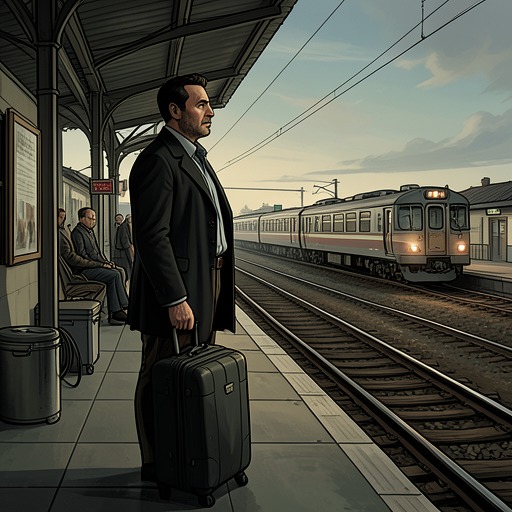
In a night entry, Roquentin sets out a concrete plan: he will take the five o'clock train, see Anny on Saturday, and expects they may spend a few days together. He intends to come back to Bouville afterward to settle his affairs and pack his trunks, with the aim of being permanently installed in Paris by March 1 at the latest. The decision therefore combines an immediate journey with an intended change of residence, but it also leaves room for a return and for practical arrangements to be completed.
The reason he gives is direct: he has no further reason to remain in Bouville because he is no longer writing his book. Relinquishing that work removes the purpose that had anchored him there. The plan to see Anny supplies a near-term destination and anticipated company, but the entry does not establish that she has agreed to a renewed relationship or that the visit will make the move successful.
Departure and Return Plans
The departure does not resolve into a settled relocation at once. After the encounter at the station, Roquentin writes that he will take the noon train back to Bouville the following day. He estimates that two days there will suffice to pack his bags and straighten out his bank accounts. He also expects the Hotel Printania to charge him for two extra weeks because he failed to give notice, and remembers that he must return the books borrowed from the library. Despite these tasks, he expects to be back in Paris before the end of the week.
These arrangements make the move tangible through its ordinary obligations: luggage, money, hotel notice, and borrowed books. They also qualify the initial declaration that he will settle in Paris. The plan is not represented as a clean break performed in a single gesture; it requires a return to the city he has decided to leave and depends on completing the affairs that still bind him to it.
Two Cities, No Guaranteed Escape
As he considers the change, Roquentin asks whether it will gain him anything. Paris and Bouville differ in their geography—one is divided by a river, the other lies beside the sea—but he sees them as alike in their underlying material character. His account turns cities into masses of stone that hold odors and carry noises through walls. The question of where to live thus opens onto a broader unease: changing surroundings may not change the condition of existence.
His image of vegetation sharpens that uncertainty. He imagines it advancing toward cities and waiting at their edges, ready to overtake them when they are dead. He says a person must remain within a living city rather than go alone into the waiting growth beyond it. Bouville, in particular, is bounded on three sides by vegetation and on the fourth by a body of dark water. Its wind drives odors out toward the sea, while plants grow between the gratings. These details make the city both a shelter from the encroaching natural world and a place whose atmosphere Roquentin finds oppressive.
The decision to move to Paris therefore does not amount to confidence in Paris as a cure. Roquentin wonders whether the change will matter, describes the cities as alike, and finally states that he is going back to Bouville. The return is part of the move's immediate logistics, but it also gives the episode its unresolved shape: he has chosen Paris as his intended home while remaining troubled by the possibility that a new city cannot free him from the unease he carries.