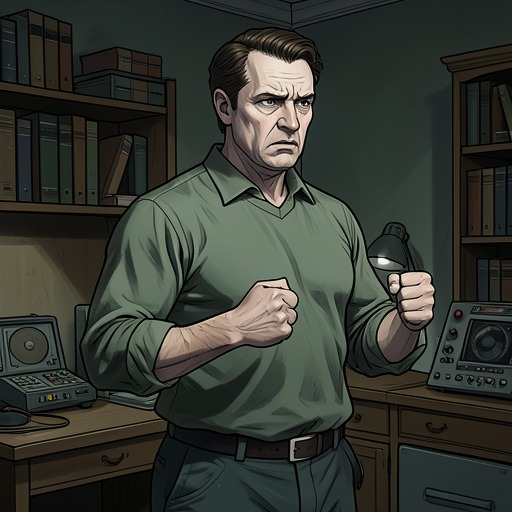
Roquentin’s failed attempt to pick up the paper
NauseaRoquentin’s failed attempt to pick up the paper is the small, physical incident that gives shape to a larger crisis of freedom and contact. On his way from the Hotel Printania to the library, he bends toward a sodden notebook page and discovers that he cannot pick it up. The paper remains on the ground; he straightens empty-handed. What might have passed as nothing becomes, in his account, the truth behind the pages he has just written: he no longer feels free to do what he wills.
The Incident and Its Delayed Admission
The episode begins not with an intention to explain himself but with a retrospective correction. Roquentin has filled ten pages while writing that nothing new has happened. He recognizes that this formulation was a lie, or at least a way of placing reason on the side of concealment. At eight-fifteen that morning, as he left the Hotel Printania for the library, he had wanted and been unable to pick up a paper lying on the ground. He had tried to shake off the meaning of this failure in the library and at the Cafe Mably, hoping that the bright light there would make it disappear. Instead, the idea stayed with him, a weight that had generated the preceding pages.
His admission also changes the terms by which he decides what counts as an event. He had withheld the incident partly from pride and awkwardness, and partly because he was unaccustomed to telling himself what happened in a way that distinguished the important from the trivial. After rereading his writing at the Cafe Mably, he rejects the pose of guarding secrets or ineffable inner states. The paper episode matters precisely because its outward scale is so slight: the difficulty lies not in narrating a dramatic occurrence but in acknowledging that an ordinary action has become impossible.
The Paper and the Expected Gesture
Picking things up is normally a source of pleasure for Roquentin. Chestnuts, old rags, and especially pieces of paper attract him; he likes closing his hand around them and sometimes feels an almost childlike impulse to carry them to his mouth. He may examine a scrap, tear it to hear its drawn-out crackle, or, if it is damp, struggle to set it alight. Afterwards he wipes the mud from his hands on a wall or tree trunk. The act is tactile and familiar, an unceremonious way of handling what other people might leave behind.
That history makes the morning’s failure more than a passing hesitation. Roquentin watches a cavalry officer’s riding boots as the officer leaves his barracks. Beside a puddle lies the paper. Roquentin expects the officer to crush it under his heel, but the man steps over both puddle and page. Roquentin approaches instead. It is a lined sheet, apparently torn from a school notebook: rain has twisted it, raised blisters across it, blurred the red margin into a pink patch, and carried the ink in places. Mud covers its lower edge. The damaged page presents exactly the kind of pulp Roquentin expects to welcome between his fingers. He bends, already anticipating its fresh, tender feel, and then cannot act.
The first record left on the page is its lesson heading, “Dictation: The White Owl.” Roquentin reads it while still bent down, then stands up with nothing in his hands. The failed pickup has no visible consequence for the paper: it remains where it is. Its consequence is a break between intention and action in Roquentin, who can formulate the familiar gesture, approach its object, and even read the words on it, but cannot complete the movement.
From Inhibition to Loss of Freedom
Roquentin gives the failure an emphatic meaning: he is no longer free and can no longer do as he wills. The statement emerges from a precise contrast between what he wants and what he can bring himself to do. Nothing in the scene indicates that the page is physically inaccessible; he has bent down close enough to read it, and the obstacle is described as his inability to pick it up. The action therefore unsettles the ordinary assumption that a simple intention is sufficient to command the body.
The incident also reframes his earlier attempts to dismiss it. The thought does not vanish when he goes to the library or the Cafe Mably, and it is not made harmless by calling it insignificant. His account moves from an apparently inconsequential event to the pressure it exerts on his understanding of agency. The paper is not merely a prop in a story about feeling powerless: the precise, thwarted gesture is what allows that feeling to take form.
Contact and the Status of Things
Roquentin connects the paper’s touch to a more general unease about objects. In ordinary life, things are supposed to remain in their place: people use them, put them back, and treat them as useful rather than alive. But Roquentin experiences them as capable of touching him, and finds that contact unbearable. He is afraid of encountering objects as if they were living beasts. His inability to close his hand on the page thus belongs to a disturbance in the assumed boundary between a person and the material things around him.
The scrap’s condition sharpens that disturbance without making it supernatural. It is waterlogged, swollen, smeared, and partly sunk into mud; Roquentin’s attention lingers on its texture and on the contact he expects to make. The paper is at once an ordinary discarded object and the focus of a bodily revulsion that defeats a habitual act. The tension is not between a clearly defined danger and a safe response, but between Roquentin’s established pleasure in handling scraps and his new fear of contact with things that seem almost animate.
Retrospective Structure and Significance
The episode reaches the reader through Roquentin’s act of rereading and revising his own account. He first writes as though there has been nothing new; only afterward does he expose that statement as a concealment of the morning’s central fact. The narrative gives the small failure an unusual double position: it has already occurred in the day, but it becomes legible as the source of the preceding pages only when Roquentin admits what he left out. His correction makes the writing itself part of the event’s aftermath.
The paper incident also recalls the earlier moment at the seashore when Roquentin held a pebble and felt a sickening sensation. He now sees that the remembered experience belongs beside the present fear of contact, linking the inability to pick up the page to a broader disturbance in his relation to material existence. The recollection does not supply a complete explanation; it identifies a recurrence. An ordinary object, approached by hand, becomes the point at which familiar habits of use and control cease to feel secure.
As a result, the episode is both slight in outward action and decisive in its account of Roquentin’s condition. A cavalry officer steps over a wet school page; Roquentin bends, reads its heading, and rises empty-handed. The difference between that modest scene and the weight he assigns it is the point: what he had been unwilling to call an event exposes a loss of confidence in his ability to act and a fear that the supposedly inert world may press back upon him.