Roquentin and the Self-Taught Man’s Lunch Debate
NauseaRoquentin and the Self-Taught Man’s Lunch Debate is a confrontation between an all-embracing humanism and Roquentin’s insistence that existence cannot be made meaningful by assigning people a common moral purpose. The lunch conversation turns the Self-Taught Man’s faith in human fellowship into a test Roquentin refuses to pass; as the exchange reaches its limit, philosophical disagreement becomes nausea, and Roquentin leaves the room. The later conversation with Anny supplies a striking parallel: her former system of privileged situations and perfect moments has also lost its authority, though the two arrive at that change through different experiences.
The Lunch and the Social Scene
Before the argument fully takes shape, Roquentin is already isolated and apprehensive about what will follow his reunion with Anny. He is due to see her in four days and regards her, for the moment, as his sole reason for living. He fears her eventual departure and knows that she would not consent to grow old before him; his need for her is sharpened by his sense of weakness and loneliness. That private dependence forms a counterpoint to the broad, impersonal fellowship the Self-Taught Man will soon defend.
Roquentin looks around the restaurant and sees its diners not as a community united by purpose but as people keeping themselves occupied. In his account, each diner treats a small task as indispensable: the commercial traveller sells Swan Toothpaste, while a young man attends to his girlfriend. Roquentin includes himself in this pattern, but claims a difference of awareness: he knows both that he exists and that the others exist. The thought of explaining existence to a distinguished white-haired diner makes him laugh until he cries, while the Self-Taught Man watches in surprise. The scene makes ordinary sociability look like a performance sustained by unexamined assumptions about usefulness.
That laughter gives way to a sharper exchange over the Self-Taught Man’s socialist commitments. He says he knows people in the Socialist section, mostly by name, but regards all men as his friends. On his morning journey to work, he imagines the other men heading to their jobs as the goal of his efforts, though they do not yet know it. Roquentin gives him outward approval but inwardly recognizes a familiar humanist posture: a declared devotion to humanity that, in Roquentin’s view, substitutes an abstract idea of people for attention to actual individuals.
Humanism and Refusal
Roquentin describes humanism as a family of competing roles. Its adherents may claim to love people as they are or as they ought to be, to save them with their consent or against it, or to cherish life in humanity or death in humanity. He sees not a unified affection but a collection of positions whose advocates dislike one another as individuals even while professing love for humankind. The Self-Taught Man, Roquentin thinks, contains these incompatible humanisms without recognizing their conflict.
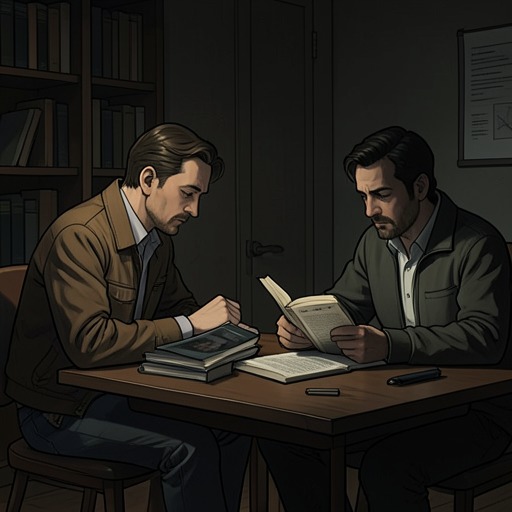
The argument becomes personal when the Self-Taught Man connects Roquentin’s writing to his research and books. Roquentin rejects that account of his purpose. The Self-Taught Man’s expression changes, as if he has detected an enemy, and Roquentin senses that something between them has died. The episode marks a shift from friendly conversation to a struggle over whether Roquentin can be given a reassuring label and absorbed into the humanist’s scheme.
Roquentin refuses both the label and its apparent opposite. In his view, calling himself an anti-humanist would still let humanism define the terms: it could turn opposition into one more stage within its own comprehensive account. He states instead that he is not a humanist. When he says that it is impossible to hate a person more than one can love one, the Self-Taught Man answers by challenging the reality of the abstractions behind such sentiments. Roquentin’s supposed concern for humanity, he argues, is directed at symbols such as Youth, the Love of Man and Woman, and the Human Voice, rather than at the particular people Roquentin would have to recognize in the street.
Nausea and Departure
The Self-Taught Man ultimately tries to restore their closeness by telling Roquentin that he loves people at heart and that they are separated only by words. Instead of reconciling them, the claim brings the conversation to a physical and emotional impasse. Roquentin cannot speak; as the Self-Taught Man smiles close to his face, he struggles to swallow bread. The expectation that he must love people provokes the return of nausea, which he had sensed approaching for more than an hour.
The episode develops from argument into an acute awareness of objects and existence. Roquentin’s hand grips the dessert knife; he drops it, picks it up again, and bends the blade against the table. The gesture does not lead to an attack. He notices that he feels capable of acting, but imagines that injuring the Self-Taught Man would only introduce another unnecessary event into a world already full of things that exist. He gets to his feet while the room spins, and the Self-Taught Man watches him.
Roquentin excuses himself as tired, thanks the Self-Taught Man for the invitation, and says goodbye to the assembled diners. They do not answer. Outside, he imagines that the restaurant’s occupants had taken him for one of themselves and now see him as an intruder who has lost the appearance of a man. The image of a crab retreating from a human room gives the departure its final estrangement: he leaves not having persuaded the group, but having broken, in their eyes, the likeness that had made him seem to belong.
Anny and the End of Privileged Moments
The later conversation with Anny provides a related account of how a person tries to give shape to exceptional experience. In her former doctrine, privileged situations were preceded by signs and entered gradually; a person then had to decide whether to turn the situation into a perfect moment. The situation was material to be worked upon, and making the moment perfect was, in Anny’s account, a duty rather than merely an aesthetic exercise. Her explanation frames exceptional experience as a demand for appropriate acts, attitudes, and words.
Anny illustrates that demand with a story about a captured king. The king does not react when he sees his chained children, but begins to grieve when a servant is led past in chains. The point, as she presents it, is that certain situations prescribe what responses are permitted: sometimes one must not cry, while ordinary pain, such as dropping a log on one’s foot, allows open complaint. Her example makes the doctrine a matter of situational judgment, not an instruction to display the same stoicism everywhere.
She then recalls the first kiss she gave Roquentin, in Kew Gardens beside the Thames. Unknown to him at the time, she was sitting on nettles, and the pain continued as she moved. She regarded the kiss as an engagement and a pact, important enough that she had to prevent the pain from entering her awareness. For more than twenty minutes, while Roquentin pleaded for the kiss she had already decided to give, she maintained that control; she says she felt nothing until they stood up. The memory reveals how completely she once subordinated bodily discomfort to the role and significance she assigned to a moment.
Anny now rejects the idea that love, hate, or death descends upon people as an independent force capable of elevating them. She sees those names as distinctions imposed upon experiences that are more alike than people suppose. Roquentin recognizes that her account approaches his own, though expressed in different words, and says they have changed together. Set beside the lunch debate, Anny’s changed outlook shows another route away from prescribed meaning: where the Self-Taught Man tries to gather individuals into a universal love, Anny and Roquentin recognize the limits of the categories once used to make particular relationships and experiences seem exceptional.