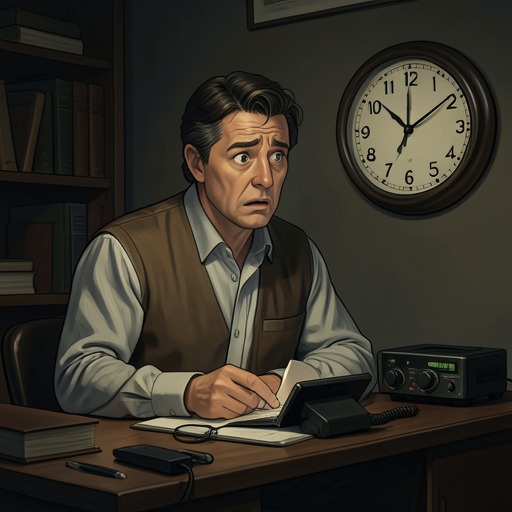
Roquentin’s nausea in the café
NauseaRoquentin’s nausea in the café is a turning point in the novel’s account of his estrangement from ordinary existence: a place he had relied on for company and light becomes another setting in which his familiar world loses its coherence. The episode reaches its reversal when the phonograph plays “Some of These Days.” As the singer’s voice completes the music, Roquentin feels the nausea disappear and his gestures acquire a new ease. The relief is real but temporary, and the record’s fragile order stands in stark contrast to the unstable time and material world around him.
The Café as a Lost Refuge
Roquentin enters the café intending to meet the patronne, but Madeleine, the waitress, tells him she is out shopping. The disappointment of finding her absent coincides with the onset of a disturbance he can no longer contain. Until then, cafés had seemed like his only refuge: they were brightly lit and occupied by other people. Now the nausea has reached even this place, and the prospect of being confined to his room leaves him with nowhere to go.
The onset is not presented as a clear explanation or a response to a single deliberate action. Roquentin hesitates at the entrance, becomes disoriented, and feels drawn into the room as its lights and colors seem to move around him. Madeleine approaches to take his overcoat; he notices her appearance without recognizing her as he normally would. His perception of the familiar waitress is briefly detached from ordinary recognition, as though even a routine encounter has become strange.
Roquentin sinks into a seat and loses his bearings. The nausea persists, accompanied by a desire to vomit, and he records that it has not left him since it began. The episode matters because it extends his condition beyond the places he had already associated with isolation: the crowded café offers no reliable protection from it.
Ordinary Objects and Unsteady Time
The café remains materially specific even as Roquentin struggles to orient himself. His glass contains yellow beer, the seat has a broken base, and he has to press his heels against the floor to keep from sliding. Nearby, people play cards at a table. He senses them before he can properly look at them, then notices a hand picking up and handling the cards. What might ordinarily register as background activity instead becomes difficult to take in as a stable, coherent scene.
Roquentin’s difficulty is not that the room has ceased to contain objects, but that their ordinary familiarity no longer makes them transparent. The broken seat imposes a small, immediate requirement on his body, while the cards and the card players’ movements resist being assembled into an effortless picture. A routine gesture stretches in his perception rather than passing cleanly into the next. The café is full of people, objects, and activity, yet their presence does not restore the human company he had expected to find there.
This unsettled perception also gives the episode its account of time. Before the music, the café’s instants seem to drag and spread rather than form a purposeful sequence. Roquentin’s attention catches on the card-playing hand, a broken seat, and the people around him; these details belong to a present that feels difficult to fill or move through. The contrast that follows is not simply between silence and sound, but between a time that seems to dissolve into repetition and the more clearly bounded duration of the record.
The Record and the Change in Experience
After calling to Madeleine, Roquentin asks her to play the record he likes, “Some of these days.” The request is a concrete attempt to change what is happening in the café. The card players might object to music while they play, so Madeleine says she will ask them. Once the phonograph starts, Roquentin recognizes the melody. He recalls hearing American soldiers whistle it in La Rochelle in 1917, and identifies the recording as the oldest in the collection, a Pathé record for sapphire needle.
The music’s effect depends on its formal order. At first Roquentin attends to its successive notes: each arrives, presses forward, and is gone. He recognizes that he cannot preserve one note by stopping it; detached from the movement that carries it, it would lose the quality it had in the music. Instead, the notes’ rapid succession forms a progression that he must let continue. The record’s ordered movement offers a contrast to the café’s difficult present, though it remains dependent on a working phonograph and can be interrupted.
As the music proceeds toward the singer’s entrance, Roquentin anticipates it as the point for which the preceding notes have prepared. The performance’s apparent necessity is also fragile: a broken spring or an interruption could stop it. That combination of inevitability and vulnerability makes the music’s completion moving to him. When the final chord dies away, the brief silence confirms that an event has taken place: the nausea has disappeared.
The change is physical as well as perceptual. Roquentin feels his body become hard and his gestures alter; reaching toward the beer glass seems to move in time with the song rather than as an awkward, isolated action. The music appears to fill the room and hold its ordinary time at a distance. The glass, which had belonged to the café’s unsettled material surroundings, now looks dense and important enough for him to want to lift it. He experiences a brief happiness, but the relief comes through the music’s duration, not through any lasting repair to the café or its objects.
Meaning and Limits of the Reprieve
The café episode sets two kinds of duration against each other. The record has a beginning, progression, and ending, while the surrounding time feels diffuse and difficult to inhabit. Its sequence gives each note a place in a movement that will carry it away; the apparent order depends on accepting that no individual note can be kept without changing it. The music therefore does not abolish transience. It makes transience legible as a form.
That form also depends on material conditions. The performance can continue only so long as the phonograph plays the record; a broken spring could bring it to an end. The same fragility that threatens the music sharpens Roquentin’s attention to its passage and completion. The instrument and recording are not merely background to his change: their ordered, vulnerable performance determines the shape and duration of his relief.
The episode’s reversal is decisive but limited. The nausea vanishes as the voice is heard and the final chord passes, and Roquentin feels happy while reaching for the glass. The evidence does not show the café becoming permanently safe or the nausea being cured. Instead, the music provides a temporary counter-experience: for the length of the performance, Roquentin’s body and gestures seem to belong to an order distinct from the unsettled time he had been enduring. The return of the surrounding café after the song leaves that reprieve bounded, not absolute.