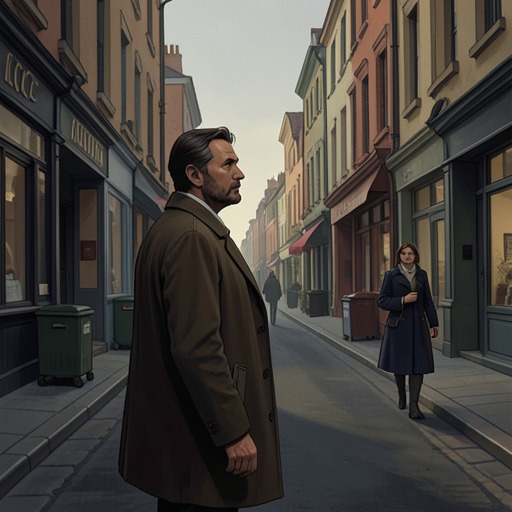
Roquentin Reunites with Anny
NauseaAntoine Roquentin Reunites with Anny is the long-awaited meeting between former lovers, but its decisive turn is not a romantic renewal: it is their discovery that they have changed in parallel without becoming close again. In Anny’s room, Roquentin hears that her former doctrine of “perfect moments” has ended and recognizes in her account an echo of his own thoughts about existence. Their intellectual affinity opens a brief space of tenderness, then exposes the relationship’s irreparable distance. After four years apart, the meeting ends with Anny asking him to leave because she is expecting someone.
Arrival and Recognition
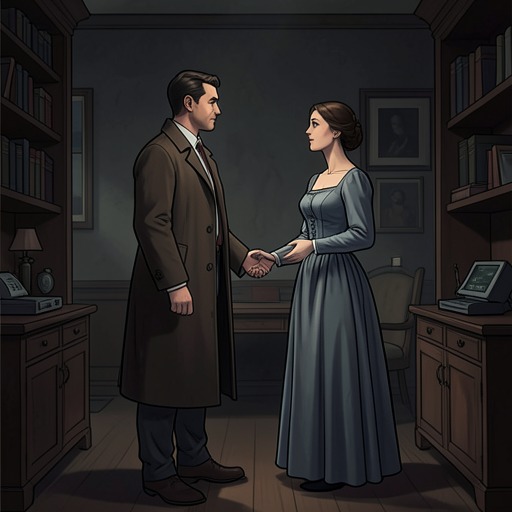
The reunion follows Roquentin’s anticipation at the Railwaymen's Rendezvous, where his train is due to leave in twenty minutes and the gramophone accompanies his feeling of adventure. On Saturday, Anny opens the door wearing a long black dress. She does not offer her hand or say hello; instead, she quickly gets through the formalities and tells him to sit anywhere except in the armchair near the window. Her manner is sullen and guarded, yet unmistakable to him: it is really Anny, with the morose expression he remembers from her adolescence.
Time has also made their former image of one another impossible to recover. Anny is no longer the little girl Roquentin recalls; she has grown heavier and looks tired. Those visible changes do not explain what she means when she suddenly tells him that she has changed. She pours tea and waits for him to answer in the way she expects, leaving him to wonder whether her appearance is what she meant. The delay makes their renewed intimacy tentative: even before their disclosures begin, each has to guess what the other is ready to say.
The End of the Perfect Moments
Anny’s most consequential disclosure is that there are no more perfect moments. The phrase reaches back to the method by which she once interpreted exceptional circumstances. She explains that, as a child, she loved the illustrations in Michelet’s books: each picture occupied a page, seemed rare and grand, and depicted a scene whose corresponding historical episode might appear much later in the text. Their selection suggested that certain events possessed a special importance.
Anny called such events privileged situations. A few illustrations could elevate the deaths, assassinations, or royal entries they depicted above other episodes, even when those others offered greater visual or historical interest. For her, the image’s grandeur lay not in accurate drawing—the figures’ arms and legs were often badly attached—but in the apparent importance conferred by the scene and its framing. The pictures gave her a model for separating exceptional moments from the undifferentiated flow around them.
That model became a demand placed on experience. A person had first to be plunged into something exceptional and feel able to put it in order; only when all the necessary conditions were realized could the moment become perfect. Anny calls this not simply a work of art but a duty: privileged situations had to be transformed into perfect moments. Her changed outlook therefore involves more than losing a taste for dramatic scenes. She has relinquished the moral rule that required her to organize experience into exceptional, meaningful form.
A Shared Change, Not a Restored Bond
Roquentin responds by telling Anny that he is pleased they have changed together and in the same way. He prefers this recognition to seeing her move ever farther away while he remains fixed as a marker of her point of departure. He says that what she has just told him resembles what he came to tell her, though in different words, and that they have met at the point of arrival. For a moment, shared understanding appears to reverse the separation that has defined their years apart.
Anny does not simply accept that interpretation. She says it would have been more convenient if he had not changed, and that it displeases her to discover someone thinking the same things she does. She also suspects that he may be mistaken. The scene gives her account and his equal weight without making them interchangeable: Roquentin welcomes their likeness as a consolation, while Anny resists the comfort he would draw from it.
He nevertheless tells her about his adventures and his thoughts on existence, perhaps at too great a length. Anny listens closely, eyes wide and eyebrows raised, but attentive listening does not amount to agreement. Roquentin cannot convince her and only irritates her; he falls silent, wanting to take her in his arms. Their exchange thus moves between intellectual closeness and physical desire without resolving either into a renewed relationship.
The Limits of Recognition
Anny asks what a person can do after thinking through all that Roquentin has described. He bows his head. She then repeats the bleak conclusion that she outlives herself. The exchange exposes a limit in their newly recognized affinity: a changed understanding may name their condition, but neither can turn that understanding into a shared course of action or a return to their former life.
As evening comes on, Anny’s pale face grows difficult to make out and her black dress blends into the room’s shadow. Roquentin mechanically lifts his cup and drinks the cold tea; he wants to smoke but does not dare. The small, suspended gestures accompany his realization that they have nothing more to say. Only the previous day he had questions about the places she had visited, the people she had met, and the men who might have courted or loved her. Now that history no longer draws his curiosity: he feels it mattered only insofar as Anny had given it her whole heart, whereas she had, at bottom, been indifferent to it.
Their meeting closes on the plain fact that four years have passed and they have nothing more to say to each other. Anny abruptly tells Roquentin to leave because she is expecting someone. The encounter has delivered recognition without reunion in the fuller sense: they can perceive a likeness in their changed ideas, but the discovery does not restore desire, curiosity, or a common future. Its arc runs from Roquentin’s expectation of adventure through temporary intellectual convergence to a separation made explicit at Anny’s door.