Roquentin’s apparent Sunday adventure
NauseaRoquentin’s apparent Sunday adventure is a moment when an uneventful walk through Bouville seems to become a novelistic quest, complete with a summons, a threshold, a choice, and a destination. Its decisive turn is also its undoing: nothing extraordinary happens, but Roquentin briefly experiences the scattered hours as a story that has been leading toward him. When the feeling vanishes, its afterimage is not fulfilment but regret—and a sharper awareness of how much he longs for adventure.
An Ordinary Walk Takes on the Shape of an Adventure
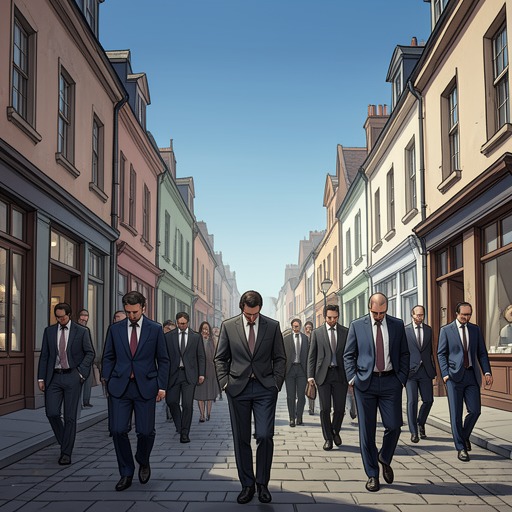
As Sunday evening closes in, Roquentin feels his heart swell with adventure. The change is less a change in the street than a transformation in his sense of being there: everything remains as it was, yet seems different, and he imagines himself as the hero of a novel. For a moment, the familiar distinction between an ordinary day and an eventful life appears to have collapsed. He is no longer simply walking home; he feels that he is present at the beginning of a plot.
The streets lend this expectation its physical signs. At the corner of Rue Basse-de-Vieille, a milestone that first looked black grows whiter with each stride. Roquentin treats its gradual emergence as a promise: once it is fully clear, he will stop beside it and the adventure will begin. He advances despite briefly wanting to turn back, touches the stone, and reaches the shadow of Sainte-Cecile, its windows glowing. The act is small, but his attention makes it a threshold crossing: the object seems to announce a change that the world itself does not confirm.
That mismatch governs the scene. Roquentin waits, heart beating, and searches the empty square. He sees nothing. Rather than accept the absence as an ending, he revises the imagined route: Rue Basse-de-Vieille, he decides, was only a stage; the awaited event must lie at the end of Place Ducoton. Adventure persists by moving its destination ahead of him. The walk gains suspense not from any external danger or encounter but from Roquentin’s conviction that an encounter is due.
The Unchosen Route and the Waiting Place
At Passage Gillet, the expectation divides. Roquentin wonders whether someone is waiting at the end of the passage, while also feeling that something at Place Ducoton needs him in order to come to life. He cannot pursue both possibilities. He chooses the latter and relinquishes the passage, imagining that he will never know what might have been reserved for him there. The decision gives the walk a moment of genuine irreversibility: even without discovering a concrete opportunity, he experiences himself as having surrendered one possible story for another.
Yet Place Ducoton is empty too. Roquentin asks himself whether anything will really happen and admits that he does not know what to do. He drifts toward the lights of Café Mably and looks through its large, steamed windows, unsure whether to enter. The sequence keeps offering the appearance of a decisive destination, then withholding the event that would justify it. A street corner becomes a milestone, a square becomes a stage, and the café window becomes the frame of a possible revelation.
The Face at Café Mably
The café is full, its air blue with cigarette smoke and steam rising from damp clothes. Roquentin recognizes the red-haired cashier behind her counter and notices her melancholy smile and apparent stomach trouble. His description turns her into an image of quiet bodily decay; the encounter is filtered through the same heightened, unsettling perception that marks his experience of existence elsewhere. But in this moment he does not turn away. He suddenly feels that she is the person for whom he has been waiting.
Nothing in the cashier’s behavior establishes that she has been expecting him. The significance belongs to Roquentin’s perception: from the far end of the café, her face seems to return something that can link the scattered moments of Sunday and solder them together. He has spent the day, he thinks, only to end here, looking through the window at her face against the red curtain. The ordinary scene acquires the unity he had been seeking in the streets—not because the cashier explains or resolves anything, but because Roquentin experiences her as the point toward which the day has converged.
That feeling culminates in a strikingly static tableau. The wide window, the heavy air, the cashier’s face, and Roquentin himself seem to form a complete whole, and he is happy. The episode’s apparent reward is not action, possession, or a disclosed relationship, but a brief sense that the separate pieces of the day belong together. The café supplies a destination only while Roquentin can see it through the charged frame of the window; the stillness of the image is part of its completion.
The Spell Breaks
The happiness does not last. By the time Roquentin finds himself again on Boulevard de la Redoute, the feeling of adventure is gone and bitter regret remains. He reflects that perhaps nothing in the world matters to him as much as this feeling, yet it comes when it pleases and disappears quickly. Its brief visit leaves him empty and raises the possibility that it has come only to show him that he has wasted his life. The scene therefore reverses its own apparent fulfilment: the adventure that seemed to begin in the street ends as evidence of how little control he has over the experience he desires.
Behind him, the town’s Sunday disperses into the end of the day. The episode closes not with a newly established mission or consequence in the outside world, but with the dissolving of the social occasion around him and the loss of his private narrative spell. The walk has not become an adventure in the sense of a consequential external journey. It has become one in Roquentin’s momentary interpretation, then ceased to be one when that interpretation could no longer hold.
Narrative Significance
The episode dramatizes the difference between living through events and arranging them into a story. While the feeling lasts, Roquentin reads places as stages, an object as a sign, and a familiar cashier as the awaited destination; these meanings make the day cohere. Their force is real as an experience, but the streets and café do not confirm the plot he senses in them. The gap between expectation and ordinary circumstance is the event’s central movement.
The episode also makes adventure both a source of happiness and a measure of absence. Roquentin briefly feels like a novel’s hero, and the image of the day joining into a whole offers relief from its apparent disorder. Once that structure falls away, however, he is left not with the satisfaction of having lived an adventure but with regret for its brevity and for his dependence on its arrival. The false adventure matters precisely because it is not sustained: it reveals the hunger for narrative meaning, and the emptiness that returns when a passing feeling can no longer make the day seem destined.