Roquentin's preparations to leave Bouville for Paris
NauseaRoquentin's preparations to leave Bouville for Paris form the novel’s closing movement from estrangement toward a provisional purpose. As the train’s departure draws near, the city has already become indifferent to him: its streets and buildings remain in place, but the familiar meanings that once made them seem homely or intelligible have fallen away. He is leaving Bouville, yet the deeper change is that he no longer belongs to the city—or, for the moment, to any city at all.
The city becomes unfamiliar
In the grey light of sunset, Roquentin crosses the park for the first time and walks along Rue Boulibet. He knows its name but no longer recognizes the street as the place he has habitually experienced. Its uneven, tarred surface and rows of solid three-storey houses had once seemed like a country road oddly misplaced in a commercial port; now the houses are simply buildings, stripped of their rural character. The change does not require the city to disappear. What has disappeared is the familiar way of seeing it.
The park undergoes the same alteration. Its plants and grass plots, and the Olivier Masqueret Fountain, seem stubbornly present precisely because they no longer express anything to him. Roquentin understands this estrangement as abandonment: Bouville has begun to leave him before he has physically left it. The city appears to have tidied itself for new arrivals, while he remains in it for the last hours as someone already forgotten. He savours the sensation of standing between two cities, one that knows nothing of him and another that no longer knows him.
That sense of separation connects his departure to the broader disturbance in his perception of things. Earlier, when he bent to pick up a rain-soaked school notebook page beside a puddle, his familiar pleasure in handling discarded paper abruptly failed: he could not make himself touch it. The page’s swollen, blistered surface and smeared red margin remained visible, but the ordinary freedom to reach for it was gone. He concluded that he was no longer free to do whatever he wished, and that objects seemed to touch him with an unbearable, almost living presence.
Existence without familiar names
The page episode recalls Roquentin’s earlier encounter with the pebble at the seashore. He describes the feeling as a sweetish sickness passing from stone to hand, a nausea located in the hands. In both cases, a commonplace object ceases to be merely useful or inert: physical contact makes its existence pressing, while the familiar distinction between a person who acts and a thing that is handled becomes unstable.
This disturbance returns in the tram. Roquentin leans a hand on the red-plush seat, then pulls it away because the seat exists. He can identify its intended construction—leather, springs and cloth made to serve as a place to sit—and tries the name as though naming might restore command over the thing. But the word remains on his lips rather than settling onto the object. The seat’s plush becomes, in his perception, a mass of little dead paws and an immense, swollen belly; it might as well be a dead donkey floating belly-up in a river. Such images do not turn the seat into an actual animal. They reveal how inadequate the ordinary name feels when the thing’s brute presence breaks through its practical identity.
In the park, the loss of familiar reference reaches its clearest formulation. Facing the chestnut root beneath his bench, Roquentin can no longer remember it as a root in the ordinary, stabilizing sense. Words, significance and practical uses fall away. He recalls that he had once treated existence as an empty category added to things, while seeing the world as scenery and objects as tools whose resistance could be anticipated. Now existence is no longer an abstraction: it appears as the very substance of things, while their individuality and familiar identities seem like a thin veneer over disorderly, naked masses. The episode gives the departure its philosophical weight. Roquentin is not simply tired of Bouville; he has experienced the world’s presence without the reassuring framework of conventional meanings.
Farewell and practical arrangements
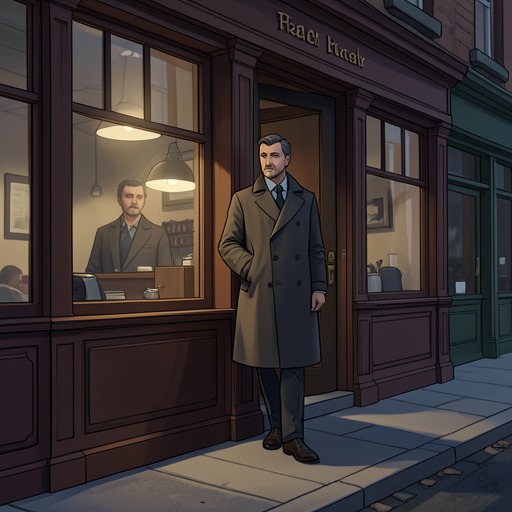
Roquentin visits the patronne to say goodbye. When she asks whether he is leaving, he tells her he is going to Paris and needs a change; she calls him lucky. His brief explanation makes the move sound practical, but the scene also registers how sharply intimacy has receded. Looking at the patronne, he can no longer imagine her body as he had the day before beneath her black wool dress. The clothing seems impenetrable, and the body he had felt able to picture belongs to him no longer. His imminent departure is accompanied by a failure of possession and familiarity even in a personal relationship.
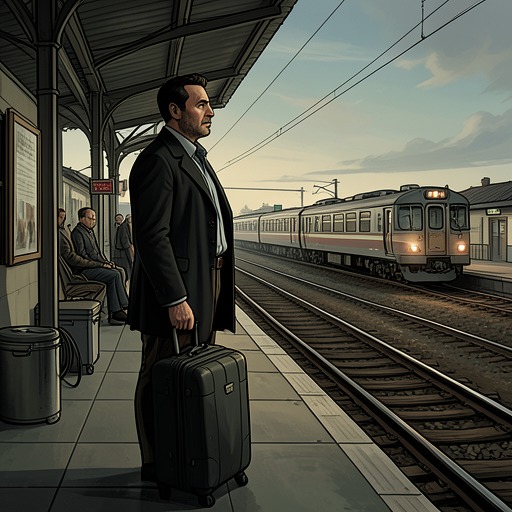
The final timetable gives the farewell concrete urgency. The train will leave in three-quarters of an hour. Roquentin counts his money and works out how he might manage on twelve hundred francs a month: a room costing three hundred francs, fifteen francs a day for food, and four hundred and fifty francs left for incidentals, laundry and films. He expects his two clean suits to last three or four years if cared for, and sees no immediate need for new clothes or underwear. The careful arithmetic does not resolve what his move will mean, but it makes clear that Paris is not merely an imagined refuge: he is preparing to live there on a finite budget, with the belongings he already has.
The possibility carried out of Bouville
Before leaving, Roquentin returns in thought to the music that has accompanied his reflections. He wonders about the person who wrote the tune during a July heat wave, imagining without claiming to know the composer’s life: perhaps there were bills to pay and a woman who did not love him as he wished. The music makes the composer’s suffering and sweat seem moving, not because Roquentin discovers a personal bond or a humanitarian lesson, but because the suffering has taken a form that can be heard again. He envies the man who made it, and hesitates before leaving because he wants to hear the singer once more.
As the Negress sings, Roquentin feels that the musician and singer have, in some sense, been saved. Their existence has not been erased; rather, the song gives it a form he can contemplate without being overwhelmed by the raw contingency he has confronted in the notebook page, the seat and the chestnut root. He is careful not to turn this into certainty that existence can be justified. The feeling arrives instead as a small joy, like warmth reaching someone frozen from a journey through snow. The song offers no settled answer and no promise that Paris will transform his life. It leaves him with the tentative possibility that making or hearing a work of art can give existence a shape beyond the immediate fact of being there.
The departure therefore closes one phase without presenting a triumphant escape. Bouville has become a place that no longer recognizes him, and his plans for Paris are modestly practical. Yet the contrast between nameless things and the composed music points toward a new course: Roquentin can leave carrying neither a restored sense of belonging nor a definitive philosophy, but a reason to consider how a life might be given form.