Self-Taught Man's expulsion from the library
NauseaThe Self-Taught Man’s expulsion from the library is the culmination of a scene in which quiet observation gives way to exposure, accusation, and physical force. Two schoolboys’ concealed actions draw the Corsican librarian’s attention to the Self-Taught Man; the librarian’s threats and assault then end the man’s years-long access to the library. The narrator watches the confrontation unfold and, afterward, accompanies him away from the reading room.
Setting and Build-up
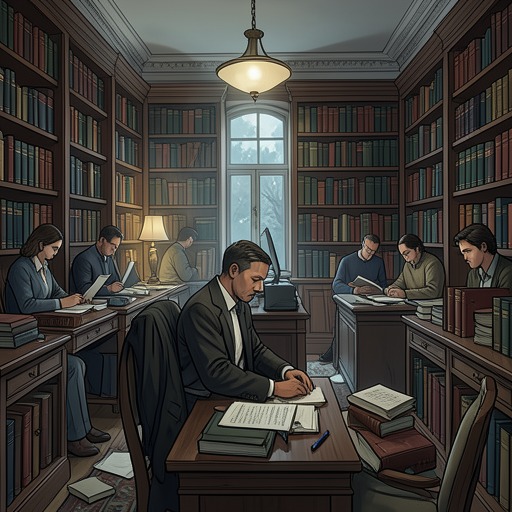
The confrontation develops inside the library’s apparently orderly reading room. Two boys come in with their satchels and settle by the stove. The younger, brown-haired boy and his larger companion choose dictionaries and sit beside the Self-Taught Man, who is absorbed in his reading. Their manner seems casual, but the narrator senses that something unpleasant is about to happen. Around them, other readers remain bent over books, lending the room an appearance of studious calm that the narrator experiences as a performance.
The boys’ quiet interaction gradually unsettles that calm. The brown-haired boy appears deferential and interested in the Self-Taught Man’s conversation, while the blond boy listens and laughs silently. The younger boy then pinches his companion without the Self-Taught Man noticing. The larger boy reacts in surprise, while the brown-haired boy keeps his composed expression. The narrator believes there is still time to prevent an impending incident, but cannot identify what intervention would help. He considers approaching the Self-Taught Man, then loses the chance when the man catches his eye and stops speaking.
The Librarian’s Intervention
The narrator notices the brown-haired boy’s hand moving out of sight beneath the table and then returning to it. The Self-Taught Man, apparently unaware of the situation around him, closes his eyes and smiles. The boys’ expressions change; the narrator tries to attract the Self-Taught Man’s attention, but the Corsican librarian has already come up behind his chair. The boys leave in alarm as the librarian begins shouting.
The Corsican accuses the Self-Taught Man of having concealed misconduct behind his requests to read and threatens to write to his employer, Chuil-lier, as well as invoke the courts. The threats bring institutional authority into the confrontation: the librarian claims knowledge of the man’s name, address, and workplace, and presents his access to the collection as something he can revoke and turn into a public accusation. The Self-Taught Man answers that he has been coming to the library for years, but the librarian does not accept this appeal to his history as a reader.
Assault and Expulsion
The confrontation briefly falters. The Corsican hesitates; an assistant librarian asks what is happening, and a woman in the reading room comments that the Self-Taught Man continues reading. The Corsican then raises his fist. The Self-Taught Man tells him that he will report an assault and leave voluntarily, but the warning does not stop the librarian. The Corsican strikes him, and the narrator rises too late to intervene. The blow is followed by another, after which the Self-Taught Man tries to attend to himself and find his package.
The librarian’s command makes the expulsion explicit: he orders the Self-Taught Man to leave and never return, threatening to call the police if he comes back. The man’s reply, that he has been a library visitor for years, has not protected him. Instead, the Corsican’s final order converts a public accusation into a lasting exclusion from the place where the Self-Taught Man has pursued his reading.
Aftermath and Significance
The narrator catches up with the Self-Taught Man at the foot of the stairs. Embarrassed and unsure what to say, he offers to accompany him to a drugstore. The Self-Taught Man does not answer at first. He turns to look back toward the entrance to the reading room and says that he can never return. The statement identifies the central consequence of the episode: beyond being driven out that day, he has lost the library as a place to which he had come for years.
The episode sets the Self-Taught Man’s attachment to reading against the librarian’s power to police who may use the institution and on what terms. The threatened letter to Chuil-lier and the mention of the courts extend that power beyond the library, while the physical expulsion enforces it inside the reading room. The narrator’s hesitation is part of the scene’s moral structure: he sees the danger approaching, considers intervening, and acts only after the assault. His eventual offer of help cannot reverse the expulsion. The scene closes not with a restored order but with the Self-Taught Man looking back at a place he believes is permanently closed to him.