Nightbitch
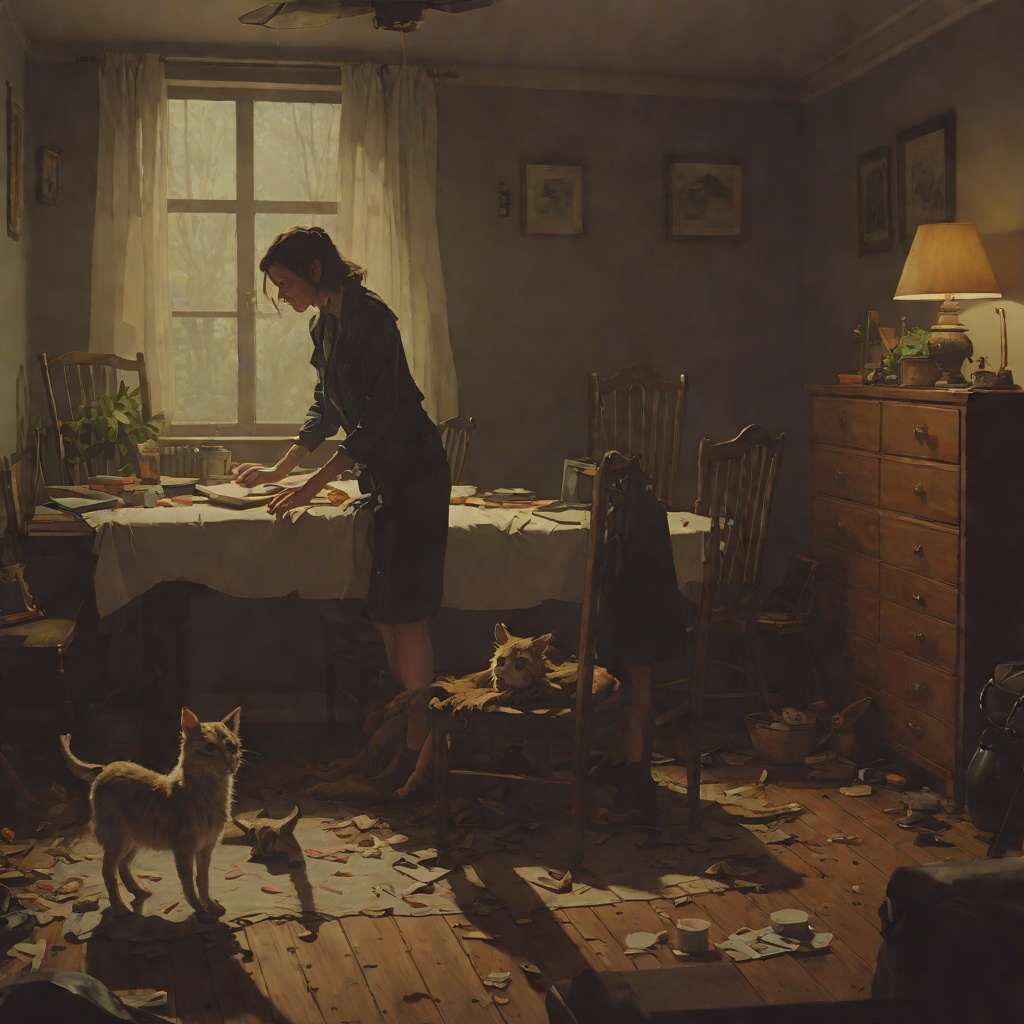
NightbitchNightbitch is the unnamed protagonist of the novel, a woman who was once an artist and who, at the story's opening, is a stay-at-home mother to a young son, married to a frequently absent engineer referred to only as The Husband. Her transformation from a self-deprecating mother into a literal dog is the novel's central conceit, a fantastical vehicle for exploring the real, unspoken rage and erasure experienced by women in motherhood. She is not merely a character who turns into a dog; she is a figure through which the novel interrogates the very structures of society, adulthood, marriage, and motherhood, which she comes to see as "masterfully designed to put a woman in her place and keep her there." Her journey is one of radical reclamation, moving from a state of quiet desperation and self-mockery to one of monstrous, instinctual freedom, and finally to a new, integrated understanding of herself as both mother and animal, artist and beast.
Identity and the Birth of Nightbitch
The name "Nightbitch" originates as a joke. When her husband returns from a weeklong work trip and comments that she had been "kind of…a bitch" the night before, she responds without pause, "Night bitch, I am Nightbitch." At first, she means it as a good-natured, self-deprecating joke, a way of being a good sport about her own nighttime irritability. However, in the days following this naming, she discovers a patch of coarse black hair sprouting from the base of her neck, and her casual joke becomes a horrifying reality. She tells her husband, "I think I'm turning into a dog," but he only laughs, a reaction that confirms her fear that he will never take her seriously. This moment marks the beginning of her physical transformation, but it also reveals a deeper truth: that the anger and bitterness she displayed that night were not aberrations but a latent part of her, "not even that far below the surface." The novel states that "ONE DAY, THE MOTHER was a mother, but then, one night, she was quite suddenly something else," emphasizing that this change is not gradual but a sudden, violent rupture in her identity. Her transformation is set against the backdrop of her husband's twenty-second weeklong absence that year, a year in which only twenty-four weeks had passed, and her son's ear infection, which had left him sleeping only in fitful bouts. These details establish the context of her exhaustion and isolation, the soil in which her metamorphosis takes root.
The Weight of Motherhood and the Conspiracy of Society
Before her transformation, Nightbitch was the picture of a self-sacrificing, domestic mother, un-gripey and un-grumpy, even after sleepless nights. But this facade hides a profound rage. She becomes consumed by expansive conspiracy theories, believing that society, capitalism, the patriarchy, religion, and gender roles are all part of a plot to keep women in their place. She inflates with "mother-rage" and composes elaborate, emotional arguments against these systems. Her anger is directed not only at abstract structures but also at her own parents, who live hundreds of miles to the east and with whom she has almost no contact; she holds them "responsible in some foundational way" for her current state. She also feels the sting of comparison to The Working Mother, a fellow artist from her graduate program who seems to have transitioned into motherhood seamlessly, posting milestones on social media while helping her baby with her installation. Nightbitch asks herself, "Why can't I do that? How can it be that easy?" This comparison deepens her sense of failure and inadequacy. She reflects on the societal myth that a top-notch education and a career could free a woman from the historical constraints of motherhood, only to discover that having a baby is not a departure from work but an immersion in it, an "unimaginable weight of work" that is staggering both physically and psychically. She feels that the gendered slur "night bitch" is unfair, as it doesn't account for the fact that she made a boy with her own body, nurturing his cells to her own detriment, to her own fatness, and the decline of her youthful sex appeal. She admits she cares about being hot in her own eyes, even as she recognizes this as a personal vision rather than a feminist mandate. This internal conflict—between her ambition, her biology, and her desire to be a "hot" mother—is the psychological pressure cooker that fuels her transformation.
The Transformation and the Embrace of the Animal
Nightbitch's physical transformation is a descent into pure instinct. In a pivotal scene, she is attacked by a pack of dogs in her driveway. She flails and panics, but as the dogs tear at her clothing, she undergoes a change: her ears twitch, her hair grows into a monstrous mane, and her eyes light with fire. She thinks, "you are an animal," and then stops thinking altogether, becoming "pure movement, pure darkness, a twitch and surge, the animal's first dream." This is not a violation but a liberation. She embraces the idea of being a dog because she can bark and snarl without having to justify it, run free, and be "a body and instinct and urge." She recalls the freedom she felt during childbirth, when she screamed and shat and swore and would have killed had she needed to, while her husband nearly passed out from the "noises" coming from her mouth. She decides that if she cannot be part of the world of ambition and money and careers, she wants to leave it behind entirely and recede into the wildness of her deepest dreams. She declares, "She was Nightbitch, and she was fucking amazing," feeling as though she had been waiting for this for a very, very long time. Her animal self allows her to act on her resentments, such as when she tramples the carefully planted petunias of her neighbor Stanley, a Republican who would never loan a tool and glares at her son for walking on his grass, and then takes a monstrous shit on his lawn. This act of vandalism is a release of pent-up fury against the petty tyrannies of suburban life. She also discovers a primal satisfaction in the kill, burying a dead animal in her yard as her "treasure, her prize." The novel suggests that what she needed all along was not medical attention or psychotherapy, not choosing happiness or adjusting her attitude, but "to sink her sharp teeth into something living and bloody and feel its essence drain away." One night of violence, of shitting where she pleased and being only a body in motion in the dark, was what she needed to feel whole.
The Dual Life and the Secret Self
After her first night of transformation, Nightbitch returns to her human form, but she is changed. The physical remnants—the fur, the tail, the claws—recede, leaving only a dark swath of skin on her forearm like a birthmark. Yet she still feels "the pulse and pant of the animal she had become." Her sense of smell is heightened, causing her to clean obscure corners of the kitchen to rid it of mold and onion and meat. She longs to tend to her son by licking him and biting at his feet lovingly, yowling as they play, and feeding him raw meat. She is simultaneously inside her full human-mother being, with all its usual worries and insecurities, but these are "somehow transformed." She feels she can abide the burdens of motherhood and marriage as long as she still has Nightbitch. This secret becomes a source of both power and guilt. She feels she is owed her secrets, but she also experiences profound guilt at not telling her husband about her transformation. She keeps it as a "silent and seductive memory inside her," pretending that nothing extraordinary has occurred. The novel notes the peculiarity that her husband, a man of science and reasonable explanations, does not attempt to get to the bottom of the dog he saw, and that she feels no real need to account for it. This mutual unspoken agreement suggests that even he, in some small or large way, has been bewitched, or perhaps that he is complicit in the fantasy that allows their family to function. Her secret is a form of agency, a part of herself that she refuses to share, and it is this ownership that allows her to endure.
The WereMothers and the Vision of a New Community
Nightbitch's transformation is not just a personal rebellion but a connection to a larger, mythic lineage. She reads about the WereMothers of Siberia, a community of women who live together, help each other, and are in a constant state of babies. She finds the passage enchanting, transported to their cold, clean woods. She loves the thought of having twenty other wives to live with, imagining the efficiency and friendship. For her, the idea of rejecting all established society for something remote and magical, a community suited particularly to its own needs, is enticing and exhilarating. She asks herself if being truly free is monstrous, and concludes that if it is, it is not a wrong kind of monstrous but a beautiful one, a way of being to celebrate rather than run from. This vision of a female community stands in stark contrast to her isolated life with her husband and son. It also connects to her own past, as she recalls her Appalachian upbringing and the skills she learned from her grandmother, who had a spell book and knew how to keep bees, dip candles, brush wool, and track animals through the woods. She realizes that her mother's distance and her pushing her away was not abandonment but "her mother's best love," a way of giving her the tools to survive on her own. She reflects on how many generations of women had delayed their greatness only to have time extinguish it completely, and how evil it is to praise women for giving up each and every dream. This recognition of her matrilineal inheritance grounds her transformation in a history of female knowledge and resilience.
The Final Stage and the Arrival at Wanda White
The novel's climax is Nightbitch's final performance, which is also her arrival at a mythic destination. The novel declares, "WANDA WHITE IS NOT a person. Wanda White is a place at which a person finally arrives." Nightbitch stands behind a heavy velvet curtain, smelling her own rosy musk, in "anticipatory ecstasy, just before she ascends to whatever is beyond that darkness and that stage—invincibility or air, something." She is on a stage, naked, with a pelt of hair bristling down her back. She begins the performance as she has begun every performance, by opening the space within her chest, then opening her mouth, and letting out a long, high howl that echoes throughout the room. She falls to her hands and lopes across the stage, snarling at the audience. Someone gasps, someone laughs, someone stifles a scream. Music soars, with violins swelling and trumpets heralding the beginning of something. The audience imagines a soprano singing in German on a dark lawn, barefoot, beneath a tree with wide branches in which hens roost, wearing a simple cotton farm dress. This final scene is a synthesis of all her selves: the mother, the artist, the animal, and the mythic woman. She is no longer hiding her transformation but performing it, claiming it as her art. The howl is both a scream of rage and a song of liberation, and the stage becomes the space where she finally integrates her human and animal natures. Her journey ends not with a return to normalcy but with an ascension into a new, more authentic way of being, one that is rooted in the body, in instinct, and in a profound connection to the lineage of women who came before her. She has arrived at Wanda White, a place of her own making, where she is finally, fully herself.