The Husband
NightbitchThe Husband is the unnamed engineer spouse of Nightbitch, a man whose profession and temperament place him at the center of the novel's critique of modern motherhood. He is introduced as a specialist in "quality control," a job whose precise meaning his wife cannot fully grasp, though she imagines him looking at machines to ensure they maximize efficiency, adjusting systems to hum at higher frequencies, or reading output reports and suggesting improvements. This vagueness about his work is matched by a vagueness about his presence: he is gone for a week at a time, returning for only forty-eight-hour stretches, and his absences structure the rhythm of his wife's life as much as his returns do. He is an engineer, and the novel repeatedly emphasizes that his engineering mindset—his devotion to structure, plans, and measurable outcomes—shapes how he responds to his wife's distress, always steering her toward practical solutions rather than emotional understanding.
Identity and Background
The Husband is defined first by his profession and second by his emotional limitations. He is an engineer who specializes in "quality control," a role that his wife cannot precisely define but that she understands as involving the optimization of systems and the reading of output reports. What she knows with certainty is that he has "little time for feelings," a "condescending patience for intuition," and that he scoffs openly at any talk unsupported by peer-reviewed scientific studies or statistics. Despite these traits, she insists he is a good man, a caring man, an affable man, whom she appreciates very much, despite everything. This tension—between her genuine affection for him and her growing recognition of his inadequacy—runs through every scene they share. The novel contrasts his temperament with hers: she is prone to indecision, anxiety, worry, and a sensation that her heart might explode; she runs hot and buzzes, needing either to keep busy or to lie down and sleep. Her husband, by contrast, needs nothing whatsoever. This asymmetry in emotional need becomes the foundation of their dynamic, in which her distress is perpetually deferred to his judgment, his good levelheaded judgment, his engineer's evenness.
Life and Plot Trajectory
The Husband's trajectory in the novel is one of gradual revelation, moving from a figure of benign neglect to one of astonished devotion. His first significant action is his response to his wife's confession that she thinks she is turning into a dog. When she tells him this after he arrives home from a week away for work, he laughs, and she does not. She had hoped he would not laugh, had hoped that when she said those words he would tip his head to one side and ask for clarification, that he would take her concerns seriously. But as soon as she said the words, she saw this was impossible. When she insists, showing him the coarse patch of black hair sprouting from the base of her neck, he pulls his hand back and cradles it, then holds up an unscathed finger and waggles it at her face, saying "Just kidding." He tells her pleasantly that her tooth looks the same to him, that she always thinks something is wrong with her. This dismissal is not cruel but it is complete; he simply cannot see what she sees. His advice, offered just before he leaves again at the end of his forty-eight-hour weekend, is to stop worrying about her hair growth or whatever and get on top of her week: "Structure, you know? Make a plan. Draw up a schedule. Treat it like it's your job. Happiness is a choice." She wants to say something, or maybe slap him right across his talking face, but instead she tries to take his suggestion to heart, telling herself he only wants what is best for her.
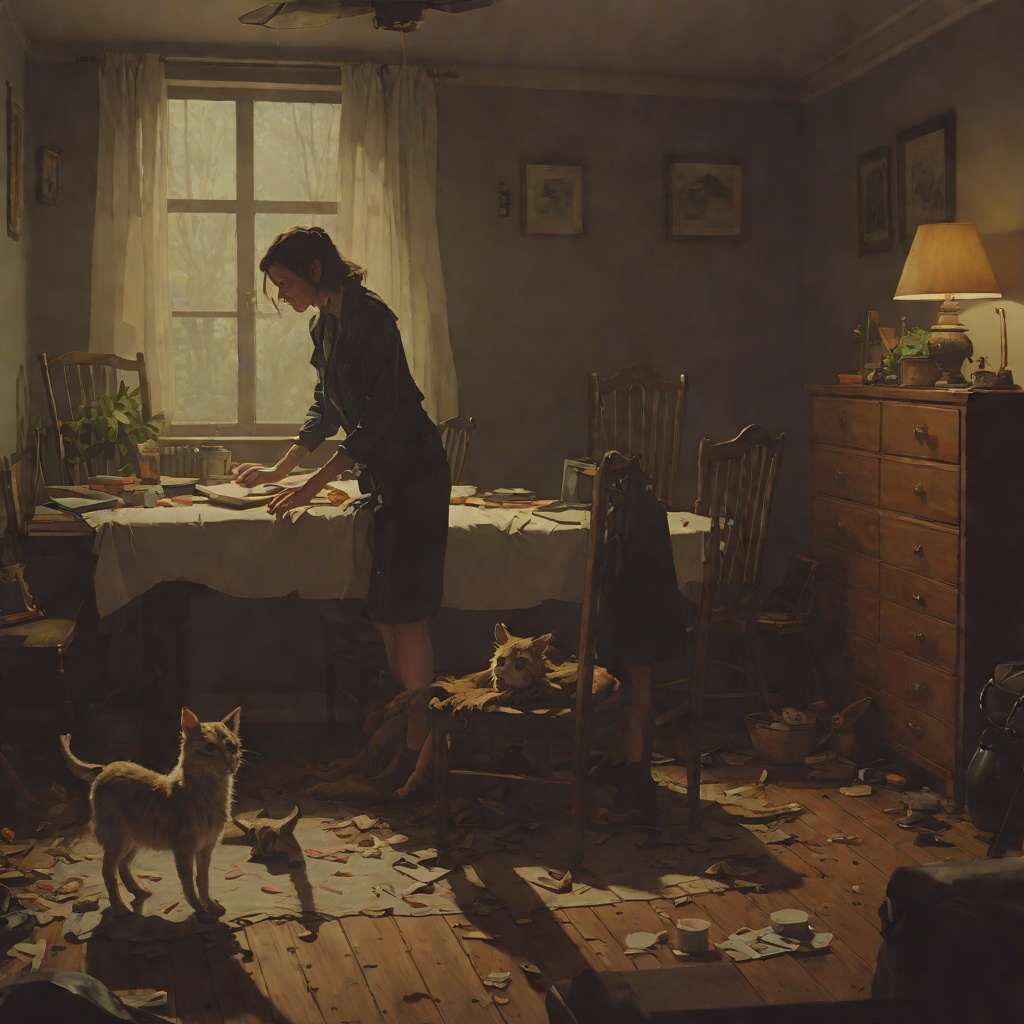
The pattern of his returns is consistent and revealing. When he arrives home, he expects a calm re-entry, some time to decompress from driving, an hour or so on his computer. If he is greeted with his wife's complaints or the boy's perturbed demeanor or a house that is a mess, it stresses him out. The mother has been indulging him for years, reminding herself again and again that he is not a bad man. During one bath scene, he asks her to put the boy's towel in the dryer to warm it, to bring in a piece of toast for the boy to eat, to fetch the boy's pajamas from his room, all while he sits on the closed lid of the toilet next to the tub, reading something on his phone. She does these things even though all week she has done them herself without even the option of help, and she reflects that it would seem petty to point this out. He is exhausted, she reminds herself, for he has just been in the car for hours, all the way from Minneapolis or Chicago, and he stayed up late that week at the hotel, reading or looking at the Internet, or simply unable to sleep because the room was too quiet or he ordered room service too late, which caused indigestion. Really, it was a challenge to be in a hotel all the time, he reports. She does night-nights after the bath because he needs to wrap up some work e-mails, even though he has had the entire week to do so. She would like to leave the house altogether and go to the coffee shop for the entire evening the moment he gets home, or shut herself in the guest room and imagine art projects or outfits or a future vacation. She wants to exit, but it would really be inconvenient for her husband, for the entire family, as he puts it, so she stays.
Key Actions and Objectives
The Husband's key actions are largely acts of omission and deflection, though they are framed by his genuine belief that he is helping. His primary objective, as he articulates it, is to help his wife manage her life more efficiently. He suggests structure, plans, schedules, treating motherhood like a job. He tells her that happiness is a choice, a phrase that becomes a kind of refrain in the novel, a hollow mantra that ignores the material conditions of her exhaustion. When she tells him she is turning into a dog, he laughs and dismisses her concern, telling her she always thinks something is wrong with herself. When she insists, he pretends to bite her and then reveals an unscathed finger, a joke that underscores his inability to take her seriously. His advice is always practical, always well-meaning, and always inadequate to the reality of her experience. He is not malicious; he is simply unable to perceive the depth of her suffering, and his solutions—make a plan, draw up a schedule—are the tools of an engineer applied to a problem that is not mechanical. His objective is to maintain the equilibrium of the household, to have a calm re-entry, to decompress from driving, to wrap up work e-mails, and he pursues this objective with a single-mindedness that his wife experiences as neglect.
Relationships and Conflict
The central relationship of the novel is the marriage between The Husband and Nightbitch, and it is defined by a profound asymmetry of perception. She sees everything; he sees almost nothing. She notices the coarse patch of black hair sprouting from the base of her neck; he tells her she always thinks something is wrong with herself. She composes elaborate, emotional arguments against the system and capitalism and the patriarchy and religion and gender roles and biology; he scoffs at talk unsupported by peer-reviewed studies. She is consumed by mother-rage, inflated with it, while he needs nothing whatsoever. The conflict is not overt; there are no screaming matches, no accusations. Instead, there is a slow, grinding erosion of her sense of self, facilitated by his cheerful obliviousness. She defers to his judgment, his good levelheaded judgment, his engineer's evenness, even as she recognizes that this deference is destroying her. She tells herself he is not a bad man, and she believes it, but the belief does not make her isolation any less complete. The novel also hints at a broader critique embedded in this dynamic: her husband, with his electronics skills and his engineering, is the one who makes all the money, even though she could make a world, and then, too, make a person to live in that world. This disparity—between his earning power and her world-making capacity—is the structural injustice that their marriage embodies.
Change and Ending
The Husband's arc culminates in a scene of transformation that recontextualizes everything that has come before. In the shower, after a moment of shared laughter and mutual transformation into dogs, he places his hands on her scratched shoulders and looks into her eyes. He says, "Your best work," and something in his face is softer and broken—an astonishment, maybe, a person he hadn't yet shown her, though they'd been together over a decade. In that face she can see that he loves her and is in awe of her, of what she has made. She sees that he had never meant for her career to be quashed, that he had always wanted for her happiness and art, and that now he sees all she has become and sees it is hers, sees that she exists as a creative force independent of him or their son but also in control of them. She sees that he would do for her whatever he could, because of his love and devotion, his near-childlike adoration of her, which had gotten lost in the ho-hum of every day after day for years and years. This revelation does not erase the years of neglect, but it transforms their meaning. The Husband was not a villain; he was a man who had lost sight of his wife, and who, in the moment of her most radical transformation, finally sees her. He laughs and laughs and laughs, and soon they are both dogs and they are in love. The scene is both a reconciliation and a re-founding of their relationship on terms that acknowledge her power.
Narrative Role and Evaluation
The Husband functions as the novel's primary foil to Nightbitch's transformation. His rationality, his devotion to schedules and statistics, his condescending patience for intuition—all of these stand in stark contrast to her embrace of the irrational, the instinctual, the animal. He represents the patriarchal order that she is rebelling against, but he does so not as a tyrant but as a well-meaning man whose kindness is itself a form of oppression. His advice to make a plan and draw up a schedule is not malicious; it is the reasonable advice of a man who cannot see that his wife's problem is not a lack of structure but an excess of it. The novel uses him to critique the ways that even good men can be complicit in the erasure of women's inner lives. His final transformation, his laughter, his declaration that her work is her best work, suggests that the possibility of change exists even within the most entrenched positions. He is not redeemed so much as revealed; the capacity for awe and devotion was always there, buried beneath the ho-hum of daily life. In this, he becomes a figure of hope, a testament to the possibility that the men who fail to see their wives might, under the right circumstances, finally learn to look.