The Cat
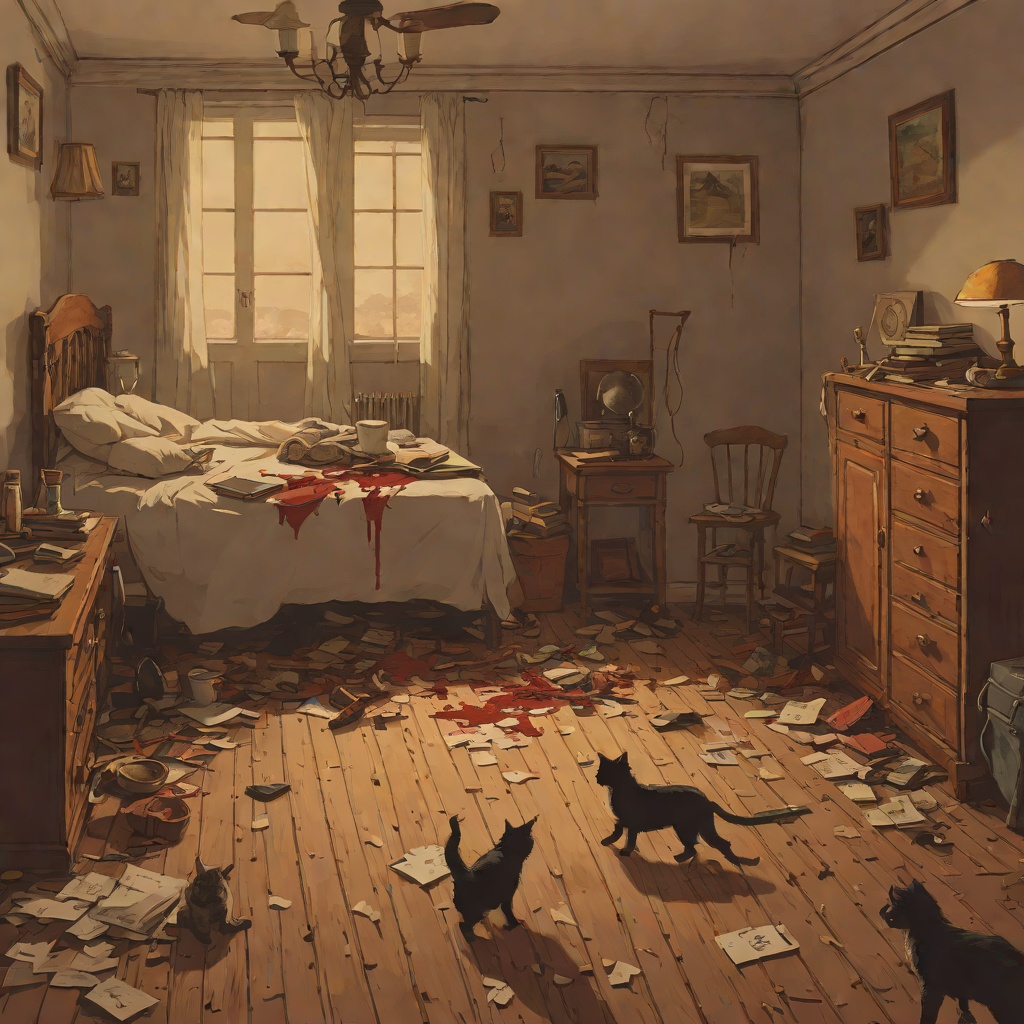
NightbitchThe Cat is the family's fat, pure-black pet, a creature of extravagant fluff and astonishing stupidity whose constant demands and perpetual underfoot presence make it a lightning rod for Nightbitch's escalating rage. Once a beloved companion from before her son's birth, the cat becomes, in the mother's transformed perception, an intolerable burden—another living thing needing to be cuddled, fed, washed, and doted over at a moment when she wants only silence and to not be touched. Its murder, a frenzied kitchen slaughter, marks the point of no return in Nightbitch's transformation, the moment her human restraint collapses entirely into animal instinct.
Identity and Early Life
The Cat was, in her prime, a beautiful creature: pure black, fluffed extravagantly, with big green owl-eyes and a tiny, high-pitched princess meow that sounded like a bell. She was, Nightbitch recalls, astoundingly beautiful and, to the same degree, astoundingly idiotic. The cat meowed frantically until someone walked over to her bowl, pointed at her food, and shook it around a bit, at which point she began to eat as if starved. She always darted in the same direction the mother was walking, then got stepped on, made a horrible noise, and rocketed off to the basement. She ate too much, became overweight, and could no longer properly clean herself, so the mother had to wash matted poop from her butt hair weekly, doing so with great disdain. The cat was prone to urinary-tract infections due to what the veterinarian called an "anomalous vulva."
Before the son arrived, Nightbitch loved the cat deeply. She had once wanted to decorate her with tiny ornaments because, while sitting, the cat took on a perfectly conical shape and resembled a Christmas tree. In her affectionate catalog of the animal's nicknames, she called her "kitty," "the fluff," "the stupid-sweet little fluffenwaffer," "the smoosh," "the rug," "her ballerina," and "her baby." The cat's fluffy paws and jingle meow were once sources of delight. The husband, too, cherished the animal, cradling the stupid thing in his arms and arguing warmly that they had all made it there together—that he, his wife, and the cat had all evolved from a single-celled organism and arrived at this moment in history together.
The Shift in Perception
Nightbitch's relationship with the cat deteriorates as her transformation begins. The fat black cat, with its unkempt fur sticking out at odd angles and big green eyes devoid of intelligence, rawls and rawls at the exact frequency that inspires homicidal rage in the mother. Adding to her premenstrual agony, the cat's persistent meowing becomes unbearable. Nightbitch admits to kicking the cat a little—mostly by accident, since the thing was always at her feet asking for more food, but also the smallest bit on purpose, just enough to loft a fount of gleeful murder-joy inside her chest. She chases the animal around the kitchen, grunting "Out out out out outoutoutout," stomping to scare it out from under the table, then grabbing its oddly rotund midsection. The cat deflates ever so little and squeaks like a toy, its tiny legs wiggling as the mother carries it to the door and propels it onto the porch.
The cat embodies everything Nightbitch has come to resent about her life. She does not want another thing needing her, needing to be cuddled, fed, washed, cooed at, and doted over. The cat's helplessness and dependence mirror the relentless demands of motherhood itself, and its constant presence at her feet becomes a physical manifestation of the weight she carries. The mother's sense that society, adulthood, marriage, and motherhood were all masterfully designed to put a woman in her place and keep her there has begun to weigh on her, and the cat, with its insatiable needs, is caught in the crossfire of this realization.
The Killing
One morning, with rotting potatoes stinking in the garbage and not a scrap of meat in the house save the horrible cat's horrible cans of food, Nightbitch's patience finally snaps. As she scoops yet another can into the cat's dish, she sniffs at it, wondering, but finds it too slimy and flaked, too altogether anonymous to excite her appetite. She watches with disgust as the cat sloppily gulps and smacks her way through the pile of unspeakable meat. After the cat finishes its second breakfast and comes to hover, weirdly and silently, just behind her feet, Nightbitch steps on it, trips, and sprawls hard on the kitchen floor, coming down hard on the cat and sending it skittering toward the living room, eyes wide and green, the ball of her body bobbing on spindly, cartoon-fast legs.
Nightbitch's knee pulses with pain, as does her haunch. Her eyes flare with silent rage as she lunges after the cat, catches her by her back legs, pulls her across the hardwood floor, and plunges a knife into her chest. The cat's green eyes widen even more, not a hint of any intelligence behind them, just dull instinct—the smallest amount of instinct required to keep such a stupid animal alive. Nightbitch jerks the knife through the soft girth of its belly, and the animal splits open like a pair of tight pants. She growls in her chest as she bends to wrap her teeth around the nape of the cat's neck, rises in blind fury, and shakes the body back and forth, the cat deflating—squeak by small, breathy squeak—with each fling, blood splattering on the white cabinets and across the worn wood floor. A loop of purple intestine slips from the wound and flips back and forth like a wet scarf. A thick warmth spreads down Nightbitch's chin and onto her chest, and in this ecstasy, she swings her head back and forth with even greater fervor, intestines and organs slapping her face and falling to the floor. She shakes harder, furiously, blood flung to every corner of the kitchen, until a sharp snap, and the body relaxes into ultimate resignation. She stops. Blood drips onto her bare feet and in between her toes. She drops the thing from her mouth into her hands and holds it there, to sniff it and nudge it with her nose, examine it with an animal curiosity, to watch it and in this strange reverie stand still inside a gripping and extraordinary chaos.
Aftermath and Significance
The killing is not an act of cruelty for its own sake but a release. Nightbitch could not have known that what she had needed all along—more than medical attention or psychotherapy, more than choosing happiness or adjusting her attitude—was to sink her sharp teeth into something living and bloody and feel its essence drain away until it was simply a rotting and unmoving thing. The murder of the cat is the first full expression of the violence that has been building in her, the moment her human self fully yields to the animal within. It is not iron deficiency or an episode, nothing "wrong" with her—just one night of violence, one night to not care what anyone thought, to shit where she pleased, to not be needed by any living thing, and to be only a body in motion in the dark.
In the aftermath, Nightbitch's grief surfaces in a strange, tender register. "Oh dear," she thinks. "Her kitty. The fluff. The stupid-sweet little fluffenwaffer." The cat's death, and the mother's complex mourning of it, underscores the central paradox of her transformation: she has become a monster, but the love that made her human has not entirely vanished. The cat, in its helpless stupidity and its absolute dependence, was both the last thread binding her to her former self and the sacrifice required to sever it. Its death clears the way for Nightbitch's full embrace of her animal nature, even as it leaves her standing, blood between her toes, in the wreckage of the kitchen she once kept.