Thombo Tablets
The Thombo Tablets are six baked-clay artifacts that became the most contested physical evidence in the debate over Kalgash's cyclical history of destruction. Discovered by archaeologist Siferra 89 in the aftermath of a devastating sandstorm at the Hill of Thombo, the tablets were written in two distinct ancient scripts and appeared to describe the repeated fiery doom of cities. Their partial translation by paleographer Mudrin 505, and the subsequent theft of the originals by the Apostles of Flame, placed the tablets at the heart of the struggle between scientific explanation and religious prophecy as the world hurtled toward the eclipse of Dovim.
Discovery and Context
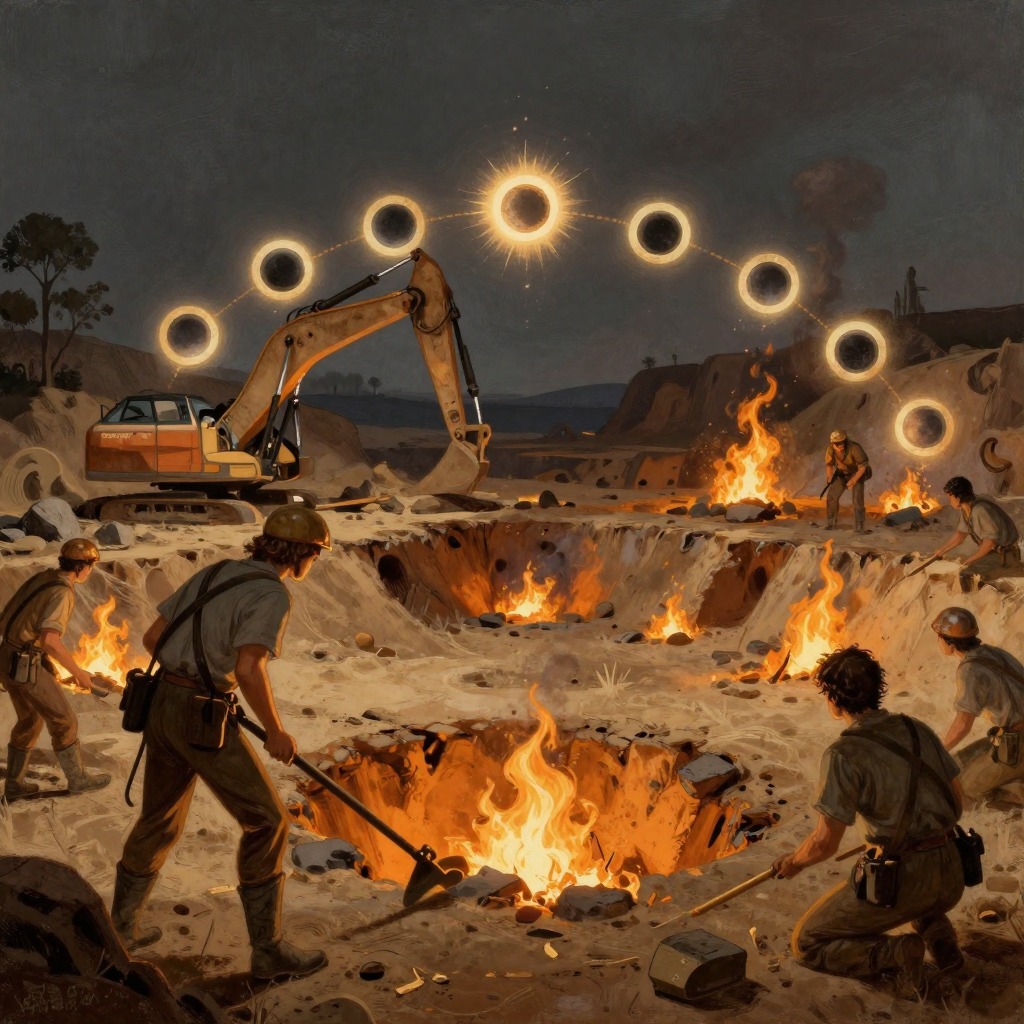
The tablets were found in the Hill of Thombo, a midden-heap south of the main Beklimot site on the Sagikan Peninsula. A killer sandstorm that threatened to destroy Siferra's entire excavation instead ripped open the hill's face, exposing a series of superimposed ancient settlements separated by layers of charcoal. Siferra and her chief stratigrapher Balik 338 immediately recognized the importance of the exposed strata: at least seven, and possibly nine, distinct towns had been built, burned, and rebuilt on the same spot over thousands of years. During the initial probe, Siferra uncovered a set of six ragged, battered slabs of hard red clay. She arranged them on her desk in two groups of three—square tablets in one row and oblong ones below—and carried them back from Sagikan in her own hands rather than entrusting them to freight shippers, so great was her sense of their potential importance.
Script and Translation
Siferra brought the tablets to Mudrin 505 of the Department of Paleography, a frail, desiccated man in his late seventies whose watery eyes were renowned for their sharpness with ancient inscriptions. Mudrin immediately identified word-groups on the square tablets, which were written in a very primitive form of the Beklimot script—he could almost recognize letters such as a "quhas" and a distorted "tifjak." The oblong tablets from the fifth level, however, were in a completely unfamiliar script, very likely syllabic, with too many different characters for it to be alphabetic. Mudrin's preliminary opinion was that the tablets were some kind of priestly warning of coming fire. Siferra herself, though no paleographer, had already identified distinct word-patterns and repeated character groups. The translations remained sketchy and hesitant, but they seemed to describe a fiery doom sent by the gods upon the world, a pattern that matched the burn lines Siferra had charted in the hill.
Theft and the Apostles of Flame
The existence of the tablets became a matter of public knowledge, and the Apostles of Flame, led by Folimun 66, sought to obtain them. Folimun claimed the Apostles possessed a key to the early clay-tablet script, texts and dictionaries from the previous Year of Godliness, but he insisted on receiving the actual original artifacts rather than copies. Siferra refused, demanding instead that Folimun give her the decoding material first. The negotiations broke down. On the evening of the eclipse, just before Siferra left for the Observatory, Mudrin came to check one last thing in his translation. They opened the artifact safe and found nothing: all six tablets were gone. Siferra was certain the Apostles had stolen them, probably to use as holy talismans after the Darkness had done its work. The theft felt to her "almost like a rape," a violation of her body, and she bitterly regretted ever having mentioned the tablets to anyone.
Significance and Aftermath
The Thombo Tablets provided the crucial link between the archaeological record and the astronomical prediction of the eclipse. The radiocarbon dating of the charcoal layers in the Hill of Thombo showed fires occurring at intervals of a little more than twenty centuries—exactly the two-thousand-and-forty-nine-year frequency at which eclipses of Dovim occur, and precisely the length of what the Apostles called a Year of Godliness. The tablets themselves, once fully translated by the Apostles using their ancient textual material, proved to be straightforward historical accounts of two separate advents of the Stars thousands of years ago, and of the attempts made by the priesthoods of the time to warn the populace. Folimun later admitted to Theremon that the theft was necessary because the tablets were "irreplaceable relics of the previous cycle" that needed to be placed in safekeeping before chaos destroyed the university buildings. The tablets thus became both a symbol of lost knowledge and a tool for the consolidation of power in the post-Nightfall world.