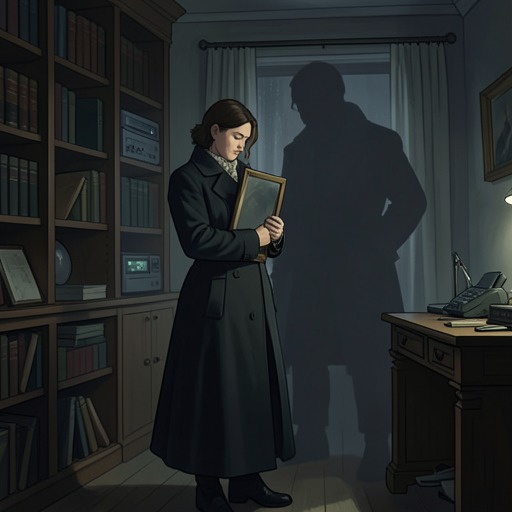
Chiaki’s Nightmare episodes
PiercingChiaki’s Nightmare episodes are recurring states in which Sanada Chiaki loses reliable access to language, continuity of self, and a settled sense of the present. They begin with a loss of sexual desire and can progress into disorientation, memories of her father’s abuse, and self-punishing behavior. The episodes are not presented as a formal diagnosis: the narrative follows what Sanada Chiaki experiences, what she remembers, and how the states affect her actions, without reducing them to a clinical label.
Onset and Recurrence
The first episode occurred during Sanada Chiaki’s second year of high school, after she and classmates watched a pornographic video at a classmate’s home. She recalls a sudden, unnamed terror and a different scene displacing the one in front of her. By the period described in the novel, the state has occurred seven times. Its recurrence is not regular or predictable, but Sanada Chiaki recognizes an early warning sign: her sexual desire disappears, leaving her alarmed by the change in her own responses.
The episodes can be prolonged. On one occasion, the loss of desire lasted 938 days. Sanada Chiaki sometimes tried to counter the resulting anxiety by having sex, but the experience did not restore a sense of connection or pleasure; at times, she became unsure of where she was or what she was doing. These details establish both the duration of the underlying change and its reach beyond a single acute crisis. A particular episode may pass, while the fear of its return remains part of her everyday awareness.
An episode nearly begins while Sanada Chiaki is with a client who has fallen asleep beside her. She fears that an observer figure she calls What’s-her-name will appear, but it does not. Unable to reach the Halcion in her handbag, she remains awake until morning. The episode’s absence does not reassure her: she is still frightened by the loss of desire and by her expectation that it may signal the start of the cycle. The scene distinguishes anticipation from the full state and shows how fear of recurrence can itself shape her night.
Triggers and the Loss of Words
During a later encounter with Kawashima Masayuki, Sanada Chiaki’s state intensifies after she feels humiliated and concludes that she has failed to arouse him. Her awareness of the situation gives way to panic, and words recede from her reach in sequence. This loss is more than difficulty speaking: familiar terms and memories that had organized the immediate scene seem to withdraw, leaving her increasingly unable to orient herself through language.
The narrative renders this process as a change in what can be accessed. Words become depleted and ineffective, while memories begin to stir and rise into awareness. Sanada Chiaki describes memories as distinct from words: they return not as orderly explanations but as material that gathers into an image and overtakes her senses. This transition helps explain why she may appear composed to someone watching her while, from within, her connection to the current situation is breaking down.
Her outward actions during the encounter sharpen that contrast. Although Kawashima Masayuki sees her calmly applying lipstick, he does not recognize the significance of her blank expression or her trembling hand. Later, in the bathroom, Sanada Chiaki repeats small tasks with her clothes and adjusts the shower temperature back and forth. These actions do not establish that she is in control of the episode; rather, the passage sets observable routine against her diminishing ability to feel and orient herself. The mismatch between appearance and experience is central to how the episodes are narrated.
Memory and Divided Self-Perception
As the episode deepens, memories of Sanada Chiaki’s father intrude. She recalls his insistence on secrecy and the contradiction between his outwardly immaculate appearance and the abuse he inflicted on her. The recollection links the present crisis to an earlier experience she had been unable to disclose. The episode does not arrive as a calm, complete account of the past; it surfaces amid the loss of words and the weakening of her connection to the present.
The recurring figure on the ceiling, What’s-her-name, gives a form to Sanada Chiaki’s sense of watching herself from outside. She eventually understands the figure as herself observing her own sexual activity, but that recognition does not make the experience harmless or easy to control. She has feared that speaking to the figure could divide her into separate people. The episodes thus unsettle not only her location and memory but also the boundaries by which she recognizes herself.
During a severe episode, Sanada Chiaki does not know who or where she is, yet retains a conviction that she must be punished. A self-condemning voice treats her identity as empty and directs hostility toward her. The contrast is consequential: the sense of personal continuity is impaired, but punishment still seems compelling within the episode. Sanada Chiaki engages in self-harming behavior and may later wake in hospital, with only an incomplete understanding of how she arrived there.
Consequences and Encounters
Sanada Chiaki’s expectation that someone will take her to hospital becomes part of the episodes’ recurring aftermath. She believes that the person who has helped her before is someone she has never met, rather than the men she has known, and hopes to see this rescuer one day. When Kawashima Masayuki enters the bathroom during a crisis, she briefly thinks he may be that person. Her uncertainty persists: she cannot establish who he is, and his presence does not immediately restore her orientation.
This encounter places her altered perception in contact with another person’s effort to understand what is happening. Kawashima Masayuki is concerned with taking the knife away from her, while Sanada Chiaki interprets his arrival through the expectation of a familiar but unidentified helper. The gap between these perspectives makes the episode legible as both an inward crisis and a difficult interpersonal encounter. Her interpretation is not evidence that Kawashima Masayuki has previously taken her to hospital; the episode presents it as her uncertain belief in the moment.
The episodes also affect how Sanada Chiaki assesses her own capacity to act. Before a possible recurrence, she worries that she will no longer be able to choose what happens to her or summon courage. During an episode, however, her actions may be governed by confusion and self-punishment rather than by a stable intention. The narrative keeps those conditions distinct: fear of losing control, altered awareness, and self-harming behavior are connected in her experience, but they are not treated as interchangeable.
Narrative Function
The episodes organize the return of Sanada Chiaki’s concealed history without presenting memory as straightforward explanation. A present-day humiliation or a feared loss of desire can precede a shift in awareness; words fall away, and memories emerge in their place. The sequence makes the past active in the present while preserving the gaps, uncertainty, and altered self-perception through which Sanada Chiaki experiences it.
Their recurrence also creates a contrast between what others can observe and what Sanada Chiaki can report. A person nearby may see stillness or a routine gesture, while she is losing access to language, place, or a continuous sense of self. The remembered count of seven episodes and the 938-day duration of one period give this pattern specific scale, while the hospital aftermath shows its practical consequences. Taken together, these states are a recurring structure through which the novel traces the persistence of abuse, the difficulty of speaking its history, and the precariousness of Sanada Chiaki’s sense of being present to herself.