Kawashima’s childhood trauma
PiercingKawashima’s childhood trauma is rooted in the abuse he suffered from his mother after his father died. It taught him to detach from pain and to rely on an inner voice for protection; those childhood adaptations return in adulthood as bodily estrangement, intrusive memories, and repeated acts of checking. The narrative links his past to present crises without presenting it as a simple explanation for everything he does: his marriage to Yoko brings a period of relief, while later fear and violence show that the wound has not been resolved.
Abuse and Early Separation
Kawashima Masayuki was four when his father died and his mother began beating him. He retained little memory of his father, apart from a vague impression of being taken on drives. Years later, at his high-school graduation, his mother said she had treated him harshly because he reminded her of his father. Kawashima had understood the beatings as punishment for being a bad child. He learned to endure them by concentrating on the idea that the person being hurt was not really him, and by repeating to himself that the next blow would come. The method helped him distance himself from pain, but the need to remain prepared also made the threat of abuse a constant presence.
He was singled out in the family: his mother did not treat his younger brother the same way. When she began taking only the younger boy on visits to a department store in Odawara, Kawashima tried to follow them. His mother brought him back and tied him up in the bathroom. He later recalled waking on the tiled floor after falling asleep and seeing the narrow road outside in the dark. The episode joins exclusion and physical abuse to an image that would recur in his life: the isolated road, empty and difficult to leave behind.
A middle-school teacher eventually arranged for him to enter the Home, which cared for abused children. Kawashima spent a little over two years there before going to live with his paternal grandmother. He began drawing after his placement, and his earliest pictures repeatedly showed narrow roads at night. The drawings gave a form to an experience he had not previously told anyone about. Much later, he disclosed this history to Yoko, who took his hand as he spoke.
The Home and the Learned Voice
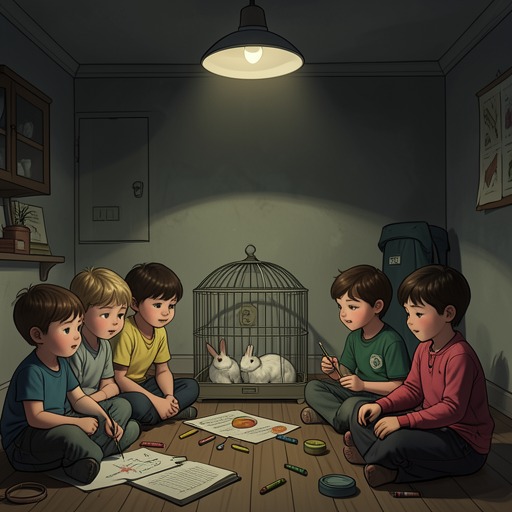
Kawashima’s recollection of the Home includes a crowded playroom and children whose behavior ranged from withdrawal and silence to aggression, distress, and attempts to seek closeness from adults. Looking back as an adult, he imagined how easily outsiders might regard such children as unbearable and use that judgment to excuse their parents’ cruelty. The passage exposes the logic by which abuse is rationalized: a child’s visible distress can be treated as evidence that the child deserves punishment, rather than as a consequence of harm. Kawashima recognizes the force of that rationalization, even as the novel’s account of his own childhood makes its cruelty plain.
His childhood strategy of separating himself from pain persists as more than a memory. During a later crisis, he again feels as though he is apart from his body, and the narration connects that sensation to the method he trained himself to use under his mother’s beatings. A protective voice also returns. It instructs him not to apologize or seek forgiveness, and to look directly at the person before him once an attack has ended. The voice recalls rules formed in childhood, when he needed a way to survive without relying on an adult to protect him.
At the height of the later confrontation, Kawashima recognizes that this apparently separate adult voice originated with him as a child. He had imagined a composed grown-up voice because his own child’s voice felt too vulnerable to protect him. In the present, he believes he is grown and can speak and act for himself. That recognition changes the voice’s role: it no longer functions only as a shield against pain, and he turns toward asserting power over Sanada Chiaki. The scene makes clear that understanding the origin of a coping strategy does not, by itself, make it safe or bring the past to an end.
Adult Life and the Return of Fear
Kawashima’s relationship with Yoko offers a period in which his old terror recedes. He supported her decision to leave her job and teach cooking, and did not oppose her wish to have a child. After they married, colleagues noticed that he seemed more cheerful. His self-loathing and episodes of panic had nearly disappeared, and he was not overwhelmed when their daughter Rie was born. The account presents these changes as significant, but not as proof that his childhood trauma has been overcome.
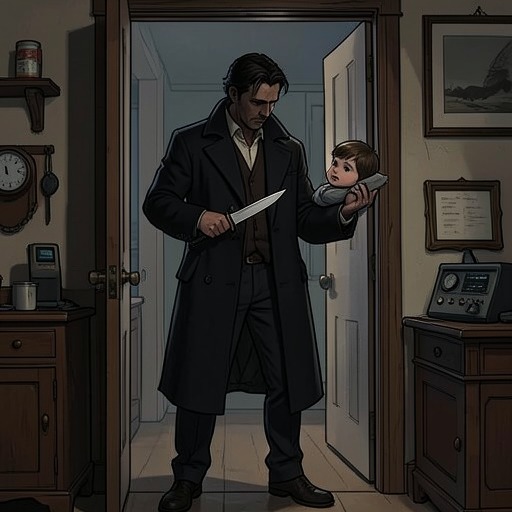
Ten nights before the opening crisis, while bathing the baby and watching Yoko dry her, Kawashima suddenly wondered whether he might stab the child with an ice pick. The thought frightened him; he repeatedly reassured himself that he would not act on it. Yet the image persisted, and each night he stood over the crib with the ice pick to confirm to himself that the baby was safe. His nightly checking echoes the childhood habit of preparing for an expected blow: both are attempts to manage fear by anticipating danger, though the adult fear concerns an act he does not want to commit.
The recurrence is especially stark because the earlier years with Yoko had seemed to loosen the cycle of fearing solitude, fearing closeness, and retreating from other people. The intrusive thought returns without warning during an ordinary family moment, abruptly interrupting his sense of safety. The story does not equate that unwanted fear with a settled intention. Instead, it shows how the attempt to obtain certainty through repeated checking keeps the feared image present in his nights.
Reconciliation, Repetition, and Unresolved Consequences
At Kawashima’s high-school graduation, his mother apologized and asked whether he forgave her. He initially nodded, then slapped her. He later described this as the only time he had hit her. The act reverses the childhood imbalance, but the episode does not amount to reconciliation: he could not accept the demand for forgiveness, and his account emphasizes the mother’s fear rather than a repaired relationship. The memory resurfaces when he faces a frightened woman in the present. Seeing her fear recalls his mother’s request for help and forgiveness, which he associates with the conviction that help does not exist in the world.
In the later confrontation with Sanada Chiaki, memories of his mother’s treatment return as he speaks about the ways she hurt and frightened him. Before he can carry out the next act he is contemplating, he experiences the memory as his mother entering and taking over his body, and he loses consciousness. The interruption connects the present crisis to the childhood violence but does not settle what will happen afterward. The evidence ends with Kawashima unconscious, not with an account of recovery or a final resolution of his actions.
The trauma’s significance lies in these returns: the dark road reappears in his drawings; the practiced distance from pain reappears as estrangement from his body; and the voice made to protect a child resurfaces in an adult crisis, where its guidance can turn toward harm. Yoko’s care and the calmer years of their marriage show that his life is not defined by abuse alone. Yet the abrupt return of fear around the baby, and the collapse into childhood memory during the confrontation, show how incompletely the past has been integrated into his present.