Kawashima’s dissociative episodes
PiercingKawashima Masayuki’s dissociative episodes turn a survival strategy formed in childhood into an unsettling adult experience: under pressure, he can feel detached from his body and perceive another version of himself as separate from it. The episodes are not presented as deliberate choices or as supernatural events. They are linked to the abuse he endured from his mother and return in moments when pain, fear, or sensory disturbance makes it difficult for him to remain oriented to the present.
Origins in Childhood
After his father died, when Kawashima Masayuki was four, Kawashima Masayuki’s mother began beating him. He learned to endure the assaults by concentrating on the idea that the person being hurt was not really him. The separation was at first a way to withstand pain and fear; through repeated practice, he could distance himself from the experience while remaining nearby in his imagination, ready to return when circumstances allowed. His mother’s response made the strategy more consequential: because he would not cry out, she struck him harder, but the increased violence also intensified his effort to detach.
The practice developed in a childhood marked by anticipation as well as immediate danger. Kawashima Masayuki’s mother sometimes attacked without warning, and he tried to remain prepared for it. He was also singled out while his younger brother was spared. When his mother took the younger child on outings and left Kawashima at home, he once followed them; she brought him back and tied him in the bathroom. The narrow road visible beyond the window became part of the remembered scene. These experiences help explain why his later episodes involve not only a retreat from pain, but a split between the self undergoing an event and the self observing or waiting apart from it.
Episodes in the Present
As an adult, Kawashima Masayuki recognizes the feeling of separation as a remnant of those earlier experiences, but recognition does not reliably prevent it. In a convenience store, after entering from the cold, he feels his bodily outline blur. A clerk’s greeting to other customers is enough to bring back the sense that he is not fully present in his own body. He imagines himself as separated and waiting a short distance away. Looking at disposable diapers, which he has decided to buy for Yoko, he becomes convinced that this other self is standing among the shelves, holding a package and beckoning to him. An ordinary errand thus becomes the setting for a perceptual division that seems real to him in the moment.
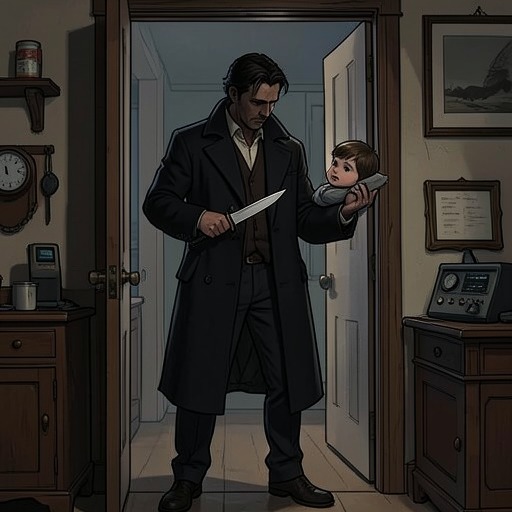
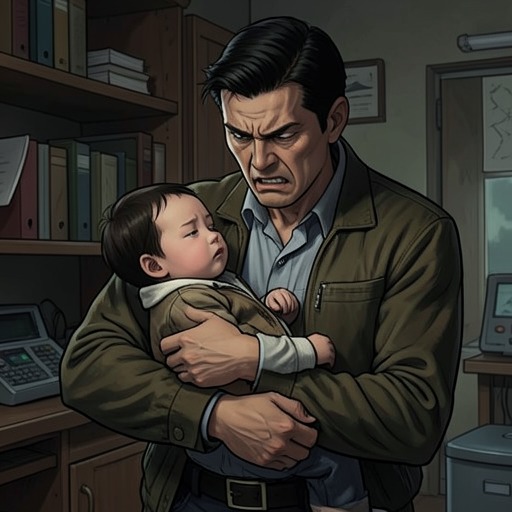
A different episode occurs beside his baby’s crib. As he looks at the child, he notices that he has been sweating without feeling it. The separation is registered as estrangement from his own bodily response: his body seems to belong to a stranger, rather than to the person he understands himself to be. At the same time, sight, sound, and smell begin to intermingle, accompanied by a burning sensation in his perception. He recognizes the recurrence with dread. The episode links the present scene to a history he cannot simply leave behind, even when he is aware that the experience is happening again.
Pain, Cold, and the Limits of Control
Kawashima Masayuki also recalls using the same technique later in life, including while living with a stripper. The memory shows that the strategy was not confined to childhood, but the narrative does not present it as a dependable form of control. While waiting near a hospital on a freezing night, he wonders whether he can again separate himself from physical pain and cold. The conditions recall an earlier winter night when Kawashima Masayuki’s mother had put industrial ammonia on his palm and then locked him outside. In that childhood memory, pain, cold, and fear reached a point at which he felt he was losing control; separation followed as an experience rather than as a planned procedure.
In the present, he cannot reproduce the state at will. He remembers that the technique involved a subtle shift of focus, but cannot maintain the concentration needed to use it while cold and under strain. Nor can he recover a clear verbal explanation of how it began. The method’s limits matter: what once helped him survive an immediate ordeal is not a stable skill he can summon whenever he needs relief. The body and the circumstances remain part of the experience, even when he tries to regard them as belonging to someone else.
Language, Memory, and Narrative Form
The episodes expose a gap between experiencing a state and being able to describe it. Kawashima Masayuki remembers that, during the original childhood experience, words and feelings seemed to be erased. Later, he reflects that putting the technique into words diminishes its power; analysis cannot recreate the unspoken process. His account to Yoko gives the history a spoken form, but telling what happened does not make the underlying response fully legible or controllable. The narrative therefore presents explanation as partial: he can connect the adult sensation to childhood abuse while remaining unable to give a complete account of the mechanism.
The book also places his experience beside Sanada Chiaki’s distinct episodes of disrupted awareness. In one encounter, humiliation and panic precede a sense that words are disappearing; memories then rise and bodily perception changes. This is not the same event as Kawashima Masayuki’s separation from his body, but the parallel makes the novel’s interest in fractured awareness broader than his personal history. Across the two experiences, ordinary language and conscious control fail at moments when memory presses into the present. In Kawashima Masayuki’s case, the dissociative episode carries the particular shape of a childhood adaptation: distance once created to endure abuse returns in adult life, but no longer stays neatly within the limits of the situation that first required it.