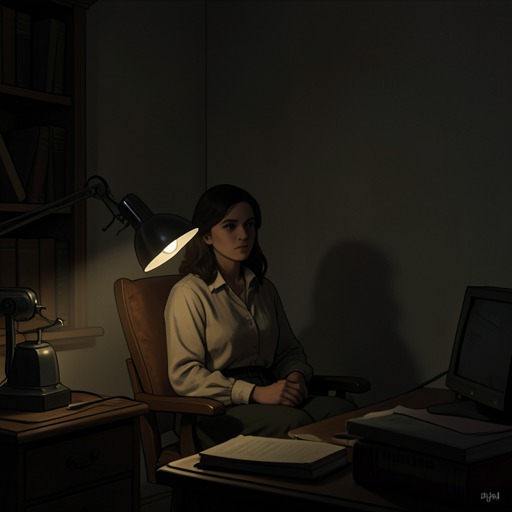
Kawashima’s Halcion-induced altered state of consciousness
PiercingKawashima’s Halcion-induced altered state of consciousness is a drug-triggered crisis in which sedative effects intersect with Kawashima’s existing fears, memories, and violent intentions. After Sanada Chiaki secretly gives him Halcion in soup, he loses his ordinary sense of orientation and experiences childhood terrors as if they were present. The episode temporarily alters his perception and pain, but the narrative connects his conduct not only to the drug: before taking it, he has already been consumed by an intrusive fear of harming his baby and has reached a dangerous conclusion about how to overcome that fear.
Background and Administration
Kawashima’s crisis has a history that predates the meal. After a sudden thought about stabbing his infant daughter with an ice pick unsettles him, he repeatedly stands over her crib at night holding the weapon to reassure himself that he will not act on the thought. By the time of the encounter with Sanada Chiaki, the fear has become part of an escalating pattern of distress. In a prior confrontation with an imagined other self, Kawashima arrives at the belief that he must stab someone else to overcome it. This context distinguishes the frightening, unwanted thought that first troubles him from the later plan to direct violence at another person.
Sanada Chiaki puts Halcion into food rather than giving it to him openly. She keeps crushed tablets in a spice bottle labeled thyme and mixes roughly two tablets into a curry soup, adding extra curry powder to conceal the bitterness. She expects the dose to take effect within about thirty minutes and to leave him deeply asleep within an hour. Her calculation is shaped by concern that the drug might first increase his sexual interest, an outcome that she fears because of her past experiences. The drug is therefore introduced in a charged encounter, not in a neutral or supervised setting.
Kawashima eats the soup and two buttered rolls. He has eaten nothing since a sandwich at Haneda Airport, and he initially notices his body warming and some of his tension easing. About twenty-five minutes after the meal, however, Sanada Chiaki watches him closely as he begins to lose physical and mental steadiness. The contrast between his ordinary act of eating and the impending disorientation makes the drug’s arrival gradual: he does not recognize at once that his perception is changing.
Disorientation and the Return of Childhood Fear
As the effect intensifies, Kawashima struggles to remain upright and experiences the room as unstable. His sense of gravity becomes distorted, and he feels drawn into a dark, enclosing space. His mother appears within this frightening experience, accompanied by the remembered accusation that he would grow up to be insane. The altered state thus gives force to a fear already rooted in his childhood: rather than encountering the present room clearly, he experiences it through the pressure of a past relationship and its humiliations.
The episode also takes the form of an overwhelming vision of his own unconscious. Kawashima experiences it as a rising mass of discarded and ruined things, while his fear takes on a threatening imagined form. These images are not presented as events occurring in the room; they are part of his subjective experience as his grasp on the immediate situation weakens. The distinction matters because Sanada Chiaki, watching him, initially understands his behavior as the effect of the tablets, while he experiences an inner crisis that draws together the drug, his fear, and memories of his mother.
Sanada Chiaki has expected the Halcion to incapacitate him, and at first she reads his altered behavior as confirmation that the dose is working. When he appears to suffer, she recognizes something of her own unpleasant first experience with the medication. Her response changes when she hears him calling for Yoko. That name brings Kawashima’s marriage and another life into the room, and Sanada Chiaki’s brief sympathy gives way to rage. The sequence shows that the drug’s effects unfold amid an active conflict: her reactions are shaped by what she hears and remembers, not by the medicine alone.
Violence, Pain, and Interrupted Awareness
Sanada Chiaki strikes Kawashima with a kitchen utensil. The impact abruptly disrupts his drugged, inward experience: his awareness of danger returns, and he tries to protect himself. Her attack does not simply end the altered state. Instead, it changes its course, bringing him out of one disabling phase while the Halcion continues to affect his judgment and perception. The collision between drug-induced impairment and a physical struggle makes the scene’s shifts in awareness difficult to separate into clean stages.
As Kawashima regains the ability to act, he restrains Sanada Chiaki and tells her to believe that pain can be overcome by refusing to doubt it. His insistence echoes the survival rule he has constructed for himself, but it is imposed on another person during an assault. The belief is therefore both a coping method and part of the immediate danger: the idea that pain can be mastered does not make her situation safe, and his attempt to make her accept it becomes an exercise of control.
The drug also appears to blunt Kawashima’s awareness of his own condition. Though injured in the struggle, he continues to move and does not respond to pain in an ordinary way. He treats the voice that had helped him earlier as a creation of his childhood and decides that he can now speak and act for himself. At the same time, his memories return to an earlier encounter with his mother, when he struck her after seeing her frightened and asking for help. His recollection carries forward his belief that help does not exist, revealing how the present violence is entangled with a past refusal of vulnerability.
Kawashima later retrieves the ice pick and turns it toward Sanada Chiaki. Before he can act, the remembered presence of his mother overwhelms him. He experiences himself as joined to her in a way he finds unbearable, and he loses consciousness. The scene ends not with a recovery of clear judgment but with a collapse that interrupts the threatened attack. His drugged state, childhood memory, and immediate violence converge at the moment he can no longer continue.
Aftermath and Significance
Sanada Chiaki cuts through the cord binding her wrists and removes the cloth from her mouth. She does not call the police, anticipating that reporting the incident would keep her at the station for hours or longer. Instead, she examines Kawashima’s overnight bag, finds his notebook and another wrapped weapon, and reads the notebook from beginning to end. The contents leave her unsure whether they describe an intended crime or a sick person’s fantasies, but they overturn her earlier image of him as a rescuer. She understands that he had not come to worship her or save her; he had treated her as a body to rent.
The sedative’s continuing effect matters to her immediate decision-making: she believes he will remain asleep for hours and is not afraid that he will wake at once. Yet the aftermath does not reduce what happened to a dosage calculation. Sanada Chiaki recalls the weapon at her stomach and considers why she felt no fear in that moment, without reaching a single explanation. She also recognizes that the same man had whispered to her, waited outside a hospital, and restrained her during the assault. That recognition does not excuse his conduct; it makes the contradiction harder to dismiss as the work of several separate selves.
The episode consequently presents Halcion as a powerful circumstance that alters consciousness, pain, and behavior, not as a complete explanation for Kawashima’s choices. Its effects intensify an encounter already shaped by his plans, Sanada Chiaki’s fear and anger, and the return of childhood trauma. The collapse temporarily stops the attack, while the notebook and Sanada Chiaki’s reflections leave her with a more complicated and unsettling understanding of the person who attacked her.