Great and Secret Knowledge
PiranesiThe Great and Secret Knowledge is the imagined, hidden prize that The Other believes can be found in the World and used to grant immense powers. It gives their research a shared objective and shapes The Other’s increasingly elaborate ritual plans, but Piranesi eventually concludes that the House is not a riddle whose value lies in a solution. An older visitor then identifies the premise as a mistake: he once believed the Knowledge that created the World would remain inside it, but came to understand that it had passed away. The concept thus changes from an object of pursuit into a test of what the House is worth apart from its usefulness.
The Object of the Search
The Other is not certain what the Knowledge consists of. His suggestions range from defeating Death and becoming immortal to telepathically learning other people’s thoughts; the imagined powers also include extinguishing and reigniting the Sun and Stars, and dominating lesser intellects by bending them to one’s will. The breadth of the list makes the Knowledge less a defined discovery than a container for fantasies of mastery over mortality, minds, and the cosmos.
The uncertainty does not prevent the search from becoming a disciplined joint undertaking. The Other and Piranesi meet on Tuesdays and Fridays to discuss their work, and The Other organizes the sessions carefully, never allowing them to last beyond an hour. The regularity gives speculative ambition the outward form of research: the two speak as collaborators, although the object they seek remains undefined.
Ritual as a Method of Pursuit
The Other’s search is not limited to discussion. In the Second South-Western Hall, he tells Piranesi that he will work on a ritual and advises him that he may not want to stay nearby. The ritual is intended to free the Knowledge from whatever holds it captive in the World and transfer it to the participants. They have already performed it four times, each attempt in a slightly different version; The Other says he has made further changes and wants to hear how they sound in the place where the ceremony will occur.
His explanation of the planned ceremony joins performance to visualization. After an invocation, he intends to enumerate the powers he seeks: defeating Death, penetrating lesser minds, becoming invisible, and other abilities. As he names each power, he imagines himself possessing it—living forever, reading someone else’s thoughts, or becoming invisible. He considers adding a brazier and burning incense for the real attempt. These details show how the search turns an uncertain hypothesis into an increasingly concrete procedure, without establishing that the ceremony can deliver what it promises.
The pursuit also leads The Other to plan a journey deeper into the labyrinth. After Piranesi supplies information about the stars visible in a particular room, The Other decides to go there and perform the ritual, acknowledging that the destination is farther inside than he has ever gone and therefore carries risks. He weighs those risks against rewards he calls potentially immense, then asks Piranesi to return and establish which constellations can be seen at different times of year. The planned expedition shows how the promise of the Knowledge directs both their research and their movement through the House.
Piranesi’s Reassessment
While walking home after observing the night sky, Piranesi arrives at a change in belief. He no longer thinks it matters whether the Knowledge exists: it may exist, or it may not, but he does not intend to spend more time looking for it. He describes this as a Revelation, because its truth came before he could reconstruct the reasoning that led him there.
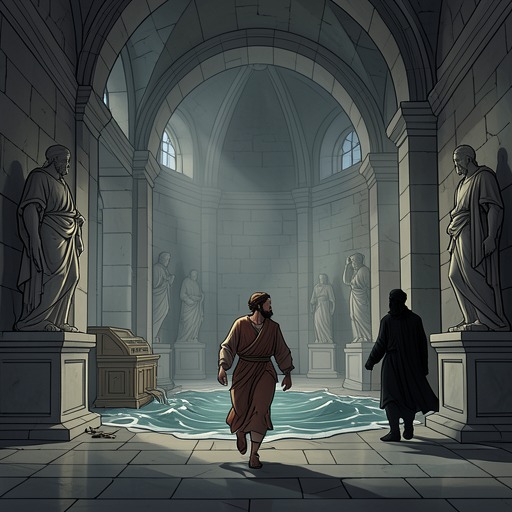
In trying to understand that realization, Piranesi returns in thought to the One-Hundred-and-Ninety-Second Western Hall in moonlight. The beauty and calm of the room, and the reverent faces of the statues seemingly turned toward the Moon, make him see the cost of the search’s underlying assumption. Treating the House as a riddle or text to decipher makes its value seem like something to extract: once the Knowledge is found, the House would be reduced to scenery. For Piranesi, the vision reverses that logic. The House has value as itself, not merely as a means to an end.
The difference between the two men becomes clear when Piranesi tries to tell The Other what he has learned. He proposes that they stop searching and establish a new program of scientific research. The Other is occupied making notes on his device and initially fails to attend to the announcement. Piranesi repeats that the House has revealed they should abandon the search. The contrast is not simply between belief and disbelief: Piranesi has become willing to let the question remain unresolved, while The Other is still organizing his plans around the Knowledge’s possible rewards.
The Older Visitor’s Correction
An older visitor asks whether Ketterley still believes the wisdom of the ancients is in the House and whether he is still searching for it. When Piranesi confirms that he is, the visitor answers that The Other will never find it because it is not there and does not exist. Piranesi admits that he had begun to suspect as much. The visitor’s correction gives direct confirmation to the possibility Piranesi had reached independently, while clarifying that the search’s premise has a history.
The visitor says that the idea came from him. Before seeing this world, he assumed that the knowledge responsible for creating it would remain inside, ready to be claimed. His analogy is water that flows underground through the same cracks until, over millennia, it wears away stone and forms a cave system: the resulting caves remain, but the water that made them has seeped away. In the same way, the Knowledge that created the World is not lying within it as a recoverable object.
He distinguishes his former error from The Other’s continuing investment in the search. In his view, The Other is an egotist who thinks in terms of utility and cannot imagine why anything should exist if it cannot be put to use. That judgment echoes Piranesi’s Revelation from another direction. The Knowledge is not only absent; the hunt for it also expresses an instrumental view of the House that mistakes a world of intrinsic value for a storehouse of power.
Meaning and Consequences
The Knowledge’s changing status marks a decisive shift in the meaning of research. For The Other, inquiry is oriented toward possession: discover the hidden source, perform the ritual, and gain powers. For Piranesi, the House’s beauty becomes a discovery that cannot be reduced to a useful answer. His decision to stop searching does not depend on proving that the Knowledge is impossible; he recognizes that the search no longer matters to him, then comes to understand how its promise has distorted his attention to the House.
The older visitor’s account completes this reversal without making the House itself a mere illusion. His image of the vanished water separates a world from the force that formed it: the traces of an origin can remain after that origin has gone. The Knowledge therefore ends as a failed object of pursuit and as a measure of competing ways to value the world. The Other seeks power to be extracted from it; Piranesi learns to regard the House as sufficient in itself.