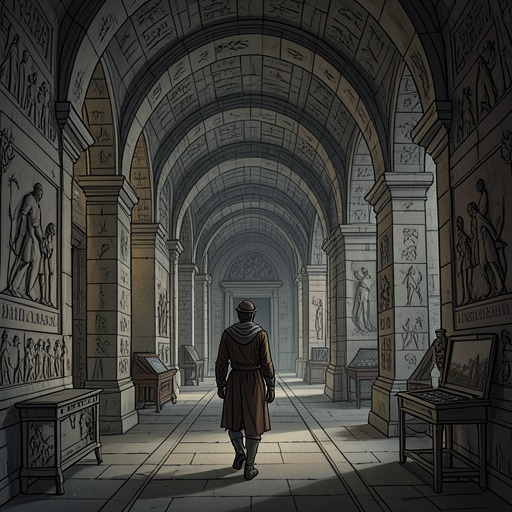
Statues as eternal witnesses and guides
PiranesiThe House’s statues serve as enduring witnesses and guides, shaping how Piranesi understands the world and how he responds to danger, memory, and other people. He regards them not as inferior copies of living things but as unique, permanent presences: they can bless a hall, protect someone caught in a flood, and illuminate the character of people he cannot fully understand. Their guidance remains part of his life even after he returns to the outside world, making the statues a lasting bond between his two ways of living.
Presence and Meaning in the House
Piranesi’s reverence for the statues belongs to a larger understanding of the House as a world with its own life and power. When The Other dismisses the Halls as dreary, identical rooms filled with decaying figures and bird droppings, Piranesi inwardly objects. The Lower Halls teem with sea creatures and vegetation; the Tides move with power; birds and people inhabit the Middle Halls; and the variety of columns, niches, doors, and windows makes the Halls distinct. The statues, too, are unique, or so widely separated in their repetitions that Piranesi has yet to encounter a duplicate. Their surroundings are not empty scenery to him: they form a living world in which even signs of ordinary animal life matter.
That conviction shapes his response to the joined Tides. After the waters sweep through the surrounding Halls and crash against the Walls, the water in the Ninth Vestibule falls until it barely covers the First-Tier Plinths. Piranesi discovers that he has been holding something in his hand: a marble finger from a faraway statue, brought there by the Tides. The small fragment makes the vast event intimate. Even after the waters have receded, a piece of the House’s statuary remains in his grasp, an encounter that sits beside his certainty that the House’s beauty is immeasurable and its kindness infinite.
The statues’ permanence also informs Piranesi’s account of the difference between the House and the outside world. Words such as Manchester and police station have no meaning in the House because those things do not exist there. Rivers and mountains, by contrast, are represented in statues. Sarah Raphael describes them as representations of actual rivers and mountains in the outside world; Piranesi resists the implication that a statue is therefore lesser. He argues that the statue is perfect, eternal, and immune to decay, qualities the changing thing it depicts does not possess. The disagreement makes the statues more than useful images: they stand for a different standard of reality and value.
Guidance, Protection, and Attention
The statues’ role is not limited to contemplation. During the Great Flood, Piranesi’s warning to 16 tells her to leave the endangered Halls and explains what to do if caught in the currents: climb quickly, because the statues are gracious and will protect her. The appeal is practical as well as devotional. Piranesi treats the statues as reliable presences within a dangerous environment, and his advice translates that trust into an action that may keep another person alive.
This sense of guidance appears again in his memory of watching the Thousand Statues in the Third Northern Hall. Under the bright stars, they look out over the Hall as if blessing it. The setting is quiet, but Piranesi cannot shake the feeling that something is happening; the statues’ watchfulness lends the scene an atmosphere of attention rather than vacancy. His perception accords with the way he interprets the House throughout: its structures and inhabitants are not inert matter simply because they do not speak in human language.
Piranesi’s use of statues also depends on respect. When Raphael asks whether taking photographs would be disrespectful, he tells her she may take them and recalls that he sometimes took photographs for Dr Ketterley. What matters to him is that Raphael asks the question at all. Her hesitation shows that she, unlike Dr Ketterley, regards the House as something deserving care. The exchange distinguishes access from reverence: someone may observe or record the statues without treating them as disposable objects, and Piranesi recognizes that distinction in Raphael’s manner.
Statues as Interpretations of People
After returning to the outside world, Piranesi finds that the statues still help him interpret people and situations he does not understand. His first impulse remains to look for one that might enlighten him. The habit is not presented as a relic he simply outgrows. Instead, it shows that the House has given him a durable way of attending to experience: he turns from confusion toward an image, then considers what the image reveals.
His recollection of Dr Ketterley takes the form of a statue in the nineteenth north-western hall. A man kneels beside a broken sphere, his sword shattered into five pieces after he used it to break the object open. Though the sphere and weapon are ruined, he studies the fragments in the hope that they will yield knowledge. The image gathers a contradiction: the desire to understand has destroyed the very object and instrument through which understanding was sought, yet the man cannot relinquish the expectation that the wreckage might still teach him something. Piranesi uses the statue to frame Dr Ketterley through an image of knowledge pursued destructively and pursued still.
For Laurence Arne-Sayles, the associated image is a bloated, heretical pope seated on a magnificent throne in an upper vestibule. The figure knows he is repulsive and takes pleasure in the shock he causes; laughter and triumph mingle in his expression. The statue does not merely identify Arne-Sayles with authority or learning. Its force lies in the figure’s delight in being disturbing, and in the imbalance between the splendour of the throne and the bulk that threatens to split it. Piranesi’s chosen image makes the teacher’s self-display and capacity to unsettle part of the remembered portrait.
Raphael is represented by two statues, and the difference between them preserves two valid readings of what she has done. In Piranesi’s mind she first appears as a queen in a chariot, protector of her people, embodying goodness, gentleness, wisdom, and motherhood. That image expresses his gratitude: Raphael saved him. But Piranesi also chooses a second figure, in an antechamber between the forty-fifth and sixty-second northern halls, walking forward with a lantern. The figure is androgynous, and the darkness around it seems immense; its raised light and searching gaze suggest someone who proceeds alone, whether by choice or because no one else had the courage to follow. The pair of images holds rescue and solitary courage together rather than reducing Raphael to a single role.
Continuity Beyond the Labyrinth
The statues’ hold on Piranesi persists in ordinary encounters outside the House. Seeing a woman pass with two children, one carrying a wooden recorder, he recognizes the scene through a statue in the twenty-seventh southern hall: two laughing children, one holding a flute. The real-world instrument is not identical to the statue’s, but the resemblance lets him encounter the people as familiar without confusing them with the stone figures. His perception continually moves between lived experience and the House’s images.
That continuity is especially significant because Piranesi once expected the statues to become irrelevant in the new, old world. He discovers that the opposite is true: when faced with a person or situation he does not understand, he still looks for a statue that might enlighten him. The House has not simply supplied a store of memories; its images remain an active interpretive practice. Its statues accompany him beyond their halls, carrying their distinct lessons into circumstances they could not have depicted literally.
In that sense, the statues make the novel’s contrast between representation and life more complicated. Piranesi refuses to call a statue an inferior copy, yet he also uses statues to understand living people, places, and actions. Their permanence does not isolate them from experience; it gives him forms through which experience can be considered. The closing assurance that the House’s beauty is immeasurable and its kindness infinite echoes that continuing relation: the statues endure not as lifeless remnants, but as presences whose guidance Piranesi carries with him.