Sōriatsu-sha
PiranesiCare for the dead is a defining practice in Piranesi’s life and an ethic made visible through labor: he brings offerings, keeps remains in order, speaks to the dead, and moves them to safety when the flood threatens their resting places. His care extends even to Valentine Ketterley, whose violence had injured him; in death, Ketterley too becomes someone to be handled gently and given a place among the others.
The Work of Visiting and Remembering
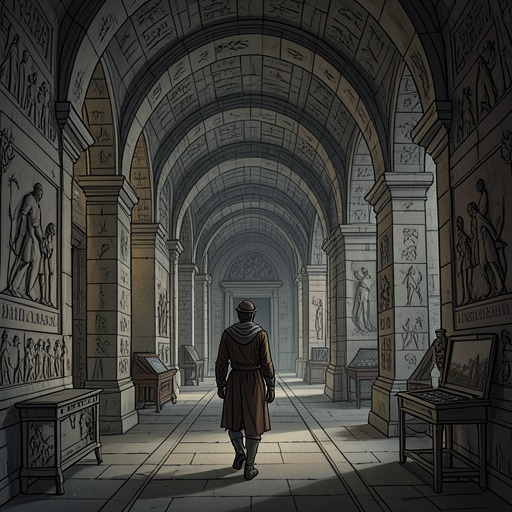
Piranesi visits the dead throughout the House, bringing food and water, along with water lilies gathered from the Drowned Halls. He speaks to them about what he has been doing and the wonders he has encountered, believing that this lets them know they are not alone. The practice is not presented as a single ceremonial occasion but as repeated attention: the dead are visited, addressed, and remembered as individuals within the world they shared with the living.
The visits demand substantial effort. When Piranesi resumes them after several weeks away, he notes that the dead lie several kilometres apart, making it a serious undertaking to reach them all in one day. He brings each one food, water, and water lilies. At every niche and plinth, he whispers the name Addy Domarus, hoping that the person who belonged to that name will accept it. Instead, he senses a faint repudiation, as though the name is being pushed away. The episode shows that remembrance cannot be imposed at will: his care includes listening for a response, even when the response is rejection.
His attention is material as well as conversational. The Biscuit-Box Man’s long bones are tied together, while the skull and a red Huntley Palmers and Family Circle biscuit tin hold the remains in a particular arrangement. When the old seaweed twine dries and falls apart, Piranesi makes new bindings from fish leather and restores the bones to good order. The small bones remain gathered in their tin rather than scattered. Care here means maintaining a body’s coherence with the specific objects and arrangements through which it has been preserved.
Piranesi’s sense of responsibility also reaches beyond the dead whose remains he regularly tends. He gives the albatrosses dry seaweed, white feathers, and a worn woollen jumper for their nest, despite knowing that surrendering the fuel represented by the seaweed may leave him colder. The choice places the possibility of a new albatross in the House above his own immediate comfort. This attention to vulnerable life clarifies the wider shape of his ethic: care is practical, costly, and responsive to the needs of those who depend on him.
Moving the Dead to Safety
When the flood approaches, care becomes a task of rescue. Nearly all the dead stand in the path of the floodwaters, so Piranesi begins carrying them to the Upper Halls. He transfers the Biscuit-Box Man’s bones into a blanket, leaving the small bones in their biscuit box; he ties the blanket with seaweed twine, carries it through the Second Vestibule and up a twenty-five-metre staircase, and lays the bones on a statue’s plinth. He then returns for the box. The arrangement preserves not only the remains but the distinctive way they had been kept together.
He moves the People of the Alcove and the Folded-Up Child to safety as well, choosing the nearest staircases to their usual dwellings. The Fish-Leather Man’s many tiny bone fragments make him especially difficult to transport: Piranesi keeps him wrapped in the blanket rather than unpacking him, to reduce the risk of losing any pieces. He leaves the Folded-Up Child nestled in her blanket because he wants her to feel safe in unfamiliar surroundings. These differences matter; the work is not simply relocating bodies, but attending to what each one requires.
The effort takes nearly three days. Each dead person’s bones weigh between 2.5 and 4.5 kilograms, and the staircases are twenty-five metres high. Piranesi finds the hard physical labor helpful because it interrupts his obsessive thoughts about the injuries inflicted by The Other and his fear of 16. The practical work does not erase those dangers, but gives his attention an immediate purpose: the dead must be carried, protected, and returned to safe places.
The albatross chick also figures in his flood preparations, though he decides not to carry it. He calculates that the Forty-Third Vestibule will have, at most, a thin covering of water, and recognizes that the adult birds would not permit him to take the chick upstairs. His decision rests on both an assessment of the danger and an acknowledgment of the birds’ strength and limits; his care does not mean assuming that every creature can or should be handled by him.
The Dead as a Community of Persons
Piranesi describes thirteen dead people in the House, including the Concealed Person, whose resting place in an Upper Hall means the flood does not require him to be moved. He insists that the others are well because he takes good care of them, and explains that this means keeping them as complete and tidy as possible, bringing offerings of food, drink, and water lilies, and talking to them. The number matters: these are not anonymous remains folded into an indistinct category, but a community whose members have places, histories, and particular needs. When he says he must return the Biscuit-Box Man, the Folded-Up Child, and the People of the Alcove to their appointed places, their temporary safety is already understood as a disruption of belonging, not a final destination.
His care is learned from the House’s own record of how the dead were treated. The older Fish-Leather Man’s bones were once threaded with fish-leather thongs, which later decayed; those who came after him patiently collected the bones and laid him with their own dead, out of reverence for human life. Piranesi’s work continues that material respect: the remains are gathered, bound, protected from loss, and situated among companions. Even his understanding of the Folded-Up Child is relational. Believing that the House wanted an inhabitant to witness its beauty and receive its mercies, he has imagined that she was intended to be his wife; since forming that thought, he has felt it right to share what he has with her. His belief is speculative, but the daily acts it prompts—visiting her especially often and bringing her offerings—are concrete.
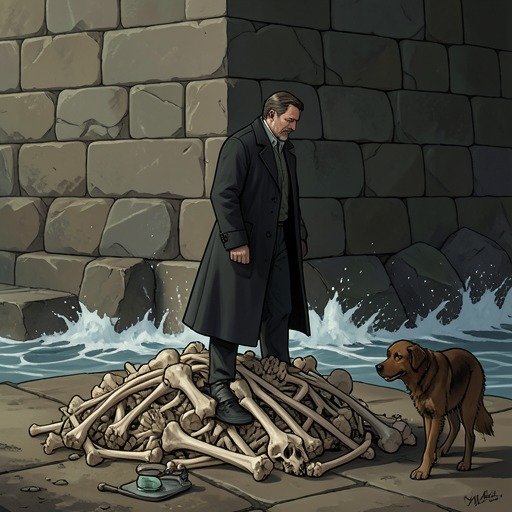
This practice also shapes how Piranesi responds to a newly dead person. After Valentine Ketterley dies, Piranesi finds his battered body tangled in a staircase balustrade in the Eighth Vestibule. He disentangles it, lays it straight, arranges its limbs, and cradles the broken head in his lap. He acknowledges his former anger and asks forgiveness, while reassuring Ketterley that the body’s damaged appearance is temporary: fish and birds will strip away the broken flesh, leaving bones that Piranesi can clean, arrange, and place in sunlight and starlight beneath the statues’ gaze. The tenderness is striking precisely because Ketterley had injured him. Death does not erase the violence, but it does not exempt the dead from care either.
Burial, Belonging, and the Measure of Care
Piranesi’s response to the dead reaches beyond immediate protection toward their future place among the House’s inhabitants. He estimates that Ketterley’s remains will take six months to become clean bones. The body is held in a plastic net with a mesh wide enough for fish and birds to reach the flesh, but fine enough to keep the small bones from being lost. Piranesi plans to gather the bones and take them to the Empty Niche in the Third North-Western Hall, where he will arrange Ketterley beside the Biscuit-Box Man: long bones bound with twine in the middle, the skull to the right, and a box for the small bones to the left. He imagines Ketterley joining Stanley Ovenden, Maurizio Giussani, and Sylvia D’Agostino among his colleagues. The plan gives the newly dead a place and a recognizable form, extending to him the same patient ordering Piranesi has practiced for others.
That work carries an ethical contrast. Arne-Sayles sought Marepool III’s head because he believed a magical rite could transfer the seer’s knowledge to himself and inaugurate a New Age; Piranesi’s care, by contrast, treats the dead not as instruments for another person’s advancement but as persons deserving attention, preservation, and companionship. His rituals are modest and physical—food, water, flowers, clean bindings, careful transport—but they resist anonymity and use. The practice does not depend on certainty about the dead’s beliefs or on their ability to answer: even when a name is rejected, or when Ketterley cannot respond, Piranesi continues to attend to what the dead need. In this way, care becomes both a daily discipline and a measure of how human beings are valued.