Theory of Another World
PiranesiThe Theory of Other Worlds is Laurence Arne-Sayles’s account of how forgotten knowledge and power persist beyond ordinary reality: when they leave one world, they create another and leave a passage between the two. The theory makes the labyrinth neither an arbitrary fantasy nor merely a metaphor. It is a place formed by what the familiar world has lost, and a door that can be found by recovering a mode of perception that modern rationality has suppressed.
Origins and Central Claim
In the late seventies, Arne-Sayles shifted away from asking what lost beliefs and powers contained and toward asking where they had gone. He had earlier treated them as a kind of energy; now he reasoned that energy could not simply wink out of existence. Its departure must have had consequences elsewhere. This became his most famous idea: when knowledge or power leaves this world, it both creates another place and leaves behind a hole, a door connecting the world it left to the place it made.
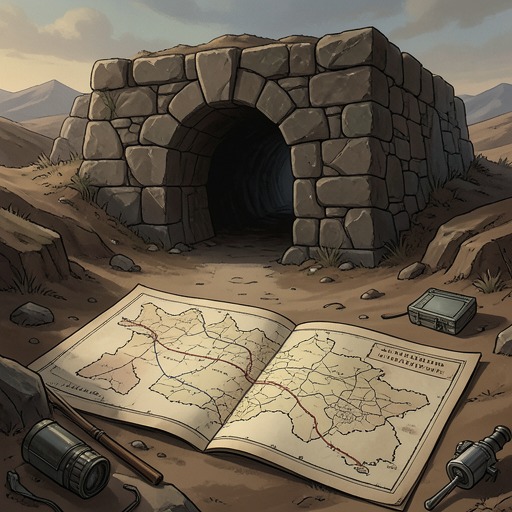
Arne-Sayles explains the process through rainwater sinking into a field. Some water evaporates or is taken up by living things, but some seeps into the earth. Over decades, centuries, and millennia, its passage cracks the rock, wears a crack into a hole, and makes of that hole the entrance to a cave. Beyond it, the continued flow hollows caverns and carves pillars. In the same way, the world’s departed magic must have a passage: perhaps small, perhaps unstable, and liable to collapse, but still present and therefore possible to find.
This image gives the theory both a material process and a history. The other place is not described as appearing all at once; it is made by the accumulated departure of what a world can no longer retain. The door is the visible consequence of that long movement, a fragile threshold between worlds rather than a wholly separate realm without connection to this one.
Finding the Door
Arne-Sayles published his third and most famous book, The Half-Seen Door, in 1979. It presented the theory of other worlds and recounted how he had entered one after a struggle. In the book, he argues that the first discovery is the hard part: once the door has been found, it is always with the seeker, who can simply look for it. To see it initially, however, one must cleanse one’s vision by returning to the geographical place where one last believed the world to be fluid and responsive. He describes this as returning to the point before modern rationality took hold of the mind.
For Arne-Sayles, that place was the garden of his childhood home in Lyme Regis. By the time he returned in 1979, the house had passed through several owners, who refused his request to stand in the garden for hours performing an Ancient Celtic ritual. He learned from a friendly milkman when the owners would be away and broke in during their holiday. The account thus places the claimed passage not in an untouched wilderness but in an ordinary, privately owned garden to which the seeker has returned through deliberate trespass.
The garden’s roses connect his adult search to a specific childhood memory. Standing in cold, rainy weather among roses planted by his mother, Arne-Sayles concentrated on being a child there, before the world and his mind had become constrained. He remembered himself in a blue wool romper suit, holding a metal soldier with peeling paint. The act of remembering, he says, freed his mind and cleansed his vision at once; the elaborate ritual he had prepared became unnecessary. He no longer saw or felt the rain, but stood in the clear sunlight of early childhood, with the roses’ colours unnaturally bright.
Passage into the Other World
Once his vision had changed, Arne-Sayles saw doors into other worlds appear around him. He recognized among them the particular door through which everything forgotten flows. Its edges had been frayed and worn by the passage of old ideas leaving this world: the threshold itself bore the history that the theory assigns to it. He located the door in a gap between the Antoine Rivoire and the Coquette des Blanches and stepped through.
On the other side he found a vast chamber with a stone floor and marble walls. Eight enormous statues surrounded him, each depicting a different minotaur; a marble staircase rose to a great height and descended to an equally disorienting depth. A sound like a thundering sea filled his ears. The scene gives physical form to the theory’s proposal: the other world is not only an explanation for vanished beliefs but a space with its own scale, architecture, and overwhelming sensory presence.
The contrast between the rainy garden and the chamber also makes the passage depend on a change in perception as well as a change of place. Arne-Sayles’s memory of childhood is not incidental preparation for an adventure: in his account, it is what clears his vision enough to recognize the door. The threshold becomes findable when he recovers the earlier responsiveness to the world that rational adulthood had displaced.
Later Significance
Arne-Sayles never wrote about the ritual he had used with Marepool III, but the later theory offers a framework for understanding how he thought about lost powers. His published account does not make the ritual itself evidence of a specific mechanism; rather, it documents the subsequent development of his idea that what disappears from one world may persist elsewhere. The distinction matters: the theory grows from his earlier conception of power as energy, while the book recounts a separate claimed encounter with a passage.
Much later, Sarah Raphael uses Arne-Sayles’s explanation to make sense of Matthew Rose Sorensen’s disappearance. She had heard him describe other worlds and initially thought he was trying to wind her up; her colleagues eventually stopped listening, while she continued because she thought that his talk might yield something useful. A recording of Arne-Sayles states that Matthew attempted to enter another world and that he would not have disappeared if he had not tried. Raphael asks whether something about the attempt caused the disappearance, and Arne-Sayles confirms it.
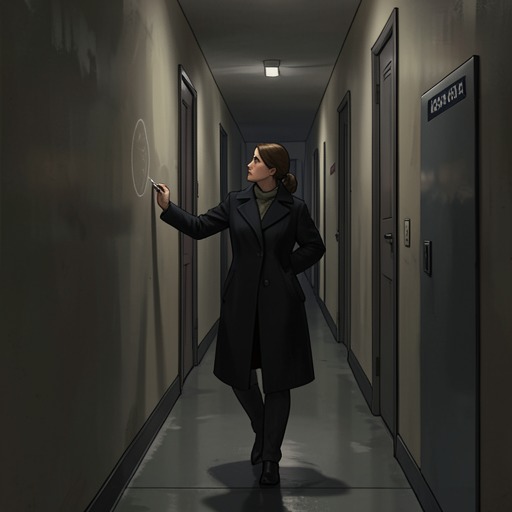
Raphael also explains that Arne-Sayles had described how to return to a pre-rational mode of thought and had told her that, once she had done so, she would see paths all around her and which one to choose. She had assumed he meant metaphorical paths. Discovering that he meant actual ones came as a shock. His account therefore reaches beyond his own entry into the labyrinth: it supplies Raphael with a practical, if initially misunderstood, guide to the same kind of crossing.
The theory’s narrative force lies in its joining of loss to access. Departed knowledge is not simply erased; it leaves a world, shapes another, and wears a door into being. Arne-Sayles’s childhood garden makes that claim personal and geographical, while Matthew’s attempted entry and Raphael’s discovery of literal paths make it consequential for others. The door is at once the mark of an absence and the possibility of passage through it.