Maekawa Risenzai
PiranesiPre-rational consciousness is the childlike mode of wonder that Laurence Arne-Sayles describes as a means of seeing beyond the assumptions of modern rationality. In his account, it is not an abstract theory alone: deliberately recalling childhood alters perception, makes a doorway to another world visible, and becomes a method he later teaches Sarah Raphael to investigate Matthew Rose Sorensen’s disappearance. Its significance lies in the uncertain boundary it opens between a change of mind and a passage into another world.
Definition and Method
In an extract from his 1979 book The Half-Seen Door, Arne-Sayles argues that finding the doorway requires a person to cleanse their vision. The way to do so is to return to the place where that person last believed the world to be fluid and responsive, before modern rationality took hold of the mind. He identifies this as a return not simply to a location, but to the state of perception associated with it: a childlike openness to a world that does not seem fixed or inert.
For Arne-Sayles, that place was the garden of the house where he grew up in Lyme Regis. The method depends on recovering a specific early experience, rather than applying a universal ritual. He recalls himself as a child standing before the roses in a blue wool romper suit and gripping a metal soldier whose paint was peeling. The remembered scene gives pre-rational consciousness a concrete form: childhood is approached through a place, flowers, clothing, and a small object held in the hand.
Memory and the Doorway
Arne-Sayles describes the act of remembering as unexpectedly powerful. Once he focused on his childhood in the garden, he says, his mind was freed and his vision cleansed; the elaborate ritual he had prepared was no longer necessary. The shift is conveyed through a change in perception: he no longer saw or felt the rain, but stood in the clear sunlight of early childhood, while the roses appeared supernaturally bright.
The memory does not merely restore a past mood. In the account, doors into other worlds begin to appear around him, and he recognizes the one he seeks as the world into which everything forgotten flows. Its worn, frayed edges suggest passage, as though old ideas are continually leaving this world through it. Arne-Sayles locates the visible door in a gap between two rose varieties, Antoine Rivoire and Coquette des Blanches, and steps through. The episode makes recollection both the means of changing consciousness and the immediate precursor to crossing into another world.
Teaching and the Problem of Ritual
The account also informs Arne-Sayles’s teaching. As his student later explains, he maintained that he could access the labyrinth-world simply by adjusting his frame of mind and returning to a childlike state of wonder. He claimed to be able to do this at will. Most of his students, however, got nowhere when they tried to follow the same approach. He consequently devised a ritual for them, presenting it as a concession to their lack of ability rather than as the true basis of access.
This distinction complicates the apparent simplicity of the method. Arne-Sayles’s own book makes memory, rather than ritual, decisive; the students’ experience suggests that his personal ability could not readily be reproduced. Ritual becomes a practical substitute for an inward adjustment that he treats as superior, while also exposing the gap between his claim of voluntary control and his students’ failure to reach the labyrinth-world by imitation.
Raphael and Matthew Rose Sorensen
Arne-Sayles later applies the same principle to Sarah Raphael. He tells her to adjust her perceptions and perform the actions he will outline so that she can understand what happened to Matthew Rose Sorensen. His explanation links Raphael’s purpose to Rose Sorensen’s earlier attempt: Rose Sorensen had tried to enter another world to understand Arne-Sayles’s thinking, while Raphael is urged to make the attempt to understand Rose Sorensen’s.
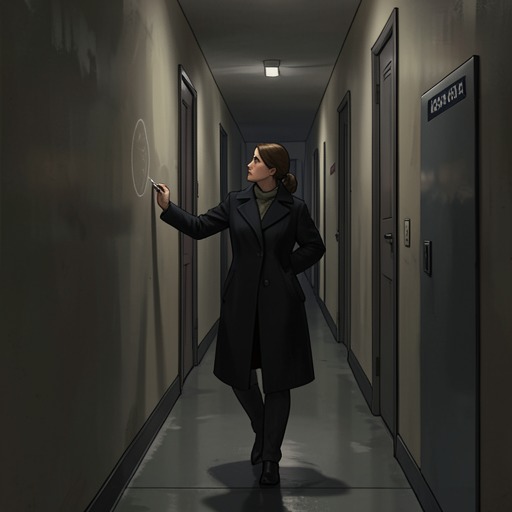
Raphael recalls that Arne-Sayles described how to return to a pre-rational mode of thought. He also told her which path to choose after she began to see paths around her. She had assumed the paths were metaphorical and was shocked when they proved literal. Her experience turns the perceptual instruction into a consequential encounter with the labyrinth-world, not merely an exercise in interpretation.
Perception, Identity, and Access
The concept’s appearances connect a recovered childhood state to access, but they do not establish that every person can enter the other world through memory alone. Arne-Sayles describes his own recollection as immediately effective, whereas his students’ attempts failed and Raphael needed both instruction and a specified path. The contrast leaves the method partly personal: the principle is taught, but its successful enactment depends on conditions the account does not fully explain.
The narrative also connects a changed mode of perception with a changed understanding of identity. After Raphael describes the paths, Matthew Rose Sorensen explains that he was shocked and frightened on first arriving, then fell asleep and Piranesi was born. Later, he found journal entries that had frightened him because he thought he must have been mad when he wrote them. He now understands that Matthew Rose Sorensen wrote them while describing a different world. Pre-rational perception thus stands at the threshold of both the labyrinth and the story’s recognition that the person who entered it and Piranesi are bound to the same history.