The House’s benevolence
PiranesiThe House’s benevolence is Piranesi’s belief that the House is a living, generous world: it sustains its inhabitants, offers wonders and refuge, and may care for him even when its actions are beyond his understanding. The conviction shapes his daily practices and his account of the House’s nature, while his disagreements with The Other expose how differently the same place can be seen—as a source of life and meaning, or as a collection of dreary rooms and useful resources.
A World That Sustains Life
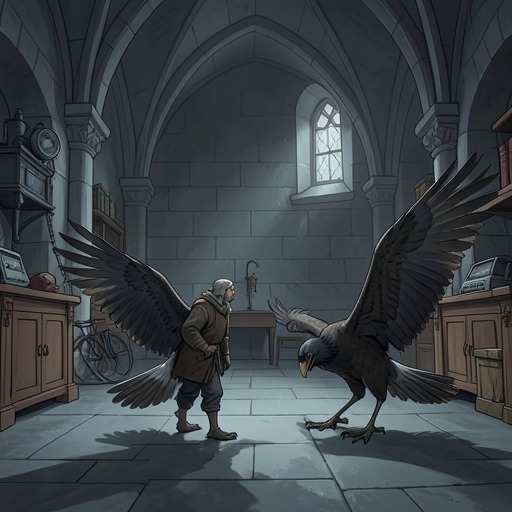
Piranesi’s declaration that “The Beauty of the House is immeasurable; its Kindness infinite” is not an abstract compliment. His understanding of kindness is grounded in the House’s material provision. The Lower Halls belong to the tides, whose waters bring fish, crustaceans, and sea vegetation; the Upper Halls belong to clouds, which supply fresh water as rain and streams. Between them, the Middle Halls are the domain of birds and men. The House’s ordered structure makes life possible, and its distinct environments provide different forms of nourishment.
This account makes benevolence inseparable from the House’s physical processes. Its waters move through the halls, its rain descends the staircases, and its sea life feeds its inhabitants. Piranesi does not treat these as a backdrop to human existence: the tides and their movement possess a power that cannot be reduced to human use. The House gives life through an arrangement in which water, food, animals, and architecture are interdependent.
The conviction also rests on attentive observation. In answer to The Other’s description of the House as endless, dreary rooms full of decaying figures and bird droppings, Piranesi thinks of the sea creatures and vegetation in the Lower Halls, the birds and people in the Middle Halls, and the tides’ movement and force. Even the droppings The Other finds repellent register the presence of life. Nor, to Piranesi, are the halls interchangeable: their columns, pilasters, niches, apses, pediments, doors, windows, and unique statues vary from place to place. His reverence grows out of noticing what contemptuous shorthand erases.
Care, Provision, and Reciprocity
Piranesi extends his sense of the House’s care to the dead. He visits them with food, water, and water lilies gathered from the Drowned Halls, and tells them what he has been doing and what wonders he has encountered. He believes that the House wants an inhabitant to witness its beauty and receive its mercies; he imagines that the Folded-Up Child may have been intended as his wife, though something prevented that future. His visits make this belief an ethic of attention: the dead should not be left alone, and what the House gives him should be shared.
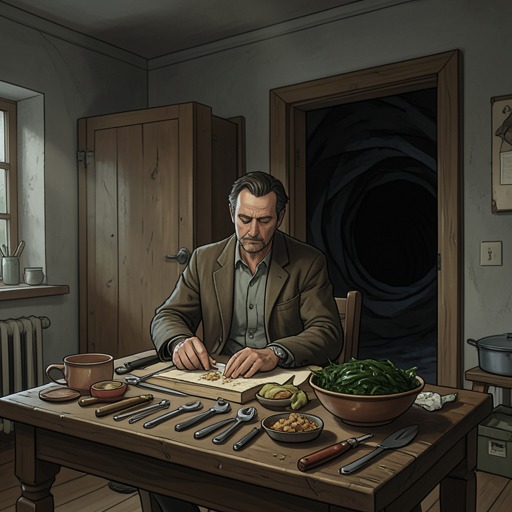
His account of material provision is more complicated than a simple claim that the House gives everyone what they need. The Other receives a varied supply of objects, including sleeping bags, shoes, plastic bowls, cheese sandwiches, notebooks, and Christmas cake, while Piranesi mostly receives fish. He wonders whether the difference reflects their abilities: he can fish, gather and dry seaweed for fuel or food, and cure fish skins into leather, whereas The Other cannot fish and may be unable to manage without the House’s provisions. He concludes that, absent those supplies, The Other might die—or Piranesi might have to spend much of his time caring for him. Benevolence, in this account, is unevenly distributed and interpreted through practical dependence as well as gratitude.
That practical difference does not keep Piranesi from regarding The Other as a recipient of care. The Other’s gifts of warm sleeping bags and notebooks matter to him, even as he attributes the House’s wider provision to its concern for someone less capable of looking after himself. His understanding of kindness thus includes both what the House supplies and the human labor required when its help is insufficient or unequal.
Faith and Disagreement
Piranesi knows that The Other does not revere the House as he does, but his companion’s contempt still shocks him. The disagreement is not simply over taste. The Other treats the halls as monotonous rooms and the statues as decaying figures; Piranesi sees a varied world whose apparent debris records living processes and whose forms merit sustained observation. He chooses not to press his rebuttal when he expects it would only irritate The Other, and checks his anger by considering that The Other may not be able to see things as he does. Reverence here coexists with restraint toward someone who does not share it.
Their contrasting approaches briefly meet when The Other considers a ritual. Piranesi suggests addressing an invocation to a star, which he describes as a source of power and energy. The Other is surprised by the proposal, then develops it in practical terms: a fixed, unusually bright star and a distinctive place in the labyrinth would make the ritual more suitable. His interest quickly ebbs, and he returns to insisting that every hall is alike. The exchange shows that Piranesi’s sense of the House’s powers can become useful within The Other’s plans, even though the latter does not adopt Piranesi’s reverence for the place itself.
Trust Amid Forgetfulness
The House’s benevolence becomes most difficult to reconcile with experience when Piranesi confronts his memory loss. Reading his journal can trigger painful emotions and nightmarish thoughts, so he resolves to proceed cautiously and in small portions. The Other and the Prophet have both said that the House causes madness and forgetfulness; Piranesi accepts their conclusion, including that the House is the cause of what he has forgotten. His trust is not based on denying the harm or claiming to understand it.
Instead, Piranesi turns the problem into an inward exchange: he asks himself whether he trusts the House, answers yes, and concludes that if it has made him forget, it has done so for a good reason—even though that reason remains unknown. His assurance that he is the House’s beloved child comforts him. Benevolence here is a faith maintained without explanation: the House may be the source of injury and confusion while still being trusted as a protector. The tension is central to the concept, because trust neither erases the cost of forgetting nor resolves the uncertainty about why it happened.
The House as More Than a Representation
Piranesi’s disagreement with Sarah Raphael over statues reveals another consequence of his reverence. When Raphael distinguishes a statue of a river or mountain from the actual river or mountain in the outside world, Piranesi objects to the implication that the House’s versions are inferior. The words “Manchester” and “police station” have no meaning in the House, he observes, whereas rivers and mountains are present there as depicted forms; he allows that the actual landscapes must exist in the Older World, but rejects the idea that their representations are merely lesser copies. For him, a statue may be perfect, eternal, and exempt from decay in a way its worldly counterpart is not.
This insistence extends the House’s benevolence beyond food and shelter. Its statues are not simply signs pointing away from the House toward a more real world; they belong to a world with its own integrity and value. Piranesi’s faith therefore resists an exclusively instrumental or comparative view of his surroundings. The House matters not only because it provides for human needs, but because its forms, inhabitants, and patterns are worthy of attention in themselves.
The idea also resonates with Laurence Arne-Sayles’s account of ancient people as living in a world that answered them: a river could be understood as aware of carrying a boat, and stars as bearers of meaning rather than convenient patterns. Arne-Sayles insists that this dialogue was not only a human projection but a quality of reality, and that the world changed when such communication ceased. Piranesi’s own sense that the House is alive, powerful, and capable of care makes his reverence intelligible alongside that theory, without proving that the House’s intentions are knowable. The novel preserves the difference between Piranesi’s trust and a settled explanation: the House gives life, but its kindness remains something he experiences and believes rather than fully comprehends.