The intrinsic value of the House
PiranesiThe intrinsic value of the House is the realization that it matters in and of itself, rather than as a means to some further prize. For Piranesi, this insight breaks the spell of the search for the Great and Secret Knowledge: the House need not yield a hidden answer to deserve reverence, and its beauty is not merely scenery awaiting explanation.
A Revelation in the Moonlight
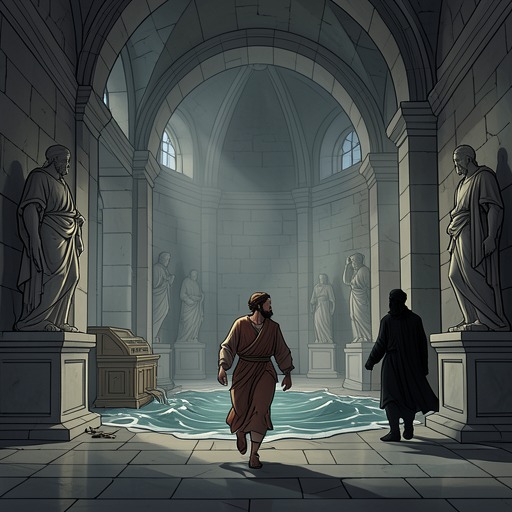
Piranesi’s understanding arrives as he walks home after observing the constellations. He describes it as a revelation: he knows the conclusion before he can retrace the reasoning that brought him there. His mind returns instead to the One-Hundred-and-Ninety-Second Western Hall in moonlight, where the hall’s beauty and calm, and the statues’ reverent-looking faces turned—or apparently turned—towards the Moon have made a lasting impression.
That image displaces the search’s central assumption. Seeking the Knowledge has encouraged Piranesi and the Other to treat the House as a riddle to unravel or a text to interpret. Under that logic, discovering the Knowledge would seem to extract the House’s value, leaving only scenery behind. The moonlit hall suggests the opposite: the experience of the place already possesses value, before it has been converted into an explanation or a usable result.
The House as an End in Itself
Piranesi states the conclusion directly: the House is valuable because it is the House. It is sufficient in and of itself, not a means to an end. This claim does not depend on proving that the Knowledge is impossible. Piranesi allows that it may or may not exist, but the uncertainty no longer governs what he chooses to pursue. He no longer intends to spend his time searching for it.
The distinction changes how the House can be approached. If it is only a code concealing a reward, its halls matter chiefly as clues; once the answer is found, their significance would be spent. If the House has intrinsic value, interpretation and discovery need not exhaust it. Its beauty and calm are not evidence pointing beyond the place but part of what makes the place worth attending to.
Knowledge, Utility, and Control
The realization also sharpens Piranesi’s unease with the powers the Other associates with the Knowledge. One example is the promised ability to control lesser minds. Piranesi rejects the premise that there are lesser minds: as he sees it, there are only himself and the Other, both intellectually keen and lively. He then questions the desirability of control even if such a hierarchy existed. The promised power therefore looks less like an unqualified benefit and more like an aim that needs moral scrutiny.
The Other later distinguishes the House from the knowledge that created it. He compares that knowledge to water that once flowed underground, gradually wore passages through stone, and then disappeared, leaving a cave system but not the water that formed it. The analogy separates origin from present value: the House’s existence need not preserve its cause as an accessible possession. The Other adds that Ketterley could not accept this because he thought in terms of utility and could not imagine anything existing without being usable. Against that instrumental view, the House’s value does not depend on recovering its maker’s knowledge or putting the place to work.
Consequences for Piranesi’s Search
Once he abandons the search, Piranesi imagines pursuing a different kind of science, following whatever paths the data indicate rather than subordinating inquiry to a promised prize. The prospect makes him excited and happy, and he is eager to explain the change to the Other. His response shows that relinquishing the Knowledge is not a rejection of curiosity or investigation; it is a change in what inquiry is for.
The concept consequently sets two ways of regarding the House against one another. One treats it as a store of useful secrets and measures its worth by what can be claimed from it; the other recognizes the place as worthy in its own right. Piranesi’s moonlit vision gives that second position its force, while his questions about control expose the ethical cost that can accompany the first.