Tsushima
PiranesiTides are the House’s recurrent movement of water, a life-supporting condition of its Lower Halls and a force capable of transforming its corridors into a perilous flood. They order Piranesi’s daily observations and calculations; when he discovers that four tides will coincide, this familiar environmental rhythm becomes an urgent warning, and during the flood it shapes both the struggle to survive and his later understanding of home.
The House’s tidal order
The Lower Halls are the domain of the tides. Their windows appear grey-green with moving water and white with foam, and the halls supply fish, crustaceans, and sea vegetation. Tides are thus not a decorative feature of the House but part of its provision for life. Their regular changes also govern the exposure of places that are usually underwater: during an unusually severe wind, the high tides rise higher and the low tides fall lower than usual. At low tide, a Lower Hall beneath the Thirty-Seventh South-Western Hall is left entirely without water, an uncommon opening in which seaweed, pebbles, starfish, and shells lie across the pavement.
This order is dynamic rather than fixed. The House’s weather changes after the ceilings of the Twentieth and Twenty-First North-Eastern Halls collapse: clouds drift through the broken ceilings into the Middle Halls, making the region colder and greyer. The episode establishes that the House’s environmental systems can be altered by structural damage. Tidal observation therefore takes place within a world where weather and architecture interact, and where changes in one part of the environment can affect conditions elsewhere.
Observation, calculation, and warning
Piranesi maintains a Table of Tides as one of his regular duties. He combines observations with equations he has invented and checks the calculations every few months for extraordinary events in the coming weeks. This practice makes tidal knowledge both empirical and practical: it is a record of recurring movement, but also a means of anticipating danger and protecting himself and The Other.
When he resumes the work after neglecting it, he discovers that a Conjunction of Four Tides will occur in less than a week. The discovery comes close to being too late. His last calculations covered a period that had ended more than two weeks earlier, and he recognizes that neglecting the table has put both himself and The Other in mortal danger. Rather than remain with his initial alarm, he returns to the calculations to estimate the consequences. Because the volume and force of the water are difficult to predict precisely, his forecast is a range: between forty and a hundred halls may flood. The uncertainty does not make the warning less useful; it defines the scale of the risk he must prepare for.
The flood’s course and consequences
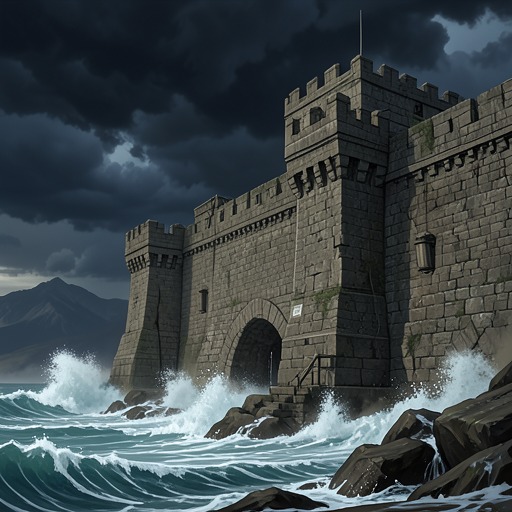
On the day of the flood, Piranesi wakes tense and recognizes from the air that rain has already begun in the Vestibules. By late morning, the first tide is ascending the staircase in the Ninth Vestibule, and water is spreading across nearby pavements. Later, as he watches The Other in the First Western Hall, water is filling the Second and Third South-Western Halls; the waves are already striking their walls. The developing flood is not a single sudden wall of water but a sequence of rising tides reaching different parts of the House.
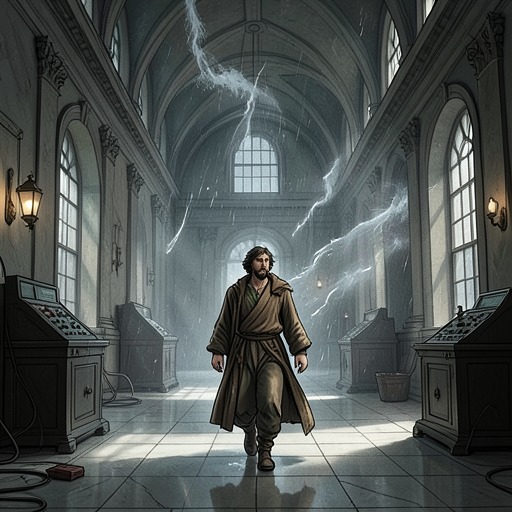
At noon, the last two tides rise in the Tenth and Twenty-Fourth Vestibules, filling the surrounding area with turbulent water. Piranesi and 16 take refuge high above the floor, on a cornice roughly seven metres up. The Other, instead of reaching the safety of his boat, goes to retrieve his gun and fires at them. The flood thus brings environmental danger into direct conjunction with human conflict: the rising water threatens everyone, while The Other’s conduct creates an additional danger for the people trying to escape it.
The waves eventually fall. Water drains through staircases into the Lower Halls, and the heads of the bottom tier of statues emerge above the surface again. Piranesi and 16 have survived, though the roar had prevented them from speaking and left them wholly occupied with saving themselves and one another. The receding water restores visibility to familiar landmarks, but it does not undo the changes the crisis has made in their circumstances. Piranesi later returns the dead to their allotted places and walks among the statues, aware that he may be seeing them for the last time before leaving with Sarah Raphael.
Memory, home, and the tides beyond the House
The tides remain part of Piranesi’s sense of belonging after the flood. He tells Sarah Raphael that the House is his home, even while its waters still lap against the walls and its statues drip. His decision to leave is difficult partly because it means facing the House’s future emptiness and his own solitude; he chooses to go with Raphael, but the departure does not erase his attachment to the place.
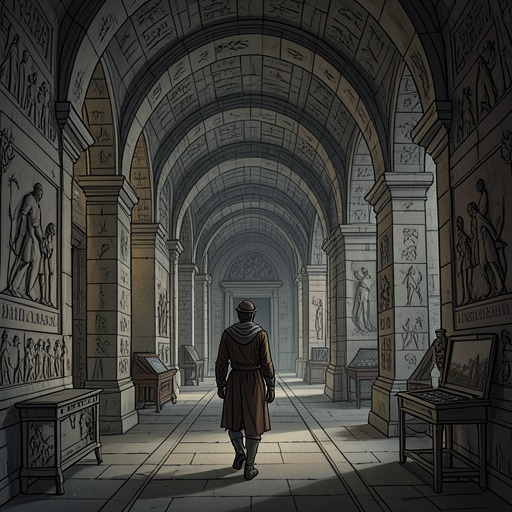
Years later, in the outside world, tidal patterns persist as an inward map. Piranesi recalls the seasons, ebbs, and flows alongside the halls and their intricate routes, and can mentally walk from a named vestibule to a named hall by recalling each turn and statue. In a dream he embraces a statue in the Fifth Northern Hall and feels he is home; on waking, he distinguishes that remembered home from the place where he now lives. Even an ordinary city snowfall evokes the sound of tides beating against marble walls, and the sound brings him calm. The tides therefore outlast their immediate function as a hazard or resource: they remain a sensory and spatial language through which Piranesi remembers the House and locates his connection to it.
Narrative significance
The tidal cycle gives the House both its material rhythm and its narrative pressure. In ordinary conditions, water sustains the Lower Halls and offers a familiar sound that accompanies Piranesi through daily life. In the Conjunction of Four Tides, the same system becomes catastrophic, and careful observation is what makes the danger legible before it arrives. The resulting flood exposes how survival depends on knowledge of place, preparation, and cooperation, while also revealing the limits of prediction: Piranesi can estimate the number of halls at risk, but not exactly how much water will come or where it will strike.
The motif also links environmental time to memory. Tides recur through seasons and calculations, while individual events—the warning, the flood, and the decision to leave—alter Piranesi’s relation to the House. In the concluding outside-world recollections, their ebb and flow has become a portable form of orientation. The House is no longer his immediate surroundings, but its waters continue to shape how he remembers home and finds moments of calm.