Animalcules
PossessionAnimalcules are microscopic life-forms whose presence turns water that seems pure into a crowded, active world. In Randolph Henry Ash’s writing, they embody the unsettling abundance revealed by magnification; in his collecting and experiments, they become objects of scientific inquiry that also bear on religious belief, evolutionary change, and the possibility of life continuing beyond individual death.
Appearance and Poetic Function
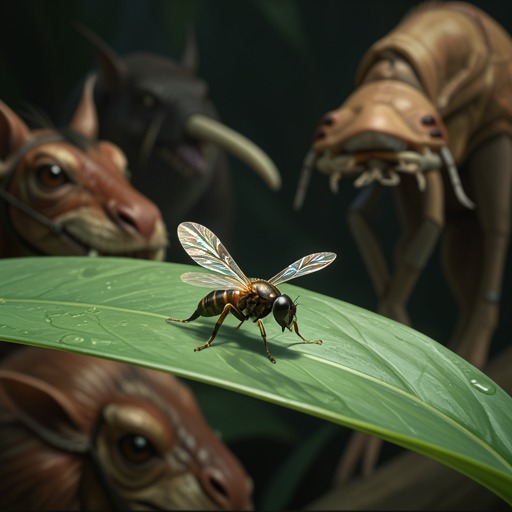
In a poem, Ash imagines a glass of water held to his lips as transformed by the microscope: what appears limpid and pure would instead be a seething multitude of animalcules. He compares their movement to dragon-tails, springs, coils, and hairlike fronds, then enlarges the image to whales crossing the oceans. The shift in scale makes the microscopic world feel vast rather than negligible: magnification does not simply clarify a familiar object but multiplies the world and unsettles the observer’s sense of its limits.
The image also makes seeing an interpretive act. Ash calls the optic lens a slicing sword, capable of dividing as well as multiplying what it reveals. The instrument discloses forms of life that ordinary sight misses, but it also changes the world into something newly strange. Animalcules therefore mark both the reach and the disturbance of scientific observation: apparent clarity gives way to complexity, without that complexity becoming fully comprehensible.
Ash’s Study of Microscopic Life
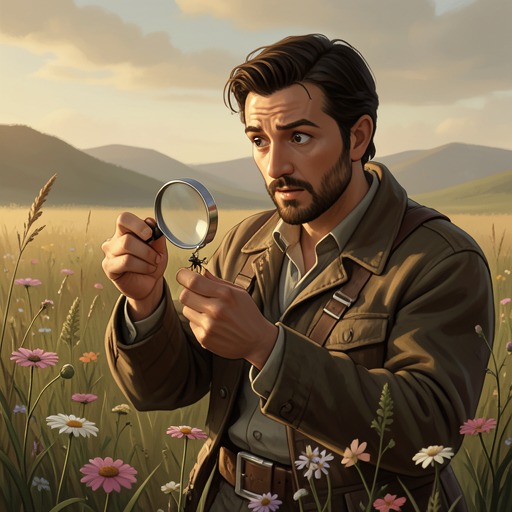
During his northern stay, Ash collected specimens in the mornings and kept them in pie dishes and other china vessels around his sitting-room. He described the arrangement to Ellen Ash as a disorderly, improvised landscape, then worked with his microscope in the afternoons. His particular attention to sea anemones belonged to a broader Victorian enthusiasm for keeping and studying small marine creatures in glass tanks and aquaria.
His investigations were not detached from the ethical concerns surrounding dissection. Collectors and investigators cut and examined delicate tissues in the hope of reaching the nature of life itself, while anti-vivisection arguments made the possibility of cruelty a visible part of the debate. Ash tested whether movements that might look like signs of pain continued after an organism’s death. He concluded that the responses he observed in primitive organisms were automatic rather than evidence of pain as humans understand it, a judgment that allowed him to continue his work while recognizing the demanding claims made by scientific knowledge.
Reproduction, Change, and Continuity
Ash’s interest in animalcules and other simple organisms led him toward questions of reproduction and development. Influenced by Richard Owen’s work on parthenogenesis, he experimented with hydras and plumed worms that could produce new heads or segments by budding. He also studied the apparent relation between jellyfish and polyps, and the capacity of hydras and polyps to form new creatures from cut parts.
These processes fascinated Ash because they suggested a continuity and interdependence among living forms. Reproduction without sexual congress, and the emergence of new organisms from fragments, complicated the idea of the individual as a wholly separate unit. For Ash, that biological continuity held out a possible answer to the fear of individual death, especially as confidence in a certain promise of Heaven weakened. The organisms did not settle that religious question, but their observed capacity for renewal gave it a material, investigable counterpart.
Science, Faith, and the Limits of Evidence
Ash’s fascination with microscopic life sits within a broader tension between scientific evidence and religious belief. Studying the beauty and intricate functioning of small organisms, he found it difficult to dismiss the possibility of design; at the same time, he considered the evidence for development through gradual change difficult to deny. His attention to life at small scales thus sustains competing explanations rather than resolving them in favor of either creation or evolution.
In a letter about spiritualism, Ash likewise distinguishes patient inquiry into living organisms and dead minds from attempts to obtain certainty through séances or planchette writing. He allows that forms of spirit or haunting may exist, but argues that they should be approached through sustained contemplation and scientific instruments such as microscopes and spectroscopes, not by treating alleged manifestations as proof. Animalcules belong to this method of disciplined attention: they are not answers delivered from beyond, but evidence encountered through observation, open to interpretation and capable of making the familiar world less certain.
Observation and Its Consequences
Ash’s work also exposes a contradiction in the culture of collecting. He condemns collectors for ravaging fragile shore habitats and destroying the natural forms they claim to admire, yet his own collecting, boots, scalpel, and killing jar contribute to the same damage. The desire to inspect life closely can therefore become destructive: the instrument that makes hidden organisms visible may also remove them from the environment that sustains them.
That conflict gives animalcules a significance beyond their role as illustrations of scientific progress. They belong to a living world that exceeds human perception, but the effort to know that world can alter or harm it. Ash’s writing holds both truths together: observation reveals astonishing abundance, while the pursuit of knowledge remains answerable for its methods and consequences.