Insects
PossessionInsects occupy a meeting point between poetry, natural history, and the Victorian debate over how life begins and changes. Christabel LaMotte writes poems about insect life, and Randolph Henry Ash responds by imagining a long poem of his own: a dramatic monologue about Jan Swammerdam, whose microscopic work disclosed the minute structures and activity of insects. Insects also become material for Ash’s later experiments, through which reproduction without sexual congress and the regeneration of organisms prompt him to think about life’s continuity and the fear of death.
Insect Life as a Poetic Subject
Ash admires LaMotte’s insect poems for bringing together the brilliance and fragility of insects with their capacity to bite, snap, and devour. He reads their subject not as decorative nature but as a challenge to poetic description: a truthful account of insect life would have to acknowledge behavior that resists idealization. The poems’ attention to such creatures also informs his understanding of LaMotte’s imaginative independence; he remarks that she does not seem to share the revulsion he associates with women’s responses to these life-forms.
The poems prompt Ash to question familiar assumptions about insect societies. He points to the mistaken belief that the communal centers of bees, wasps, and ants were governed by male rulers, and imagines that accurate description would require a poet to reckon with what observation had newly disclosed. Insects thus unsettle inherited categories as well as literary conventions: close attention to their lives can revise what people think they know about nature and social organization.
Ash’s Project on Swammerdam
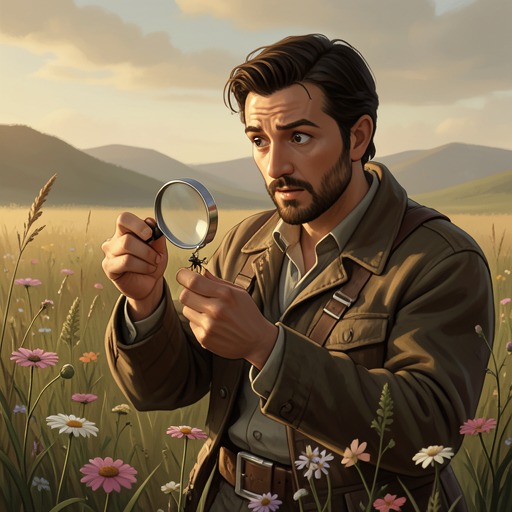
Ash proposes a long, dramatic monologue on Jan Swammerdam, rather than a lyric poem. He describes the project as the short, miraculous, and largely tragic life of the Dutch naturalist, whose optical instrument opened up the minute world of insects, just as Galileo’s telescope revealed the motions of distant celestial bodies. The comparison places the insect-scale and the cosmic within one field of inquiry, each made accessible by instruments that extend human sight.
Swammerdam’s work appeals to Ash because it joins scientific discovery to the particular details through which a life becomes imaginable. Ash recalls that Swammerdam made small ivory instruments for examining insects, choosing a less harmful material than metal. He contrasts those finely made tools with his own medium: words, which he calls the dead husks of other men’s words. The poem would have to animate another mind through language, drawing on the minute objects and acts of observation in which, Ash believes, a human consciousness inheres. His uncertainty about whether such a poem would contain Swammerdam’s mind or his own makes the project an exploration of both natural history and imaginative authorship.
Observation, Experiment, and Belief
Ash’s sustained interest in insect life belongs to a wider commitment to patient investigation. In a letter, he rejects attempts to obtain knowledge of the dead through spiritualist performances and favors prolonged study of minds and living organisms, aided by instruments such as the microscope and spectroscope. He does not deny that unexplained phenomena may exist; rather, he distinguishes speculation from methods of inquiry he considers tested and intellectually responsible. Insects exemplify the kind of subject whose intricacies demand observation rather than a shortcut to certainty.
His natural-history work also exposes a tension between religious belief and scientific evidence. While studying small marine organisms, Ash finds their forms and functioning difficult to contemplate without imagining a designing intelligence, yet he also finds the evidence for development through ordinary causes difficult to dismiss. His response is not a simple choice between faith and science: careful observation intensifies the question without resolving it. The correspondence similarly links the scientific study of life to uncertainty about religious narratives and the changing grounds of belief.
Reproduction and the Continuity of Life
Ash’s investigations extend from insect life to the reproductive systems of small organisms. Influenced by Richard Owen’s work on parthenogenesis, he conducts experiments with hydras and plumed worms that can produce new heads or segments by budding. He is also interested in the apparent relation between jellyfish and polyps, and in the capacity of fragments of certain organisms to become new creatures. These cases make reproduction and regeneration visible as processes that complicate the idea that individual life is bounded by a single body.
That possibility bears on Ash’s preoccupation with mortality. The apparent continuity among organisms seems to him potentially capable of modifying the idea of individual death, at a time when inherited certainty about Heaven is trembling. Insects and other small life-forms therefore matter not only as poetic material or objects of scientific attention: they become evidence in an unfinished inquiry into whether life persists through change, and how much observation can establish about that persistence.