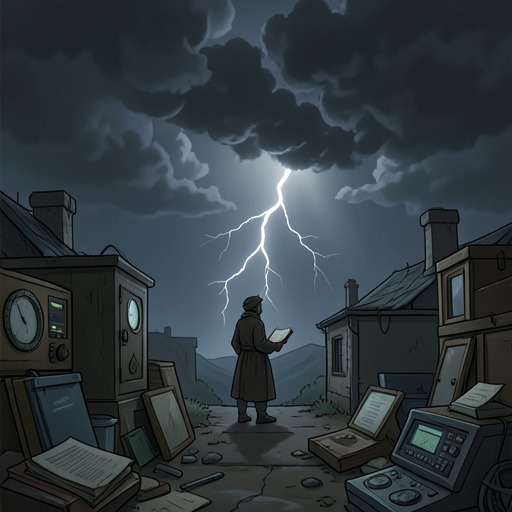
Spirits
PossessionSpirits in Possession are more than a question of whether the dead can return: they mark a contested boundary between life and death, matter and mind, faith and experiment. Across letters, recollections, and a séance account, their supposed appearances offer consolation to mourners and material for poetic or religious speculation, while inviting the suspicion that desire can shape what witnesses believe they see. The novel keeps these explanations in tension rather than granting either a simple victory.
Belief and the Border Between Worlds
In a discussion recorded by Crabb Robinson, Randolph Henry Ash requires experimental conviction before accepting spiritual manifestations. He argues, however, that historical imagination itself depends on a kind of poetic belief in the mental world of the people being studied. The distinction is unstable: imaginative sympathy can make another mind present, but Ash fears it may leave him without beliefs of his own. Christabel LaMotte declines to settle the question when the company asks her about rapping spirits, leaving the gathering’s disagreement open.
A later account of Brittany gives the question a different framework. There, death is described not as an absolute end but as passage between stages in an existence with multiple worlds that may interpenetrate. Uncertain places and states—night, sleep, and the meeting of land and sea—can become thresholds where messengers hover. In this account, the Celtic otherworld Síd is associated with a still centre rather than linear time, while Christianity is described as setting earthly life apart from the absolute destinations of Heaven and Hell. The contrast makes spirits part of a larger dispute over how reality is organized, not merely whether a particular ghost has appeared.
Christabel also considers whether contemporary interest in the spirit world might support the Celtic view. She refers to Swedenborg’s account of successive states of being, each with its own dwellings, temples, and libraries, and to efforts to obtain messages from beyond the veil. Her examples include spirit wreaths, messages laboriously tapped out, invisible music, and moving lights. Her report presents these as experiences she cannot explain, not as proof that resolves the matter. The uncertainty is sustained by the difference between testimony and demonstration.
Consolation, Testimony, and Skepticism
The emotional stakes of belief are explicit in a letter describing a séance held by Mrs Lees. The writer recounts a bereaved mother who said she held her dead infant on her knees and felt its weight and fingers; the child’s father was also said to have touched its hair. Light and perfume were reported as further signs. The account asks how maternal love could be mistaken, making grief a source of conviction while also exposing how difficult such conviction is to verify from outside the experience.
Ash’s response to a Spiritualist planchette message is sharply skeptical. In his letter to Mrs Cropper, he objects to the idea that Samuel Taylor Coleridge’s spirit should be made to perform parlour tricks or produce incoherent writing. He says he has attended demonstrations and regards fraud and communal hysteria as the likeliest explanations. At the same time, he locates the popularity of Spiritualism in a society unsettled by materialism and by challenges to inherited religious narratives. He rejects easy consolations and certainties, but recognizes the anxieties that make them attractive.
These competing accounts do not reduce belief to simple credulity or skepticism to indifference. Ash’s resistance is intellectual, yet the séance narrative shows that his approach is not detached when the possibility of a personal loss is at stake. Conversely, Spiritualist testimony speaks to real needs for comfort, but its emotional force cannot by itself establish what has caused the reported manifestations. The novel makes the difference between what a witness experiences and what an observer can prove central to the dispute.
The Séance at Yew Tree Lodge
The fullest confrontation occurs at a séance hosted by Olivia Judge at Yew Tree Lodge, where a group of Spiritualist women known as the Vestal Lights gathers to investigate spiritual claims. According to Mrs Lees’s account, Ash attends after a recent loss and requests that his identity and purpose be withheld from the circle beforehand. When he enters, she interprets his presence as a sceptical chill; she also senses, beneath it, an unusually strong spiritual sensitivity. That interpretation is hers, and the scene preserves her account as testimony rather than as an objective verdict.
The séance follows its customary conditions: the company sits around a table in near darkness and clasps hands. Mrs Lees describes a trance, a disturbing voice, raps, touch, and a large book thrown across the room. The voice denies that a child is present, then gives an answer about stones. These manifestations are not presented as transparent communications from the dead; the account leaves their source uncertain, even as the participants try to identify who or what is speaking.
The episode turns on a white wreath and Ash’s attempt to test the manifestation. A voice announces gifts of reconciliation; a white hand bearing a wreath appears above the table. As Mrs Lees rises to go into an inner room, Ash calls for lights and reaches toward the apparent manifestation. Mrs Lees collapses, and another participant loses consciousness. Ash says he has caught the medium’s wrist, but the account questions how his explanation fits the reported positions of the people and the wreath. The scene thus supplies neither an uncomplicated supernatural confirmation nor a wholly conclusive account of fraud.
The aftermath sharpens the disagreement. The second participant remains unconscious for two days and, on recovering, is said to be unable or unwilling to speak, eat, or drink. Mrs Lees and Olivia Judge describe Ash’s intervention as destructive and insist that his conduct disturbed vulnerable participants and interrupted an attempted communication. Ash, for his part, says that he detected cheating and presents himself publicly as a detached observer. The competing descriptions make the séance a conflict not only over spirits but over who has authority to interpret what happened and whose testimony deserves credit.
Visions, Material Forms, and Narrative Function
A letter found among Priscilla Penn Cropper’s papers offers a further account of spiritual perception. Its writer disclaims the ability to summon spirits but describes seeing spirit hands, instruments sounding in different places, and Mrs Lees apparently crowned with stars. The writer also claims a power of scrying: images first appearing as points of light and then seeming to thicken into solid presence. The examples include a woman sewing, a detailed gold fish, a clock later recognized in a room, and a mass of feathers. The letter asks what kind of bodies such presences possess and whether they are resurrected bodies, temporary material forms, or likenesses of the dead.
The language of those questions makes materiality itself part of the mystery. Dust, flesh, flowers, and the body offered as medium are imagined as matter that might disperse, persist, or be gathered again. In the séances, the alleged spirits are likewise encountered through objects and physical signs: a wreath, a book, music, touch, light, or a voice. Those signs may be read as contact with the dead or as products of performance and expectation; they do not settle the matter simply by appearing tangible.
Spirits also connect private grief to the novel’s broader concerns with imagination and evidence. The séance controversy shows how a sincere search for communication can coexist with theatrical effects and skeptical scrutiny, without making any one witness’s account final. Ash’s poetry and the accounts written about him further complicate the boundary between imaginative presence and spiritual presence. What remains is not a confirmed map of the afterlife, but an unresolved encounter among longing, interpretation, and the limits of proof.