Polyps
PossessionPolyps are marine organisms that become central to Randolph Henry Ash’s natural-history observations and experiments. Their capacity to regenerate from fragments offers him a concrete example of life continuing through change, sharpening the novel’s questions about development, death, and the reach of scientific explanation.
Observation and Collection
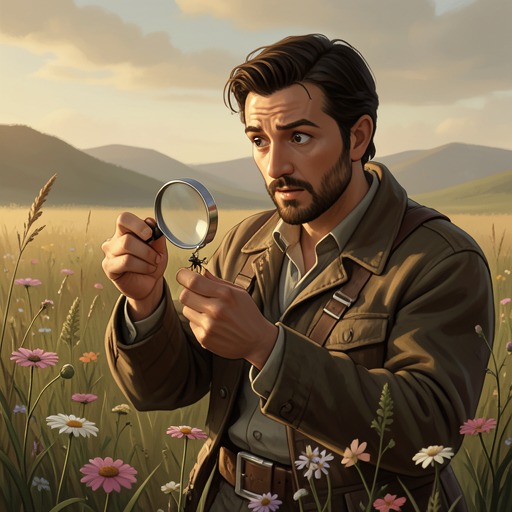
During his Yorkshire expedition, Ash studies marine life in the evenings after walking and dissection. In a letter to Ellen Ash, he describes keeping Polyps alongside other specimens in plain yellow pie dishes, having abandoned tall specimen jars. Their placement among varied organisms makes the study part of a sustained investigation rather than an isolated curiosity.
The coast is not simply a backdrop to this work. At Filey Brigg, Ash reaches into a deep pool to retrieve a recalcitrant Polyp, and a wave carries off a net he had left beside him. He escapes unhurt, with only scratches, and expects to return with his marine specimens. The incident places close observation within an environment that can interrupt and endanger the observer’s careful collecting.
Experiment and Regeneration
Ash’s interest in Polyps belongs to a broader study of reproduction. Influenced by Richard Owen’s work on parthenogenesis, he experiments on hydras and plumed worms, whose bodies can produce new heads or segments through gemmation. He also investigates the relationship between Polyps and the Medusa, or transparent jellyfish, which appear to be unfertilised buds of certain Polyps.
His experiments include removing hydra tentacles and cutting Polyps into pieces, each of which becomes a new creature. The result makes bodily division more than a destructive act: in these organisms, fragmentation can generate further life. Ash sees this as evidence of the continuity and interdependence of living forms, and entertains the possibility that such continuity might complicate the idea of individual death.
Science, Belief, and Mortality
The Polyps’ regenerative capacity does not settle Ash’s religious questions. Their intricate functioning makes it difficult for him not to imagine a designing Intelligence, yet he also feels the weight of evidence for the Development Theory: change unfolding over immense periods through ordinary causes. His observations hold these explanations in tension rather than allowing one to erase the other.
The experiments also belong to a period of intense interest in dissection and the elusive nature of life. Ash’s work with small organisms leads him to consider whether life persists through processes that exceed the lifespan of an individual creature. The Polyps thus give physical form to a question that remains unresolved: whether continuity in nature can answer the fear of death, or whether it only shows how life changes and propagates beyond any single body.