Hydras
PossessionHydras are small organisms in Randolph Henry Ash’s natural-history studies whose ability to regenerate makes them a striking example of life continuing through division and renewal. Ash’s experiments on them connect precise observation to a larger question: whether the interdependence of living forms can unsettle the idea that individual death is final.
Observation and Experiment
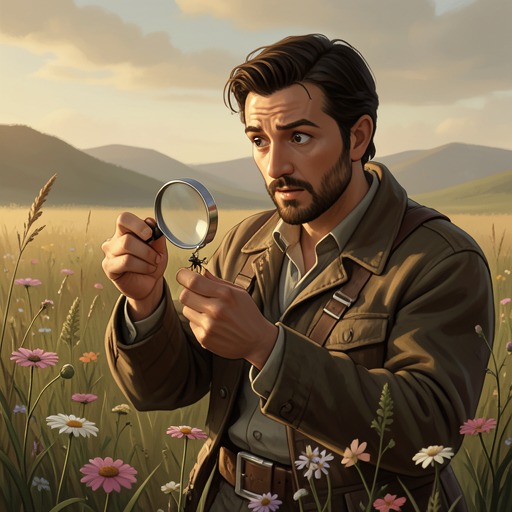
During the Victorian period’s intense interest in anatomy and the workings of life, Ash studied reproduction in simple organisms. Influenced by Richard Owen’s work on parthenogenesis, he experimented on hydras and plumed worms, which could grow new heads and segments from a single tail through a process called gemmation. By cutting hydra tentacles and dividing polyps into fragments, he observed that each fragment could become a new creature.
The experiments were part of a broader practice of close dissection and microscopic inquiry. Ash sought to distinguish automatic responses in primitive organisms from sensations that could properly be called pain, and his observations led him to regard their apparent writhing and shrinking as reflexive rather than evidence of felt suffering. The work thus placed the hydra within a scientific investigation that joined questions of reproduction to questions about the limits and responsibilities of experimental knowledge.
Regeneration and the Continuity of Life
The hydra’s capacity to renew itself fascinated Ash because it suggested that life might be continuous and interdependent rather than confined to separate, self-contained individuals. A severed part that became a whole creature complicated the boundary between an organism’s destruction and its persistence: what looked like an ending could also become a beginning.
For Ash, this biological pattern carried emotional and philosophical weight. In an era when confidence in religious assurances of Heaven could falter, the possibility that life continued through recurring processes offered a way to reconsider the fear of individual death. The hydra did not prove personal survival after death; instead, its regeneration gave Ash a natural phenomenon through which to imagine continuity without relying on spiritual claims.
Scientific Inquiry and Religious Uncertainty
Ash’s reflections on hydras belong to a wider tension between scientific evidence and inherited belief. In a letter to Ellen Ash, he describes examining marine organisms in plain yellow pie dishes and finding their intricate forms difficult to reconcile with a simple rejection of design, even as he acknowledges the evidence for gradual development through ordinary causes over immense spans of time. Close study sharpens rather than settles the question: beauty and function invite religious interpretation, while observed change supports evolutionary explanation.
That uncertainty also shapes Ash’s response to spiritualism. He rejects séances and planchette writing as unreliable routes to knowledge of the dead, favoring patient study of minds and living organisms, including the microscope and spectroscope. His interest in hydras exemplifies that preference: regeneration matters not as a supernatural message but as a biological process whose implications must be approached through observation and disciplined thought.
Narrative Significance
Hydras make a small organism bear a large conceptual burden without reducing its biology to proof of a human hope. Their regeneration gives Ash a concrete instance of life’s capacity to renew itself, while leaving unresolved whether such continuity answers the human fear of death. The creature therefore stands at the meeting point of experiment, religious doubt, and poetic imagination: its observable transformations invite metaphysical questions but do not close them.