Roland and Maud’s reconciliation
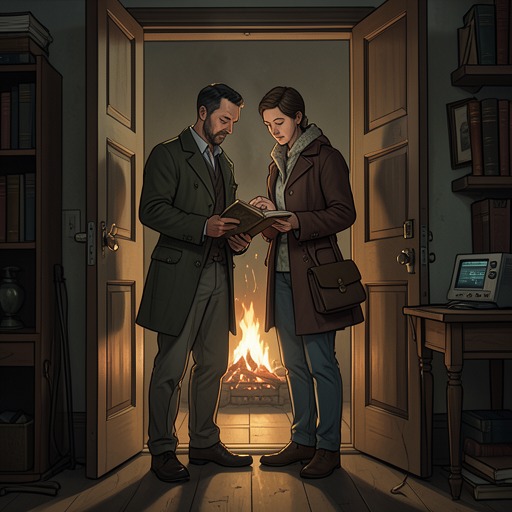
PossessionRoland and Maud’s reconciliation is the point at which their intellectual partnership becomes an openly acknowledged love. In a conversation about what will follow the discovery of the letters, each has to confront the personal history and guardedness that had kept their growing attachment uncertain. The scene moves from questions about practical consequences to frank admissions of love, then ends with their decision to be together. Its emotional change is reciprocal: neither simply persuades the other, and neither enters the relationship without reservations.
From the letters to the question of what comes next
The scene begins with Maud asking what happens next to them. Roland first answers in terms of the practical future, telling her that she will face legal problems and substantial editorial work, and saying that he has made plans. Maud proposes that they edit the letters together. Roland declines the offer as unnecessary and recognizes that she, rather than he, has become a central figure in the story. His explanation also acknowledges his own compromised entry into it: he became involved by stealing in the first place, and says he has learned a great deal.
That exchange makes the newly discovered correspondence more than a professional problem. The letters still carry legal and editorial consequences, but the question of their future together now stands alongside the work of editing them. Roland says that Ash and Vico have taught him something about poetic language and that he has things he must write. His attention is turning from the stolen documents and the scholarly contest around them toward his own writing, even as Maud tries to imagine a shared intellectual project.
The sources of their guardedness
When Maud says that Roland seems angry, he first denies it, then admits that he has been. He connects his resentment to their different positions: Maud has her certainties, literary theory, feminism, and an ease within a world he associates with Euan, while he has felt that he had nothing. He adds that he had grown attached to her and that male pride, though he knows it to be outdated and unimportant, still mattered to him. The confession identifies an asymmetry in confidence and belonging that has shaped his feelings, without reducing his attachment to that grievance.
Maud’s difficulty is different. When she tries to say what she feels, she explains that strong feeling makes her go cold and unable to speak; she does not consider herself good at relationships. She links this response to the way people treat her appearance as a kind of possession. Her explanation makes her reserve a defense against being claimed by others, not evidence that she feels nothing. This is why Roland’s assurance that he would not threaten her autonomy matters: the possibility of intimacy has to coexist with Maud’s need to remain self-governing.
Mutual declaration and decision
The guarded explanations give way to an unmistakable admission. Maud tells Roland that she loves him, while also saying that she would rather not. Roland answers that he loves her too, though he describes the feeling as inconvenient now that he has acquired a future. He contrasts their experience with the beliefs they had grown up holding and acknowledges the intensity with which Maud has come to command his attention. The exchange does not erase practical uncertainty; it makes their feelings explicit despite it.
Roland proposes finding a modern way forward, mentioning Amsterdam as a possibility. The suggestion is provisional rather than a settled plan, but it answers Maud’s concern about autonomy with the prospect of a life they might shape for themselves. He then proposes that they go to bed and work things out. Maud says that she is afraid of that too; Roland calls her a coward and promises to take care of her. The scene presents his reassurance alongside her continuing fear, so their decision to be together does not depend on pretending that intimacy has become simple.
A new beginning, not a closed future
The narrative marks their first night together without making it a resolution of every difficulty between them. The next morning, the world seems newly altered, but the description of freshness is inseparable from destruction: the aftermath carries the associations of damaged leaves, wood, and sap, as well as the tartness of bitten apples. Death and destruction coexist with liveliness and hope. The image gives the reconciliation a double charge: their relationship begins through a rupture in their former lives, yet that rupture also opens the possibility of renewal.
The scene’s placement before the postscript reinforces its importance while leaving the future open. Roland and Maud have moved from shared research to an acknowledged relationship, but the practical work surrounding the letters and the plans they have only begun to discuss remain ahead of them. Their reconciliation is therefore a decisive change in the present, not a claim that love removes legal, scholarly, or personal complications.