Maia’s birth and concealed parentage
PossessionMaia’s birth and concealed parentage transform a private separation into a secret carried across generations: Christabel LaMotte gives birth to her daughter in Brittany, then arranges for Ash’s sister Sophie to raise the child in England as her own. The concealment grants Maia a secure place in a family, yet denies her and Randolph Henry Ash the knowledge of their relationship; much later, that hidden descent changes the meaning of the documents Maud Bailey has been studying.
Separation and the decision to conceal
In her final account to Ash, Christabel says that when they parted she understood, though without certain proof, what might follow. They had agreed to leave one another and never look back. She resolved to keep that agreement out of pride and loyalty, and made arrangements to take responsibility for herself and the child. Rather than seek a shared future with Ash, she chose a route that would preserve their separation while making provision for the baby.
Christabel enlisted her sister Sophie as the one person who could help. Sophie arranged a deception that Christabel describes as more suited to romance than to her former quiet life. Necessity, she says, sharpened their wits and strengthened their resolve: their daughter was born in a convent in Brittany, then carried to England. Sophie took the child and brought her up as her own, as the sisters had agreed. The account establishes both the plan and its practical sequence, while leaving the specific arrangements of the birth and journey undescribed.
A daughter raised as Sophie’s own
Christabel later credits Sophie with loving and cherishing the girl as well as anyone other than her true mother could. Maia grows up in England, runs free in its fields, and marries a cousin in Norfolk; Christabel presents her as a squire’s wife, comely and established in a life of her own. These details show that the concealment did more than hide a name: it gave Maia a publicly legible family identity and a place within a household, even as it separated her from her biological parents.
The secret also shaped what Sophie’s family believed about its papers. After Christabel’s death in 1890, Sophie sent a package of her sister’s papers and poems to her daughter May, Maud Bailey’s great-great-grandmother. In the covering letter Sophie reportedly said that Christabel had wished May to have the works and had believed in passing them down through the female line. The family’s account makes the papers another inheritance carried through women, alongside the concealed family history that their contents would eventually help disclose.
Christabel’s reasons and the cost of silence
Writing to Ash in old age, Christabel admits that she feared he would want to take Maia for himself and Ellen Ash. She insists that Maia was hers because she had borne her, and says that she therefore hid the child from Ash and hid Ash from the child. Her confession gives the concealment an intimate motive: not simply the preservation of appearances, but a mother’s fear of losing her daughter. She recognizes the cost as well, imagining a space in Maia’s life that belongs to the father she never knew.
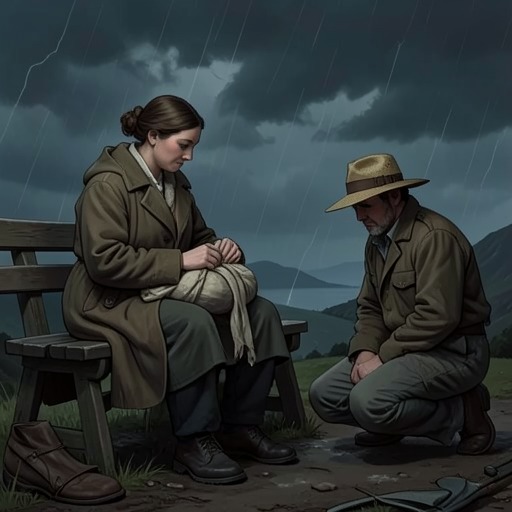
Christabel’s earlier pregnancy had been surrounded by a different, more immediate silence. In Sabine de Kercoz’s diary, the pregnancy is visible to the household but cannot be openly discussed. Sabine records that Christabel is heavily pregnant, while her father cannot bring himself to tell her that the child is welcome or to speak plainly about practical arrangements. He fears that confronting her might drive her into alienation or despair; meanwhile, Christabel accepts his kindnesses and turns conversation toward philosophical and literary subjects. The diary records the family’s uncertainty before the birth, while Christabel’s later letter explains the deliberate plan that the household could not openly name.
The birth and concealment also sit against the limited choices available to women living independently. Blanche Glover’s account of the failure of her and Christabel’s attempt at a self-sufficient life describes their hope of living usefully and fully as single women, without dependence on men or outside help, and their recognition that hostile circumstances and their own insufficient resources defeated the experiment. Elsewhere, Ellen Ash confronts the practical vulnerability of an unmarried pregnant servant, Bertha, who refuses to identify the father or demand his support. These parallel accounts do not make the women’s situations identical, but they show how pregnancy, economic dependence, and social judgment constrain the choices around Maia’s birth.
Delayed revelation and family history
The truth reaches the reader through a letter written decades after the events, addressed to a gravely ill Ash under cover to Ellen. Christabel calls it, in some sense, her testament: she asks for forgiveness, blesses Ash, and acknowledges that she had kept both him and Maia from knowing what might have been a loving relationship. The retrospective form makes the secret arrive as an act of belated disclosure, after the daughter has grown up and the parents’ separation has become irreversible.
The later discussion of inheritance clarifies the secret’s wider consequences. Euan MacIntyre observes that, under the period’s law, an illegitimate child could not inherit, and suggests that Victorian families sometimes concealed a child within a legitimate family to give the child a decent chance. He points out that Maud Bailey might otherwise have owned the body of documents outright. James Blackadder then recognizes the startling convergence: Maud is descended from both Ash and LaMotte, the two figures whose history she has been investigating. Maia’s concealed birth thus joins private protection, family transmission, and legal exclusion; it makes Maud’s scholarship an inquiry into her own origins as well as theirs.