The exhumation of the Ashes’ grave
PossessionMortimer Cropper’s exhumation of Randolph Henry Ash and Ellen Ash’s grave is at once a successful recovery and a grotesque interruption of scholarly possession. Cropper reaches the buried metal box and removes it from the churchyard, but a storm destroys his escape route and brings his rivals to him. When the box is finally opened, it yields the intimate objects and correspondence that the dead had kept from public view, making the excavation’s success inseparable from its violation of privacy and the uncertainty of ownership.
Preparation and Motive
Cropper and Hildebrand Ash establish themselves at the Rowan Tree Inn, where Cropper has taken the best room, and spend a week walking the Downs in all weather. He speaks of buying a home nearby and shows interest in forestry and organic farming. The domestic prospect contrasts with the purpose of his visit: on October fourteenth, he and Hildebrand travel to Leatherhead, then purchase heavy-duty spades, forks, and a pickaxe for cash and hide them in the Mercedes.
That afternoon they inspect the churchyard around the Ashes’ grave. The church is locked, and a notice identifies it as part of a group of three parishes under the Reverend Percy Drax. Cropper’s irritation at Drax’s obscure, veiled display of Ash’s books and inkwell reveals how closely his scholarly devotion is bound to access and control. The next night, he and Hildebrand use the purchased tools to seek the specimen box Cropper believes was buried with the couple. The distinction between an authorized visit to a scholar’s memorial and a clandestine entry into the graveyard quickly collapses: they have brought tools for digging, not for study.
The Night Excavation
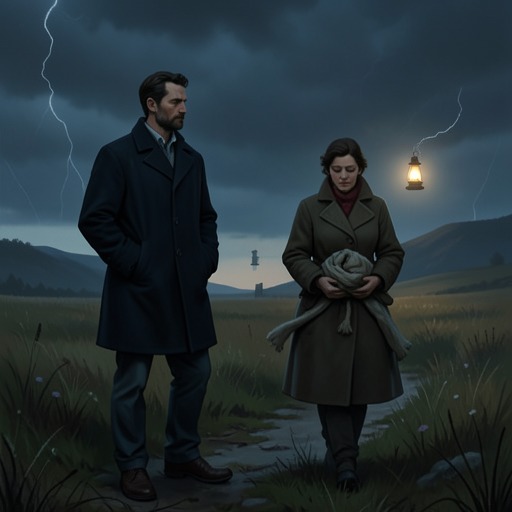
Cropper waits until one in the morning. With the Mercedes parked near the church gate, he and Hildebrand take storm lanterns and the implements from its boot and make their way through wet, slippery ground to the grave. A white owl circles the church tower as they approach. Cropper reads the moment as confirmation of his own excitement and certainty, but when Hildebrand asks where the object lies, Cropper recognizes that his precise mental picture may be something he has imagined through repeatedly envisioning the box’s reburial. He nevertheless trusts intuition and orders them to start at the head of the grave and dig methodically toward the feet.
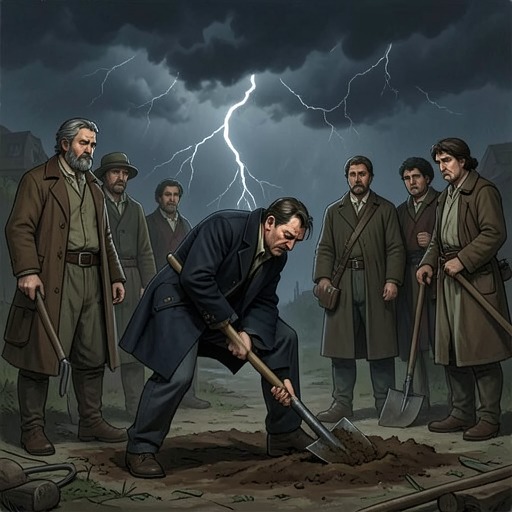
The work becomes physical and increasingly transgressive. They cut and stack turf, throw up clay, flints, roots, small animal bones, and stones, and Cropper digs with mounting exhilaration. He feels he has crossed beyond the limits of ordinary scholarly conduct and takes pleasure in the work’s strenuous immediacy. A gust of wind briefly lifts his discarded jacket; for the first time he fully registers that the pit contains the remains of Randolph and Ellen. The realization does not stop him. He pauses, sensing an unsettling presence, then resumes as the storm strikes.
Hildebrand urges him to stop and seek shelter as the wind grows dangerous, but Cropper refuses. He strikes metal, scrabbles in the earth, and brings up an oblong object coated in corrosion. Sitting on a nearby stone, he clutches the box and tries to prise open a corner with his knife. The recovery confirms that the target was not merely a product of his imagination, but the storm immediately makes possession precarious: rain and wind batter the church, tear tiles from its roof, and move among the trees with a force the scene renders almost animate.
The Storm and the Interrupted Escape
Cropper orders Hildebrand to fill the grave while he carries the box back to the Mercedes. The storm has made the churchyard a shifting obstacle course. As Cropper crosses it, the ground quakes; a huge mass of branches and earth falls across the car, blocking the route to the inn. Returning toward the grave, he sees the yew tree lean and then crash across it, covering the place where he had been digging. With the grave obscured and the car gone beneath the fallen tree, his planned escape is cut off from both directions.
Hildebrand calls for help, and a flashlight appears by the church. The figure with it speaks to Cropper, while Hildebrand crawls across the grass toward safety. When Cropper tries to run, he finds himself surrounded by fallen trees and other barriers. The light reveals Roland Michell, Maud Bailey, Leonora Stern, James Blackadder, and Beatrice Nest among the branches. Their arrival transforms the attempted clandestine recovery into a confrontation: the scholar who came to take the box is caught holding it, while his opponents have reached the scene in time to see the consequences of his expedition.
It takes the group an hour and a half to make their way on foot back to the Rowan Tree Inn. The researchers had driven from Mortlake as the storm’s effects were becoming visible, bringing a small saw from Blackadder’s Peugeot and a walkie-talkie supplied by Euan MacIntyre. They clamber over and under fallen trees and vegetation, helping one another along the way. At the inn they join stranded lorry drivers, motorcyclists, and firemen; the power is out, and the landlord provides candles while pans of water boil on the kitchen Aga. The scholars are wet, dirty, and temporarily too exhausted by their shared survival to give way to anger. Cropper, however, still holds the box.
Opening the Box
Once the group has returned, Cropper oils the box’s join and works at its rust with a knife. The lid eventually springs open. Inside is Randolph’s cloudy, stained but intact glass specimen container. Cropper opens that as well and removes an oiled-silk bag containing a hair bracelet with a silver clasp shaped as two joining hands, a blue envelope holding a long, finely plaited strand of pale hair, and another oiled-silk package with a thick bundle of ribbon-tied letters. A once-white sealed envelope, addressed to Randolph and marked to be delivered under cover, lies with them.
Cropper identifies the bundle as the lovers’ letters, connecting the objects to the concealed history the researchers have been pursuing. The sealed envelope brings the question of possession into the room rather than resolving it: Euan observes that its ownership is uncertain if it was never opened, since it might belong either to its sender or to its intended recipient, in whose grave it was found. The contents establish what Cropper has recovered, but they do not settle who has the right to claim, read, or publish them.
Consequences and Significance
The storm both enables and frustrates Cropper’s project. He succeeds in finding and removing the box, yet the collapsing trees conceal the grave, destroy his car, and leave him stranded among the scholars who oppose his solitary claim. The episode’s shared return to the inn offers temporary communal safety rather than a clean resolution of the conflict. In that cramped refuge, the box remains physically in Cropper’s hands while the people, objects, and questions associated with it are gathered around him.
The excavation also reverses the usual movement of archival discovery. These materials were not simply misplaced documents waiting for a scholar to find them: in Ellen’s account, she burned what she believed should not be exposed and buried the couple’s letters with Randolph, intending them to remain hidden until she joined him. The hair, letters, and sealed message therefore survive as the residue of deliberate choices about memory, intimacy, and the threat of future biographers. Recovering them makes historical knowledge possible, but the grave’s disturbance and the unresolved ownership of the unopened letter prevent discovery from appearing ethically neutral. Cropper’s triumph is real; so is the resistance, material and social, that makes possession more than a matter of finding the right object.