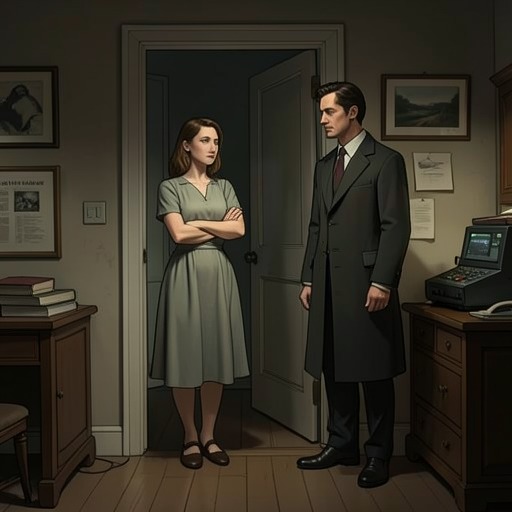
Val and Yuhan start dating and decide to get married
PossessionVal and Euan MacIntyre’s relationship grows from companionship into an intimate partnership after Roland’s disappearance has left Val to reassess what she wants. Their developing bond is marked by ordinary pleasures Val has long neglected, an ease with one another, and a mutual recognition of how they work together. When Val later tells Roland she will marry Euan, the decision makes the change unmistakable: she has chosen a future beyond her relationship with Roland.
From Roland’s Disappearance to New Companionship
Val had assumed that Roland’s sudden disappearance meant he wanted to be with Maud Bailey. In anger, she called Maud’s flat and learned only that Maud was away; the American voice answering the phone said that it was not privileged to know where. Val complained to Euan, who pointed out that she had said the relationship with Roland was over. When she challenged how he could know, he explained that he had been watching and assessing the evidence for weeks. His attentive reading of Val’s situation precedes their own relationship and helps shift the focus from Roland’s absence to the connection forming between Val and Euan.
By the time Val is staying with Euan in the house by the stables at Newmarket, their companionship has opened a space for pleasure. At the races, she watches the horses pass in a flash, then asks Euan who won because the event has gone too quickly for her to see. Afterward the three of them wander off together, buy champagne, smoked salmon, and lobster salad, and Val realizes that she has done little simply for pleasure in as long as she can remember. The outing is not a grand declaration of love; its importance lies in the contrast it creates with a life in which enjoyment has been reduced to a film or an evening at a pub.
Intimacy and Shared Pleasure
The relationship becomes physical and domestic as Val stays in Euan’s home. The narrative places them in the stable-side household and its ordered surroundings, then follows them into a bedroom described through its cream and rose-coloured furnishings. Their closeness is presented without turning it into a declaration of permanent commitment: at this point, it is a new experience of intimacy and pleasure, set against Val’s earlier sense that she had done little for herself.
Val’s conversation with Euan makes the partnership’s particular character clear. She apologizes that she does not know why he likes her; Euan answers that they work together in bed. His reply joins physical compatibility to a language of collaboration, rather than offering a solemn explanation of love. Their exchange gives the relationship a light, candid tone, while showing that Val is still trying to understand what Euan sees in her and what their intimacy might mean.
The Newmarket Setting and Val’s Changed Outlook
The racing sequence gives the relationship a setting in which excitement, waiting, and brief release become part of Val’s renewed capacity for enjoyment. She watches the empty track, waits for the sound of hooves, and sees the field sweep past before she can register the result. Euan’s answer that they have won, through the horse The Reverberator, draws her into a shared occasion. Later, when she looks at the race programme, she notices the joke in the horses’ names, including White Nights, named from Dostoevsky and Carroll’s Alice. The details make pleasure social and immediate: Val is not only watching but sharing the day with Euan and the others.
The house by the stables extends that change beyond the racecourse. Val and Euan walk around the orderly yard, where the horses accept apples, and then spend the evening together at home. The comfortable setting and their ease within it contrast with the uncertainty surrounding Roland’s disappearance. The contrast does not prove that Val’s doubts have vanished; it shows instead that she has begun to inhabit a different possibility, one grounded in present company and shared enjoyment.
Marriage and the Consequence for Roland
The relationship’s decisive turn is revealed when Val encounters Roland again. He notices that she looks happy, and she replies that she decided she could be. Roland has been trying to find her and asks whether she is all right; Val says she thought that if he could vanish, she could too, and so she did. Her withdrawal answers his disappearance on its own terms, while also marking that she has not simply waited for him to return.
Val then tells Roland that she is going to marry Euan. Roland says he is glad, and Val hopes he is not altogether glad. The exchange leaves a trace of their former attachment without undoing her decision. The marriage is the clearest outcome established for Val and Euan’s relationship: she names a commitment to Euan directly, while her pointed hope that Roland feels something more than uncomplicated approval acknowledges the emotional cost and residue of the past. The scene therefore confirms both a new future and the continuing tension between Val’s independence and Roland’s belated concern.