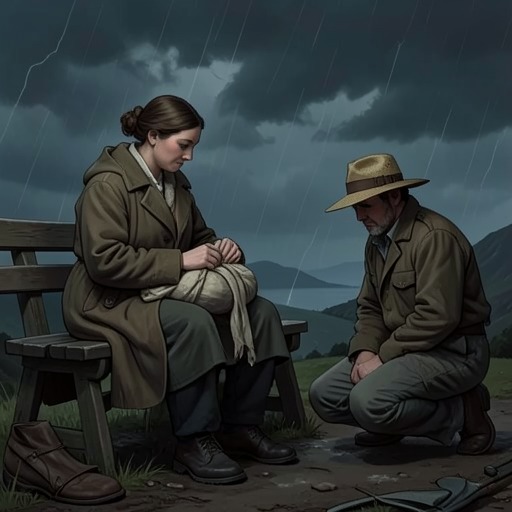
The 1868 meeting between Ash and Maia
PossessionIn the postscript dated 1868, Randolph Henry Ash encounters his daughter Maia Thomasine Bailey in a summer meadow without disclosing his identity to her. The meeting gives private, bodily form to a parentage that had been concealed across generations: Ash sees the likeness of Christabel LaMotte in the child, while Maia believes herself to resemble the father who has raised her. Their exchange is tender but unclaimed, and the message Ash entrusts to her for her aunt is lost before it can be delivered.
Causes and Background
The scene arrives after the novel has established how Maia’s origins were hidden. In a letter explaining the past, Christabel says that after parting from Ash she feared the consequences of their relationship, arranged to give birth in Brittany, and asked her sister Sophie to help her carry out a deception. The child was taken to England and raised by Sophie as her own. Christabel describes the arrangement as a decision made under necessity, and says Sophie loved and cherished the girl as though she were her true mother.
The family history had also been obscured by inheritance and the transmission of papers. After Christabel’s death in 1890, Sophie sent her papers and poems to her daughter May, explaining that Christabel had wanted her work to pass down the female line. Much later, when the concealed ancestry is discussed, Euan points out that an illegitimate child could not inherit at the time; Maud might otherwise have owned the documents outright. The postscript therefore does more than add a private meeting to Ash’s biography: it makes visible the family line and legal conditions that shaped both the child’s upbringing and the later custody of the papers.
The Meeting in the Meadow
The narrator first frames the encounter as one of those events that leaves no discernible trace in what people say or write, though later events do not therefore proceed as if it never happened. On a hot May day, a girl in a blue dress and white pinafore swings on a gate, making a daisy chain, as a tall, bearded wanderer approaches with an ashplant. Ash asks where he is and the name of the house below, though he already knows the place, then asks the child her name. She gives him Maia Thomasine Bailey, explains that she is called May as well, and says her parents and two brothers live in the house.
Ash answers her name with allusions to myth and landscape: Maia, he tells her, was the mother of Hermes, and he knows a waterfall called Thomasine. The child counters with the more immediate knowledge of her own life, recalling a pony called Hermes and saying she has never heard of a waterfall with that name. The exchange sets two kinds of knowing beside one another—Ash’s learned associations and Maia’s lively, practical experience—without making the child a passive audience for his references.
When Ash says that he thinks he knows her mother and that Maia has her mother’s look, the girl replies that nobody else says so and that she thinks she resembles her father, whom she describes as strong and kind and someone who takes her riding. Ash agrees that she also has her father’s look. He puts his arms around her waist briefly and matter-of-factly, lifts her from the gate, and sits with her on a hummock. The narration distinguishes their unequal memories: Ash recalls the meeting with absolute clarity, while Maia remembers it more vaguely as the century passes. She tells him of a pleasant life, her amusements, and her ambitions; he remarks on her happiness, and she confirms it.
Gifts, Recognition, and What Remains Unsaid
At Maia’s request, Ash makes her a crown from pliant twigs and gathers into it greenery and flowers, including ivy, ferns, grasses, bryony, roses, and honeysuckle. He fringes it with belladonna and warns her not to eat it; she answers scornfully that she already knows what she must not eat. The crown turns the meeting into an exchange of small creations, with the child both receiving Ash’s handiwork and responding to it in her own assured voice. When he names her a fairy’s child, Maia says that an aunt is always telling her poems, though she does not like poetry.
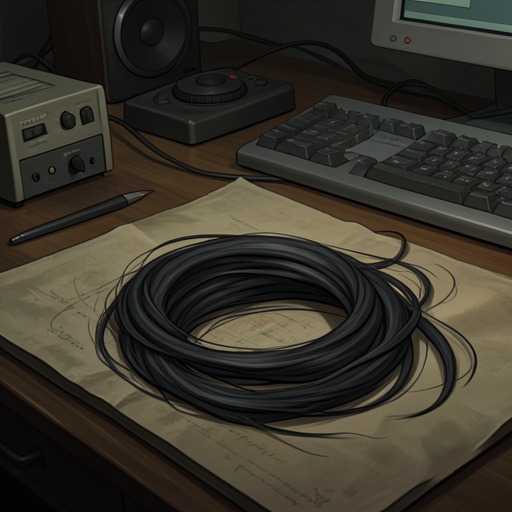
Ash then takes out pocket scissors and gently cuts a long lock of her buttercup-gold hair. Maia plaits it for him so that he can keep it tidily; he winds the braid into a fine coil and puts it at the back of his watch. The keepsake makes the encounter tangible without making its meaning explicit to the child. Ash is a poet seeking the Belle Dame Sans Merci, but instead of reaching the woman he sought, he meets the daughter whose existence has been concealed from him as a public fact. The scene does not make the pair exchange that knowledge: their recognition remains partial, carried by resemblance, touch, and a lock of hair rather than by a confession.
Before parting, Ash asks Maia to tell her aunt that she met a poet looking for the Belle Dame Sans Merci, who met her instead, sends his compliments, will not disturb her, and is going on to fresh woods and pastures new. Maia says she will try to remember. Ash kisses her in the same matter-of-fact manner, so as not to frighten her, and continues on his way. On the way home Maia meets her brothers; their rough-and-tumble breaks the flower crown, and she forgets the message. The scene thus supplies its own ending: the crown is destroyed, the message never reaches its intended recipient, and the secret meeting leaves no account in the family’s spoken history.
Narrative Form and Significance
The postscript presents the encounter after the novel’s central investigations have recovered the history that the characters themselves did not communicate. Its narrator states that the two people met and never later mentioned it, then renders the meeting in sustained detail. The contrast is crucial: the absence of a report does not mean the event had no consequence, but the reader cannot convert the scene into a remembered family story shared by its participants. Ash retains it clearly; Maia’s recollection fades. The reader alone receives its full significance through the juxtaposition of hidden ancestry and ordinary childhood happiness.
The meeting also recasts the objects that circulate through the novel’s histories of writing and kinship. Here there is no letter that can be preserved, claimed, or interpreted by scholars. Instead, Ash keeps a braid of Maia’s hair in his watch, while the verbal message he sends toward Christabel’s sister disappears when the crown is broken and the child forgets. The encounter’s traces are intimate and fragile: a likeness Ash recognizes, a keepsake he carries, and a message that never arrives. Its quietness does not resolve the lost relationship between Ash and Christabel, but it lets the reader see the daughter as a happy child in her own life, not merely as the secret at the center of a family history.