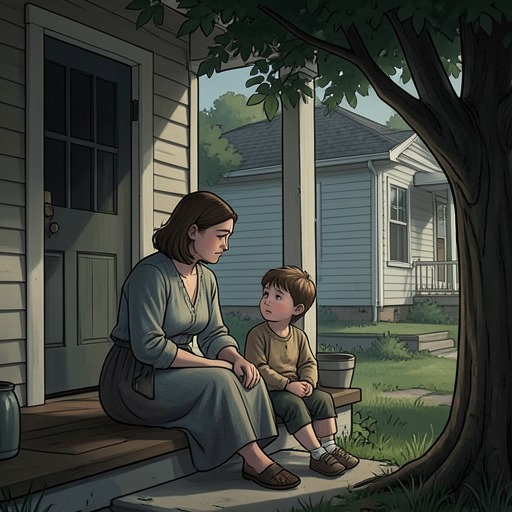
Queenie Is Left to Live Alone in an Apartment
QueenieQueenie Is Left to Live Alone in an Apartment is a childhood event Queenie Jenkins recounts during therapy with Janet: at about eleven, she was left to live mostly by herself in a flat originally intended for her and her mother, Sylvie. The arrangement exposes the cost of Roy’s abuse and Sylvie’s decision to remain with him. Queenie remembers the flat as preferable to living with Roy, while Janet insists that a child of her age had been placed in a dangerous and illegal situation.
The Apartment and Its Origins
The flat was not initially arranged as a home for Queenie alone. Roy wanted Sylvie and Queenie out, and the place was meant for mother and daughter together. After a short time, however, Sylvie stayed with Roy and the flat became, in practice, Queenie’s. Queenie says she was there for only a few months and insists that she could take care of herself. Her quick assurance makes the arrangement sound manageable, but Janet’s questions bring its actual circumstances into view: Queenie was a child, not an independent adult choosing to live alone.
Queenie estimates that she was eleven. She reconstructs her age from a bodily milestone: she began menstruating while she was living in the flat. The recollection is imprecise about the exact date and duration, but the detail establishes how young she was. Queenie first says she lived there mainly by herself, then explains that Sylvie came back from time to time. The qualification matters: her mother’s occasional return did not make the flat a reliably shared home.
The Abuse She Was Escaping
The move is inseparable from the treatment Queenie describes in the same therapy session. As a child, she stopped speaking to Roy in the hope that he would stop picking on her voice. Instead, he found other ways to upset her: he broke her belongings, accused her to Sylvie of saying rude things or stealing, and made her sleep in the car. Queenie recalls that Sylvie eventually spoke to her only about getting up for school and going to bed, while mother and stepfather spoke to each other. The flat therefore offered distance from an abusive household, but that distance came with isolation rather than dependable protection.
Queenie also describes Roy’s control over the family home. He made Sylvie sell their small house and used the money to buy another property, where the garden had to be kept spotless. The new home’s carefully maintained appearance contrasts with the fear and instability Queenie recounts inside the family. Roy later disappeared for weekends while cheating on Sylvie. Sylvie generally said nothing because she did not want to unsettle the relationship, until one day she came to the flat with a black eye and a split lip. That visit links the child’s separation from the household to the continuing violence between the adults, without making the flat a safe or stable substitute for family care.
Separation and Its Immediate Reality
When Janet asks whether the flat was rented for an eleven-year-old, Queenie corrects her: it was intended for Queenie and Sylvie, but it ended up being Queenie’s because Sylvie stayed with Roy. The distinction does not lessen the neglect; it clarifies how the separation occurred. Queenie was not describing a planned independent life, but a household arrangement that shifted until the child was the one left behind. Her mother’s visits were intermittent, and Queenie’s insistence that she managed alone sits beside the plain facts of her age and circumstances.
Janet responds directly, telling Queenie that leaving a vulnerable young person in that situation was illegal and dangerous. The firmness of the response interrupts Queenie’s effort to normalize what happened. Queenie answers that she was fine and that living there was better than the alternative: she could no longer live with Roy, who, in her account, hated her, made Sylvie hate her, and was destroying her. Her defense of the flat does not erase its risks. It shows the constrained choice through which she understands it: solitude was bearable in comparison with the abuse she was trying to escape.
Recounting the Event
The event reaches the reader through Queenie’s adult recollection, not as a detached account of the move. As she tells Janet more than she expected to disclose, she pauses to ask whether she is talking too much. Janet encourages her to continue. When Queenie recounts Sylvie arriving injured, she looks down at her palm and realizes that her nails have pierced the skin. The physical reaction accompanies the account, while Janet’s questions help make the childhood circumstances explicit: how old Queenie was, who the flat was for, and who actually remained there.
After the session, Queenie rides the Tube home picking dried blood from her palms. Back in South London, she receives a text from Darcy, with whom she has not spoken for weeks. The message does not resolve the childhood event, but the sequence carries the bodily aftermath of telling it into the present. The apartment was a brief separation from Roy’s home; speaking about it again exposes the vulnerability that Queenie’s childhood insistence on being fine had concealed.
Significance
The flat represents a double failure of safety. Roy’s abuse made remaining in the family home intolerable, yet the alternative left an eleven-year-old mostly alone while Sylvie stayed with the man who had wanted them out. Queenie’s account holds both realities together: she could experience the flat as relief from Roy and still have been placed in danger. Janet’s naming of the situation challenges the self-reliance Queenie uses to describe it, distinguishing her capacity to endure from the care she should have received.