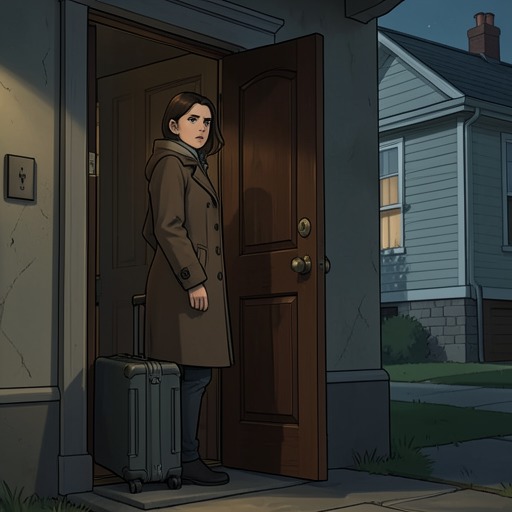
Queenie Moves Back in with Her Grandparents
QueenieQueenie Moves Back in with Her Grandparents is a turning point in which leaving an untenable home does not immediately bring relief. Queenie Jenkins packs her belongings into Eardley’s van, leaves the key behind, and moves into the household of Veronica and Wilfred. She hopes to recover there through sleep, quiet, rest, and food; instead, the move exposes how little control she feels over her life and how persistent her illness remains. The new home offers family care, but it also brings demands that make recovery harder to imagine.
Leaving the Brixton House
With everything in Eardley’s van, Queenie walks down the steps of the damp, crumbling Brixton house and leaves its key on the kitchen table. At first she says she will not miss it. What surprises her is that she lasted there as long as she did. The decision is presented not as a triumphant fresh start but as a departure from a place she has endured until endurance itself has become startling.
That initial certainty does not hold. A few days later, Queenie admits that she does miss the house when the reality of living with her grandparents sets in. Her reversal gives the move its emotional complexity: she can recognize the old home as a place she needed to leave and still feel its absence. Leaving resolves where she will live, but does not resolve how she feels about the upheaval or what comes next.
The Hope of Rest and the First Night
Queenie imagines the grandparents’ home as a place where she can recover by sleeping, resting, being quiet, and eating. The first night immediately unsettles that plan. She tosses and turns until dawn, worrying that her life is over, and fixates on the fact that she is nearly twenty-six and living with her grandparents. Her distress is bound up with the move’s meaning to her: what might be practical support feels, in the night, like evidence that her life has gone wrong.
The next morning, Veronica’s brisk routine replaces the sleep Queenie had hoped to get. Veronica wakes her, tells her to make the bed, and directs her downstairs to serve porridge for the three of them. Queenie jumps up, unsure what to do first, while Veronica moves ahead with the day’s instructions. The scene makes the household’s care tangible but not restful: food is ready, family is present, and there is also an immediate expectation that Queenie will keep pace.
Household Duties and Conflict
Veronica treats Queenie’s presence as participation in the work of the household. After Queenie has bathed, she is to run the hoover, take sheets from the trolley in the porch to the launderette for a service wash, and use the trolley to collect items from Brixton Market. Veronica says she will provide a list. Wilfred, meanwhile, invokes the water rates when Queenie shows that she has not finished her porridge. The details of the exchange place ordinary domestic tasks—washing, cleaning, shopping, and conserving water—at the center of Queenie’s new daily life.
Queenie protests that she did not come to be made into Cinderella; she came to rest. Veronica answers that Queenie has two working arms and two working legs and must help if she is going to stay. Queenie agrees to do the work but draws a limit at attending church with her grandparents on Sundays. Her answer shows both dependence and an effort to retain some say over the terms of living there. She goes upstairs with a spoonful of porridge still in her mouth, trying to return to bed, while Veronica calls after her not to do so and continues preparing chicken for the following day.
Panic and the Limits of Recovery
Even the bath Queenie tries to use for comfort becomes the setting for another crisis. She lies back carefully to keep her headscarf dry and tries to imagine that the move is temporary: that she is there for only one night, and that the next day she will return to work and carry on as before. Panic interrupts that imagined return. Unease spreads through her body; her legs do not respond when she tries to stand, her heart pounds, and the edges of her vision blur. She attempts to call for help but cannot draw enough air to get the word out, and she remains hyperventilating until the bathwater turns cold.
When Queenie says she feels strange and shows Veronica her shaking hands, Veronica answers with her own experience of shaking after giving birth to Queenie’s mother and tells her to get out of the bath. The exchange reveals a painful mismatch: Queenie is trying to communicate that something is wrong, while Veronica measures the symptom against what she herself has endured. Over the following two weeks, chores continue as Queenie feels ill, refuses phone calls, ignores messages, and panics silently so her grandparents will not see what she regards as weakness. The move gives her a place to stay, but it does not make her safe from panic or able to rest. Its significance lies in that unresolved contrast: family shelter is real, yet recovery remains difficult and largely unspoken.