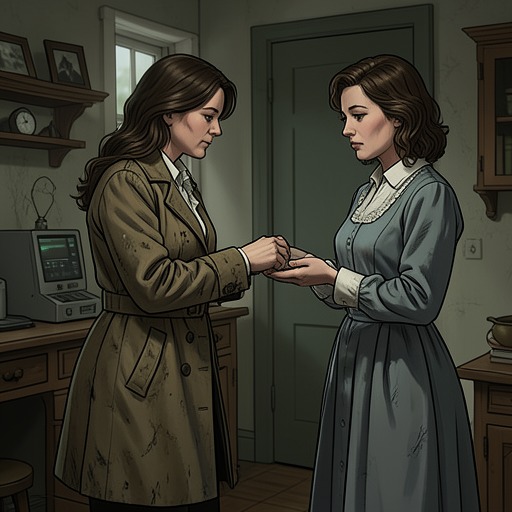
Roy Attacks Sylvie at Dinner
QueenieRoy Attacks Sylvie at Dinner is a remembered episode in which a weekly family meal becomes the setting for Roy’s physical assault on Sylvie and his humiliation of Queenie. The scene’s decisive turn comes when Roy makes Queenie’s refusal to eat the supposed cause of a conflict, then uses that conflict to force Sylvie’s face into her dinner. By ending with him blaming Queenie for what he has done, the episode exposes how his violence and his control of the family’s account of it work together.
Setting and Background
The dinner takes place within a routine Roy insists upon: weekly meals with Queenie and Sylvie at the same table. For Queenie, the meal is not a neutral family gathering. She says she could never eat in Roy’s presence and understands these dinners as an opportunity for him to keep both her and her mother together while he belittles one of them at length. The shared table, which might ordinarily signify family care, has instead become the arrangement that gives Roy access to both of his targets.
The scene is narrated by Queenie, who recalls looking down at her food as her stomach began to churn. The dim light flickering overhead and the silence around the table sharpen the tension, but the threat is also familiar: the day before, Roy had directed his abuse at Queenie, so she expects that this time he will come for Sylvie. Her prediction makes the meal feel less like a sudden disagreement than another turn in an established pattern of intimidation.
From Insult to Coercion
Roy breaks the silence by announcing that he has been thinking, and Queenie waits to discover which of them he will target. He tells her that she will not amount to anything, laughs, throws his stocky frame back in his chair, and chucks his fork onto the table. He then calls both women fools and complains that he has taken Sylvie in only to find that her child is no better. These insults cast his presence in the household as a favor and his contempt as a judgment the women are expected to endure.
Queenie looks to Sylvie, wanting her to answer him, but Sylvie looks down at her hands. When Roy continues, Queenie pushes her chair back and says she is not hungry, offering homework as a reason to leave the dining room. Roy stops her: she is not to leave his table until she has eaten everything on her plate. When she quietly says she does not feel well, he mocks her voice and tells her to stop talking like a white girl. Her attempt to describe her discomfort is thus turned into another occasion for ridicule; the dispute is no longer simply about food, but about Roy’s insistence that he can dictate what she says and when she may leave.
Sylvie finally asks Queenie to eat, a plea that does not challenge Roy’s authority so much as try to contain the moment. Roy responds by grabbing Queenie’s plate and throwing it in front of Sylvie, ordering her to eat it instead. Sylvie says she is not hungry either and suggests that Queenie might have the food later, trying to normalize a situation that has already become coercive. Roy treats neither woman’s refusal as meaningful. He loudly demands to know whether he is the only one eating and asks Sylvie to eat with him.
The Assault and Its Immediate Effect
Roy reaches across the table, grabs Sylvie by the back of her head, and pushes her face into the plate. The movement converts the earlier verbal degradation and food-based commands into direct physical violence. Sylvie cries out with her voice muffled by the food; when she raises her head, food is in her eyes, and she reaches for a napkin with shaking hands. The detail of her trembling makes the injury’s immediate aftermath visible without displacing the scene’s central fact: Roy has used his strength to make Sylvie’s body answer a demand she had refused.
Queenie has been looking on as the confrontation escalates, first willing Sylvie to speak and then trying to leave the table herself. Once Roy attacks Sylvie, he turns to Queenie and sneers that she has ruined dinner. He directs her attention to her mother and makes her responsible for the harm he has inflicted. His accusation reverses the scene’s actual sequence: Sylvie’s refusal to eat is made the offense, while Roy’s decision to seize and assault her is presented as its consequence. The blame is not incidental to the attack; it is how he attempts to define what the attack means.
Aftermath and Significance
The dinner ends in Queenie’s recollection with Roy’s accusation, not with an apology, intervention, or resolution. Her account records her earlier nausea, her effort to get away, Sylvie’s shaking hands, and Roy’s insistence that Queenie has ruined everything. Together, these details show how the episode confines both women: Queenie cannot leave when told to finish her food, Sylvie’s mild attempt to defuse the conflict fails to protect her, and Roy then assigns responsibility to the person who has witnessed his violence.
The episode also belongs to a larger period of distress. After moving in with her grandparents as she approaches her twenty-sixth birthday, Queenie describes spending her first night tossing and turning, worried that her life is over. Following the dinner recollection, she says she finally drifted off around five in the morning, comforted only by knowing her alarm would not sound a couple of hours later. The account does not present the dinner as the sole explanation for that sleepless night, but its place in the sequence connects the remembered household violence to Queenie’s present unease. As an event, the attack is both a physical assault on Sylvie and a revealing instance of Roy’s wider pattern: he controls the meal, humiliates the women, and then tries to make Queenie carry the blame.