Queenie Moves into Her Own Studio Flat
QueenieQueenie Jenkins’s move into her own studio flat marks a material step toward independence after months living with her grandparents, but the departure is neither simple nor a declaration of complete recovery. A check from her mother helps make the move possible; a punishing rental search exposes how little money can secure; and, as boxes are carried out of the shed, family members voice both their pride in Queenie and their fear for her. Her grandfather’s private recognition of how far she has come gives the day its deepest emotional turn.
The financial route out
The money for the move comes from Queenie’s mother, Sylvie, who hands her a check representing a fair portion of what she has received. She proposes that Queenie use it as a deposit and pay several months’ rent, so that Queenie will no longer have to contribute to her grandparents’ household through manual labor. Sylvie starts to pat Queenie’s shoulder, then pulls her hand away and apologizes. The hesitation makes the offer more than a financial transaction: it arrives within a relationship still marked by difficulty, even as Sylvie tries to provide practical support.
Queen ie initially refuses the check, telling Sylvie that she needs the money herself and is the one living in a hovel. The objection shows that accepting help does not come easily, and that Queenie sees her mother’s circumstances as pressing too. Yet the money becomes the means by which she can leave. Its significance lies in that concrete use: support is converted into a deposit and rent, creating a small measure of privacy and self-direction.
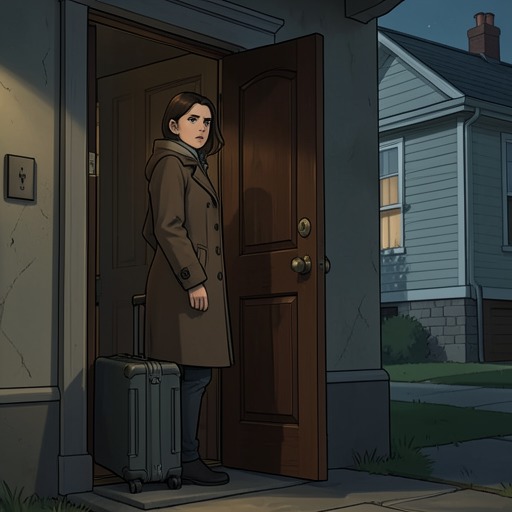
The path from check to home is costly. After four weeks, £3,000 paid to estate agents, and a phone call to Eardley, Queenie is packing for a studio so small that there would scarcely be room to swing a kitten. The comic exaggeration conveys the flat’s cramped scale without disguising the achievement: this is the accommodation she can secure, not an expansive or effortless escape. The search is one of the event’s central reversals. Moving out is possible, but only after time, considerable expense, and acceptance of a sharply limited space.
Housing against a changing city
Queenie’s difficulty finding a place of her own echoes her earlier recognition that familiar parts of Brixton have become harder to recognize and inhabit. At a fish stall opposite the site of a remembered bakery, she learns that the bakery is gone because it could not afford the rent; the fishmonger gestures toward the burger bar that has taken its place. During the Black Lives Matter march through Brixton, she sees that long-familiar market shops and stalls have given way to trendy bars and boutiques. These encounters establish a wider setting in which rents and commercial change displace older businesses and reshape spaces tied to community and memory.
The move does not establish that Queenie has found a home in Brixton, or that her rental search is directly caused by the commercial changes she witnessed there. Rather, the events sit beside one another as related pressures on belonging and affordability. In the neighborhood, businesses that formed part of her remembered landscape have disappeared; in her own search, even a substantial sum and weeks of effort yield only a very small flat. The contrast makes independence real but materially constrained.
A family divided between pride and worry
As the move begins, Queenie’s grandparents have already argued that renting is foolish and that her mother’s money should instead be used as a deposit to buy a house. Queenie counters their expectations by showing them on Rightmove that even a deposit ten times as large would not be enough to get her a house. They continue to lament that a house in Brixton once cost almost nothing, leaving Queenie to endure their account of a past in which buying seemed far more attainable. The disagreement exposes a generational gap: her grandparents’ advice rests on a housing market that no longer matches Queenie’s experience.
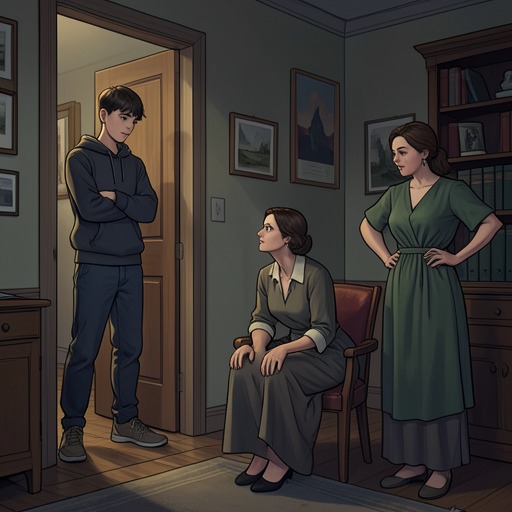
On moving day, Maggie welcomes the occasion and says the family is proud, while Diana gives a brief, understated agreement. Queenie’s grandmother remains anxious that she is not ready to live alone; Maggie first defends the move as not taking Queenie far away, then also imagines that one of Queenie’s attacks could make her fall and hit her head. The family’s concern is rooted in her recent illness, but it threatens to turn the possibility of relapse into a reason she should not leave.
Wilfred pushes back. He calls Queenie sturdy, takes her by the shoulders and shakes her to make his point, then jokes that she will be fine—and will not be coming back even if she is not. The teasing is not the only sign of his support, but it gives the family’s argument a different emphasis: care need not mean keeping Queenie at home. Maggie’s offer to bless the new flat with holy water and the continued warnings about living alone show how worry persists even as the family helps with the move.
The shed and Wilfred’s recognition
While retrieving boxes from the garden shed, Queenie remarks that Wilfred’s cane gives away any attempt to sneak up on her. The exchange opens a rare conversation. Wilfred acknowledges that they do not often talk, then explains that silence does not mean he does not feel. When Queenie first came to stay, he feared she would end up like Sylvie. He says he saw fear and resignation in Queenie, and recalls the pain he felt when Sylvie arrived after Roy had hit her so severely that she nearly could not get up.
Wilfred’s recollection connects Queenie’s stay with an older family experience of violence, but he does not treat the likeness as destiny. He tells her that she did not let what happened overcome her and that she is full of fight. After wiping his wet eyes, he turns and walks back down the garden path, leaving Queenie unable to process what he has said. The scene shifts the move from a practical task into an acknowledgment: Wilfred has watched her struggle, feared for her, and now sees her leaving as evidence of strength.
Independence without a claim of cure
Diana later makes the family’s pride more explicit. Queenie was unwell, she says, but returned to work and is now moving into her own place; that is progress. Queenie resists the larger implication, saying she would not call herself better, and tells Diana to be careful with the heavy boxes. Her answer keeps the event’s achievement distinct from a cure. She can take the next step without pretending that her difficulties have vanished.
That distinction is what makes the move a meaningful change rather than a neat resolution. The studio is tiny, the rental process has drained money, and her relatives remain alert to the possibility of another attack. Yet Queenie leaves with her family’s help and with Wilfred’s recognition that she has not given up. The move gives her a place of her own while preserving the uncertainty of recovery: independence arrives not after every fear has passed, but amid continuing care, constraint, and effort.