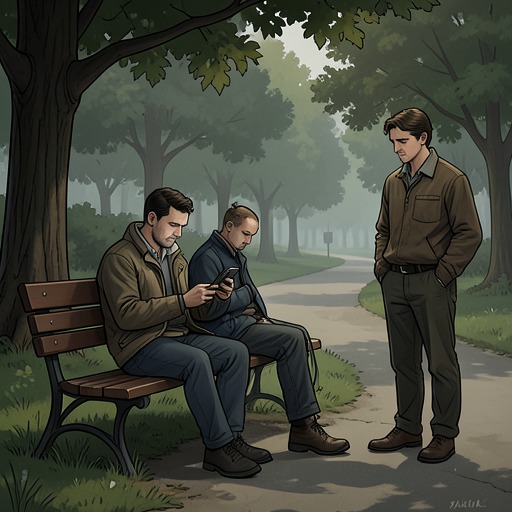
Queenie’s Final Confrontation with Ted and His Dismissal
QueenieQueenie Jenkins’s final confrontation with Ted Noman turns an attempt to impose his own terms on their relationship into a decisive boundary set by Queenie and backed by Kyazike. Ted asks for forgiveness and discloses personal history, but Queenie rejects the idea that his distress makes her responsible for him. His subsequent letter continues to seek secrecy and the possibility of renewed contact; Queenie instead gives it to Gina Row, and Gina confirms Ted will be gone from Daily Read by Monday.
Context and Immediate Stakes
On the day of the confrontation, Queenie is arranging to view a flat after work. Concern about sexual harassment has shaped her plans: she asks for a woman estate agent and arranges for Kyazike to accompany her. The practical precautions frame the encounter that follows. Queenie is not seeking a private meeting with Ted; she is preparing to leave work and meet her friend.
She sees Ted near the kitchen as she is heading out, but reaches the lift and leaves the building. At 5:31, she encounters him outside. He asks to speak and takes hold of her arm. Queenie tells him to leave her alone and tries to pull away. The confrontation therefore begins not as a mutually arranged conversation but as an interruption to her departure, with Ted attempting to secure her attention after she has already made clear that she does not want contact.
The Confrontation and Ted’s Disclosure
Queenie tells Ted that his wish to explain is for his own sake, not hers. She recognizes that she has been treated as a need for him to satisfy, and warns that she will scream if he does not let go. Ted releases her, but continues to press for a conversation and says that her actions have affected him. Queenie rejects that account: she describes him as fixating on what excites him until he gets what he wants, and insists that his conduct is his responsibility.
Ted asks for forgiveness and proposes that they go to a park they had treated as their place. Queenie refuses the private setting. She offers him only the opportunity to say what he needs to say there and then, after which she intends to leave. As her panic rises, she begins calming breaths. This exchange makes the terms of the encounter explicit: Ted seeks extended emotional access and a familiar shared space; Queenie limits the conversation and maintains her decision to go.
Ted then tells Queenie that he tried to take his own life after each of two major breakups. He says that his family and wife know about this history, and explains that he feared being alone. In his account, he married his wife in part because she was older, wanted children soon, and seemed unlikely to leave him. He also describes his relationship with Queenie as having disrupted the life he had arranged. The disclosure changes what Queenie knows about Ted, but it does not alter the boundary she has set. She says that she does care about the possibility that his account is true, while remaining uncertain about whether to believe him.
Ted’s explanation also turns to Queenie’s appearance, which he presents as part of his attraction to her. Queenie does not accept this as an excuse or as a reason to resume contact. When Ted starts to say that he should have told her about the baby, Queenie interrupts to insist again that his attempted suicide has nothing to do with her and does not excuse what he has done. She is shaking as she tells him to leave her alone. The scene holds two facts together without making one cancel the other: Ted has disclosed a serious personal crisis, and Queenie refuses responsibility for his choices or for repairing their relationship.
Kyazike’s Intervention
Kyazike arrives during the confrontation and steps between Ted and Queenie. She swings her Longchamp handbag at him and orders him to get away from her friend. She points out that Ted is married and has a baby on the way, directly confronting the information he had begun to disclose. Her intervention gives physical force to the boundary Queenie has already stated verbally.
A man nearby reacts as though Ted is the person being troubled and offers to call the police. Kyazike challenges that reading: she says she heard Queenie asking to be left alone and objects that no one had offered help when Queenie was the one seeking it. The man backs away. The brief exchange widens the scene beyond the two former partners, showing how a public observer can misread an encounter when a woman’s refusal is overlooked and a man’s complaint is treated as the more urgent one.
Kyazike then turns back to Ted and specifies what no further contact means: no emails, chats, waiting outside the building, looking at Queenie, or approaching her in any other way. She draws a clear line around both digital and in-person contact, then takes Queenie away. Her support turns Queenie’s individual refusal into an enforceable limit witnessed by another person.
The Letter and Queenie’s Decision
The next day, a letter from Ted appears in Queenie’s pigeonhole. He thanks her for hearing him and accepts that the situation is his fault. He says his disclosure was not an excuse, apologizes, and expresses a wish to become a better person. He also describes Queenie as sensitive beneath her apparent toughness, repeating the contrast between her vulnerability and the resilience he had perceived in her.
The letter’s apology is accompanied by requests that preserve Ted’s interests. He hopes Queenie will not tell his wife about their relationship, arguing that disclosure would help no one. He also leaves open the possibility that she might welcome him back if his marriage does not work out. His expressions of regret and concern for Queenie’s happiness therefore sit beside a request for secrecy and an invitation to future contact—the very access she has refused. The postscript, which comments on Kyazike’s swing, further acknowledges the intervention that ended the confrontation.
Before leaving work, Queenie places the letter on Gina Row’s desk. She decides that she cannot continue carrying the situation if she is to get better, and accepts that bringing the letter to Gina may have consequences for herself. The action is a contrast to Ted’s appeal: rather than protect his marriage or keep their history private, Queenie makes the letter available to someone with authority at work. Her decision links the personal boundary she asserted outside the building to a formal workplace response.
Workplace Consequence and Significance
In an email dated Friday, 7 June, Gina thanks Queenie for the letter and acknowledges that she should have listened to her earlier. Gina says Ted will be gone by Monday. The account does not detail the employment process, but it establishes a concrete consequence: Queenie’s decision to bring the letter forward is followed by Ted’s removal from Daily Read.
The event closes the sequence of pressure and response with Queenie acting on her own account of what she needs to recover. Ted’s disclosure does not erase his conduct; his apology does not secure forgiveness, secrecy, or a return to the relationship. Kyazike’s intervention helps make Queenie’s refusal effective in the moment, while Gina’s response carries the matter into the workplace. The ending is not reconciliation but a separation made more definite: Queenie leaves with her friend, gives the letter to Gina, and receives confirmation that Ted will no longer remain at the paper.