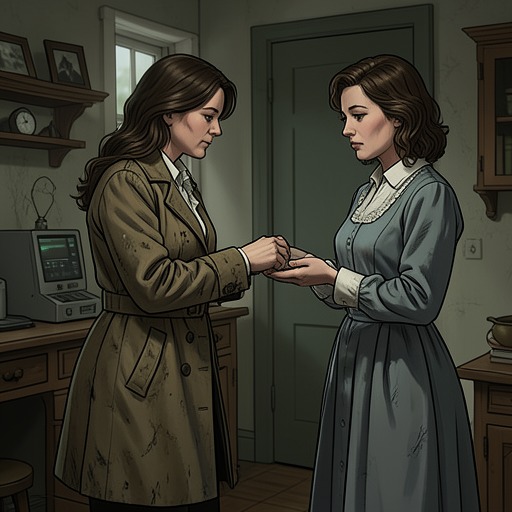
Queenie’s 26th-Birthday Family Gathering
QueenieQueenie’s 26th-Birthday Family Gathering turns a family celebration into a moment of recognition between Queenie and her mother, Sylvie. At her grandparents’ home, the arrival of a cake and birthday guests initially makes Queenie want to withdraw; later, Sylvie’s account of the name Queenie and a private card give the gathering a different meaning. The event brings affection, discomfort, family history, and the possibility of renewed understanding into the same room without resolving their difficulties all at once.
The gathering and its uneasy welcome
On her twenty-sixth birthday, Queenie is at her grandparents’ home, eating porridge when her grandmother slides an unsealed envelope across the kitchen table. The envelope contains twenty pounds, offered as money for a new top. This modest, practical gift sets the tone of a family occasion marked less by ceremony than by familiar domestic gestures.
After Queenie and Diana return from getting a treat, Queenie sees extra shoes in the hallway and hears voices in the front room. Darcy Betts emerges carrying a bright pink helium balloon printed with birthday wishes. Maggie follows with a gift bag, while Sylvie comes behind her holding a cake with only some of its candles lit. The welcome is evidently arranged for Queenie, but the attention also makes her tense: she wants to retreat to the attic that has served as a safe place. Her response complicates the conventional scene of a surprise celebration. The family has gathered to show care, yet receiving that care is not simple for her.
Maggie sweeps Queenie into a hug, and Queenie eases away before greeting Sylvie quietly. Diana makes the boundary explicit, explaining that Queenie does not like hugs and that she is allowed to refuse being touched. Her intervention matters because it gives Queenie’s discomfort social recognition rather than treating it as a failure to appreciate the celebration. Darcy is also present as a friend within this family setting, while Diana moves between cousin and advocate, introducing herself to Darcy and helping the gathering proceed without requiring Queenie to accept unwanted contact.
Sylvie explains the name Queenie
The cake prompts Sylvie to ask whether Queenie made a wish. Queenie says she no longer believes in wishes, an answer that reflects her distance from the hopeful ritual. The gathering then shifts from birthday convention to family history when Darcy asks Sylvie why she chose the name Queenie.
Sylvie recalls that, as a girl, she wished she could be a princess. Her bedroom had been near the top of the large Victorian house her father bought after coming over, and she remembers that childhood setting as part of the story behind her dream. When she became pregnant, she imagined that her daughter would be the princess she had long hoped for and decided on the name Queenie. But the meaning changed when the baby was born. Sylvie remembers placing a finger in her newborn’s hand and feeling the child grip it. In that moment, she decided that her daughter seemed more powerful than the delicate princesses she had imagined. She named her Queenie because she believed the girl would grow up strong and brave.
The explanation connects the name not simply to royal imagery but to Sylvie’s hopes for her child. It also revises Queenie’s understanding of the woman telling the story. Queenie recognizes that the mother before her, now seeming small and subdued in the armchair, is the same person who began raising her and once showed intense attachment through gestures such as dressing mother and daughter alike until Queenie was eight. The account allows Queenie to see Sylvie’s present vulnerability alongside the earlier devotion she remembers. It does not erase the ways Sylvie has been harmed or the distance between mother and daughter; instead, it makes room for a more complicated view of her.
A private message after the celebration
After the cake has been cut, Sylvie leaves while Queenie is in the garden. Maggie points out that she has left a card on the table. Queenie takes it upstairs, away from the gathering, and reads it privately. The pink birthday card bears a bright yellow price sticker that Sylvie forgot to remove. Its ordinary, slightly imperfect presentation accompanies a direct expression of care: Sylvie addresses Queenie by her full name, says she is proud of her every day, and tells her she is always there for her. She also encourages Queenie to be stronger than Sylvie feels she was able to be for her.
The card’s postscript is especially consequential because Sylvie acknowledges that Queenie is in therapy and calls it a good thing. That support is significant in the context of Queenie’s family history: her effort to seek help is not treated here as something to conceal or reject. The message is delivered apart from the public birthday exchange, giving Queenie space to receive it on her own. The card does not stand in for a full reconciliation, but it records Sylvie’s willingness to affirm her daughter and recognize her treatment.
Place in Queenie’s recovery
The birthday gathering comes after a period in which Queenie has been coping with separation from Tom, loneliness, and increasingly difficult personal and professional circumstances. At one earlier party, Darcy Betts and Fran recruited friends to make an OkCupid profile for Queenie after her relationship break, even though Queenie said she did not want to participate and was too tipsy to resist. Another encounter shows her considering a fling partly to avoid returning alone to an empty bed. Later, Gina tells Queenie that Ted Noman has filed an HR complaint and that she will be suspended; Gina also points to Queenie’s lateness, distraction, and failure to complete work responsibilities. Those events establish the pressures surrounding the birthday, rather than being events that occur during the gathering itself.
The family scene offers no simple cure for those pressures. In a later conversation with Janet, Queenie describes how being a Black woman shapes how other people read and approach her, and how that experience feeds her fear of rejection in intimate relationships. Against that broader account, the birthday’s importance lies in a more limited but concrete change: Queenie can recognize Sylvie’s love and history without pretending that everything between them is easy. The celebration moves from unwanted attention and guardedness toward a story about maternal hope, followed by a written expression of pride and support. Its emotional turn is not a declaration that the past has been repaired; it is Queenie beginning to see her mother, and their shared history, with greater complexity.